
Business 134 Corporate Finance
Business 134 Corporate Finance
Corporate Finance
UC Instructor Open Textbook Adoption Portrait
Abstract: This open textbook is being utilized in a finance course for undergraduate students by Yun Liu, Ph.D., at the University of California Riverside. The open textbook provides numerous topical and expositional innovations by the author. The main motivation to adopt an open textbook was to minimize students' financial burden. Most students access the open textbook in online.
About the Textbook
Corporate Finance, 3rd Edition, 2014
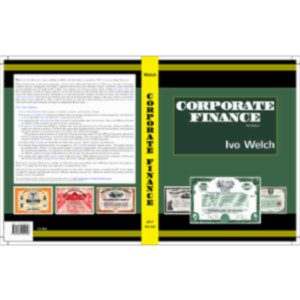 Description: "Most corporate finance textbooks cover a similar canon of concepts, and my book is no exception. A quick glance at the table of contents will show you that most - though not all - of the topics in this book...overlap with those in traditional finance textbooks and syllabi. That said, this book is intentionally different. It features many innovations in approach and emphasis. I firmly believe that it is the best introductory corporate finance book available anywhere. After you have used this book once, you will not want to go back.
The book is also an experiment in pricing. All major economics book publishers believe that professors do not care how much their textbooks cost. This book puts this belief to the test: the firsteditionn was priced at $200. This third edition is priced at $60, and it is also available for free on the web. (This price is low enough to allow many students to keep this book eve after they have completed the course.)"
Authors:
- Ivo Welch - University of California, Los Angeles
Formats:
This book is available free online, although the author warns it is not always reliable and is slow. It is also available for purchase as a print copy for $60 plus shipping.
Supplemental resources:
There are supplemental resources available for students and there is also a full set of Instructor Materials, which are only available to "legitimate instructors for university-registered courses."
Cost savings:
Similar textbooks, such as Westerfield and Jaffee's Corporate Finance, cost $290 on Amazon. Since I teach about 200 students each year this is a potential savings for students of $58,000.
License:
The book is copyrighted by the author, who has made the online version free.
About the Course
BUS 134:  Corporate Finance
Description: Explores capital budgeting under uncertainty, cost of capital, capital structure, and basics of corporate governance. May cover other related topics. Provides an understanding of the theoretical issues related to these topics. Emphasizes formulating optimal financial decisions. May include case-method teaching and data analysis.
Prerequisites: BUS 106/ECON 134 and BUS 132 with grades of “C-” or better.
GE credit: 4.0 hours - Lecture, 3 hours; term paper, 2 hours; extra reading, 1 hour
Learning outcomes:
This course aims to deepen student understanding of the theoretical issues related to the key financial decisions relevant to corporate managers through cases and real-world data analysis. Most of the students in the course are business majors.
By the end of the course, students should expect to:
- be familiar with financial theories of valuation, capital budgeting, capital structure, payouts and their interrelations,
- develop an integrated analytical and decision-making perspective, and
- be able to apply these theories to real-world situations.
Curricular changes:
Pedagogically, this textbook starts with numerical examples and then abstract to formula. This could be confusing for students who are not good with numbers and think more intuitively rather than quantitatively. I supplement it by providing my own "bird's eye" view of the topic and posting excerpts of other textbooks.
Teaching and learning impacts:
Collaborate more with other faculty: No
Use wider range of teaching materials: Yes
Student learning improved: Unsure
Student retention improved: Unsure
Any unexpected results: Yes
The material is more challenging and created a wider spread in student performance. Some students improved a lot while others were struggling.
Since the textbook is not expensive, the students are less resistant in buying cases and other educational materials.
Sample assignment and syllabus:
Quiz
This is one of the quizzes I use in this class.
Syllabus
This is the syllabus I used for the Fall 2015 class.
Textbook Adoption
OER Adoption Process
I decided to investigate open textbooks for a variety of reasons:
- To minimize students' financial burden
- To provide a different perspective of the topics
- To improve the quiz platform
This book was recommended by the affordable course material task force at my university. It was also sent to me by the author and I had used it as a reference from my previous teaching.
Several concerns in using this book are:
- The textbook cannot be downloaded
- The book is hard to navigate across pages.
I also use eQuiz to test my students.
Student access:
Most students access the textbook online.
Student feedback or participation:
The following are comments from students (with uncorrected gramar/spelling):
- I liked that it was free, as a poor college student it was really refreshing that the book was readily available online and for print for free. When i use pdfs of books, i can usually choose form a sidebar location, the table of contents that allows me to go to a specific chapter that i wanted to read about, but i couldn't do that with this book. But maybe i'm just not the sharpest tool in the shed.
- The fact that the textbook is cheap, makes it psychologically wants to open it. I have bought a textbook for another class for $160 and I didn't open it. it is more affordable to students.
- Like it very much. It is more convenient for us. We can read the textbook whenever we want.
- I liked the convenience of the open textbook. I disliked that I was unable to print a copy of it for highlighting purposes.
- The open textbook is easy to access, same as a regular textbook, and no cost. In general I enjoyed not having to pay an ridiculous about of money on a textbook.
- The open textbook is slow when loading pages even I created an account. This decrease efficiency and was at times frustrating.
- It has helped us save a large amount of money, for business and economics textbooks are ridiculously expensive. The open book is complete in stucture and usually clear about ideas. the examples are sometimes homorous to read. the speed to open and go to other pages is extremely low.....and it is difficult to read because we can only open the beginning page of each chapter directly, when i want to read the page in the middle of a chapter, i have to click next page and wait and click and wait....that is not convenient.
- The textbook sometimes does not state the idea explicit enough, like sensitivity analysis and scenario analysis, after i have read the corresponding part, i am still little bit confused about them and not sure about whether i have got the correct understanding.
- I like how the chapters are very detailed and are in a language that I can understand it . Other textbooks I cannot understand because of the vocabulary it uses I liked the textbook.
- It is easy to get the open textbook. It is inconvenient to flip over.
- It was free! I can recommend it to use it in other classes too! It took some time to open pages... and one could not switch easily between pages. I prefer downloading the book as a time-limited pdf.
- Sometimes its hard to read on a computer its easy to read and concepts are written clearly sometimes one topic have too much wording, not to the point.
- The open textbook was a different experience, I liked the book, although the text was sometimes hard to read in one pass. The open book was sometimes freeze on me when i would try to continue to the next page, and it was hard to sit in front of the computer for three hours reading
- I appreciate it free. In general, I love it for free.
Survey
These are the survey results from the class
I am a finance  professor at the University of California Riverside. I teach International Finance, Financial Strategy and Corporate Control, Seminars in Corporate Finance, and Financial Management.
Fostering lifetime curiosity and the ability of learning is more important than exposing students to a limited range of concepts, theories, and institutional details.
My research interests include Corporate Finance focusing on the role of networks in corporate governance, executive compensation, and mergers and acquisitions.