
Crim 362: Community Action Research
Crim 362: Community Action Research
Public Sociology Toolkit
CSU Instructor Open Textbook Adoption Portrait
Abstract: This open textbook was created by Meredith Williams, Ph.D., and a group of graduate students in the course SOC 590: Practicing Sociology at Humboldt State University. Creating the text gave the students a chance to learn and engage with various methods used in applied sociology. The text is now used in an undergraduate course on Community Action Research, and will be used in future semesters of Practicing Sociology. Students are able to access the toolkit online.
About the Textbook
 Toolkit
Description:
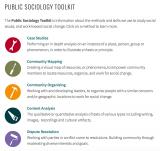
The Public Sociology Toolkit is targeted for Public Sociologists during their undergraduate or graduate education and beyond. Public sociology is a branch of the discipline with the aim of taking the sociological theories, concepts, and research skills outside of the academy, and back to the communities we study. It has a focus on methods that are used in applied settings, and for action research. Many public sociologists work outside of academia, in non-profit or government agencies. This text is online and free, so that it is accessible to activist scholars outside of the academy. The text is also dynamic, being updated annually through collaborative processes to reflect the changing face of social justice activism, and sociological research.
While there are many textbooks to teach students social science research methods, those books are largely geared toward academics who plan to stay in academia. There are also textbooks for applied social scientists, but they lack the sociological lens, and are often very costly, making them inaccessible to many students and applied sociologists. Others are geared toward practitioners for non-profits, without teaching students how to build the bridge from the academic to applied settings. I created this textbook with a group of graduate students to give us a book we could use in research-based courses at the undergraduate and graduate levels.
Authors:
- Meredith Williams, Humboldt State University
- Janae Teal, Humboldt State University
Formats:
The textbook is available online only.
Supplemental resources:
The textbook does not come with supplementary resources, but each page links to many external sources and there are various multimedia resources embedded on each page. The goal, with every page, is to give readers enough information to teach themselves the method, at a level accessible to a broad audience.
Cost savings:
Before this textbook, we used Qualitative Research Methods for the Social Sciences, 8th Edition (2012) by Bruce L. Berg and Howard Lune. The suggested retail price is currently $132.80.
I teach about 35 students each year, so the potential annual savings for students would be about $4,655.
Book Updates:
This book is updated annually, by the current students in the Practicing Track of the HSU Master’s Program in Public Sociology. We work on it as part of the SOC 590: Practicing Sociology group.
Accessibility and diversity statement:
As sociologists, diversity is core to our values and is one of the reasons we identify as Public Sociologists. Therefore, we had discussions about how best to make each page accessible to a diverse audience, and the students worked with a goal of using diverse examples and multimedia resources.
License:
The Public Sociology Toolkit by Meredith Conover-Williams and Janae Teal is licensed under a Creative Commons Attribution-NonCommercial 4.0 International License.
This means you are free to copy and redistribute the material in any medium or format and remix, transform, and build upon the material. You must give appropriate credit, provide a link to the license, and indicate if changes were made. You may do so in any reasonable manner, but not in any way that suggests the licensor endorses you or your use. You may not use the material for commercial purposes.

About the Course
This book was designed to  use in two courses: CRIM 362 (Community Action Research) and SOC 590 (Practicing Sociology). I will describe each below.
CRIM 362: Community Action Research
Description: While this is fundamentally a research methods class, it is specifically a class dedicated to learning and practicing action research. At its core, action research (1) acknowledges that people’s life experiences make them the “experts” (rather than an ivory tower academic) about their lives; and (2) has the goal of informing social change, not just producing knowledge. Action research is a fundamental part of understanding, and working in and for, social justice. This course revolves around group projects that try to learn more about real “social problems” happening on campus and in the local are. The idea is to get “hands on” experience working on an issue for the full semester, to show students ways they can use research methods in the future for their own scholarship and/or careers.
Prerequisites: SOC 382 Introduction to Social Research
Learning outcomes:
- Describe, compare, and critique various approaches to research design with a focus on social change.
- Discuss issues of subjectivity, reflexivity and power in the research process.
- Design and carry out several ethical action research projects.
- Practice with writing methodological designs, and quantitative and qualitative results.
- Hands on experience with both quantitative (SPSS) and qualitative (Atlas.ti) data analysis software.
- Professional development toward higher education, or a career in social justice or public service.
This is a capstone course for majors in our Criminology and Justice Studies major. Students can choose between this class, or completion of a Senior Thesis or Internship. I designed the class to use the textbook. Students are assigned a page to read, to refresh themselves on the method, or learn it in a self-guided way, where they can learn at their own pace.
Curricular changes:
I choose the methods on which to focus the class based on what is in the Public Sociology Toolkit.
Teaching and learning impacts:
Collaborate more with other faculty: No
Use wider range of teaching materials: Yes
Student learning improved: Unsure
Student retention improved: Unsure
Any unexpected results: No
The online format of the PST allows for multimedia examples for each research method in the toolkit. Therefore, I used more videos and podcasts, linked from the toolkit, to help students learn each method.
I have not yet made an attempt to formally determine if student learning was improved. Any feedback on student retention has been anecdotal, so far.
SOC 590: Practicing Sociology
Description: While this is fundamentally a research methods class, it is specifically a class dedicated to learning and practicing action research. At its core, action research (1) acknowledges that people’s life experiences make them the “experts” (rather than an ivory tower academic) about their lives; and (2) has the goal of informing social change, not just producing knowledge. Action research is a fundamental part of understanding, and working in and for, social justice. This course revolves around group projects that try to learn more about real “social problems” happening on campus and in the local are. The idea is to get “hands on” experience working on an issue for the full semester, to show students ways they can use research methods in the future for their own scholarship and/or careers.
Prerequisites: SOC 382 Introduction to Social Research (or equivalent)
Learning outcomes:
- Explore the methodological skills employed by working practitioners of sociology.
- Describe, compare, and critique various approaches to research design with a focus on applied methodologies.
- Design and carry out an ethical applied research project.
- Practice with writing methodological designs, and quantitative and qualitative results.
This is a course required for graduate students who specialize in our Practicing Track (the other is the Teaching Track). This is the course in which they learn about applied sociological skills such as Needs Assessments and Program Evaluation and how to use other core research skills such as survey and content analysis in an applied setting.
Curricular changes:
This course has been designed around building and using this textbook.
Teaching and learning impacts:
Collaborate more with other faculty: No
Use wider range of teaching materials: Yes
Student learning improved: Unsure
Student retention improved: Unsure
Any unexpected results: No
The online format of the PST allows for multimedia examples for each research method in the toolkit. Therefore, I used more videos and podcasts, linked from the toolkit, to help students learn each method.
I have not yet made an attempt to formally determine if student learning was improved.
Sample assignment and syllabus:
Sample Assignment
This is an assignment I use for the SOC 590 class
Syllabus 480
This is the syllabus for the SOC 480 class for Spring 2016
Syllabus 590
This is the syllabus for the SOC 590 class for Fall 2014
Textbook Adoption
OER Adoption Process
While there are many textbooks to teach students social science research methods, those books are largely geared toward academics who plan to stay in academia. There are also textbooks for applied social scientists, but they lack the sociological lens and are often very costly, making them inaccessible to many students and applied sociologists. Others are geared toward practitioners for non-profits, without teaching students how to build the bridge from the academic to applied settings. I created this textbook with a group of graduate students (enrolled in SOC 590: Practicing Sociology) to give us a book we could use in research-based courses at the undergraduate and graduate levels.
Student access:
Students access the text only online. As the owner of the domain, the text is easy to edit using the Wordpress platform.
Student feedback or participation:
So far, anecdotally, the students have responded positively. The students who helped create the text:
- expressed feeling a high level of engagement and appreciation for the opportunity to be creative.
- expressed excitement about being involved in something cutting edge.
- had frustration over trying to make each entry consistent
- had fear about writing for an unknown audience.
Students who have been assigned the text in class:
- express relief over the price
- have fun discussing the various examples on each page
- wished they had access to the site and examples in their earlier research methods courses.

I am a sociology professor at Humboldt State University. I teach Introduction to Criminology and Justice Studies, Criminological Theory, Gender, Sexuality and Crime, Introduction to Social Research, Qualitative Research, Community Action Research and Practicing Sociology.
Core to my pedagogy is diversity and inclusion. By creating a textbook with my students, I can gather a variety of perspectives from our diverse students, and we can cull examples from a wide variety of sources. Part of inclusion is making sure our course content is accessible to students from all income levels, so when possible, I use online resources rather than texts that must be purchased.