
ECON 201: Principles of Microeconomics
ECON 201: Principles of Microeconomics
Principles of Microeconomics
Common Course ID: ECON 201
CSU Instructor Open Textbook Adoption Portrait
Abstract: This open textbook is being utilized in a microeconomics course for undergraduate students, both business and non-business majors (for General Education), by Richard Gearhart, Ph.D., at California State University, Bakersfield. The open textbook provides an overview of topics covered, as well as relevant examples of real-world scenarios. The main motivation to adopt an open textbook was to save students money and make the material easy to access. Most students access the open textbook in a PDF format.
Reviews: The book has been reviewed by two faculty members from the CSU (CSU1, CSU2) and one faculty from CCC within the California higher education systems.
About the Textbook
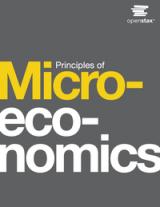 Microeconomics
Description:
Principles of Microeconomics covers the scope and sequence of most introductory microeconomics courses. The text includes many current examples, which are handled in a politically equitable way. The outcome is a balanced approach to the theory and application of economics concepts.
The chapters in the book are short and have links to further information, allowing students to read about concepts outside of the book, as well as move to within different areas within the book. It contains a number of educational videos on topics that may be of further interest to the students, including biographies of famous economists and their contributions to the subject. After the subject matter of the chapter is presented, the book provides definitions for key terms, a review of key concepts within the chapter, and review questions that require knowledge of the economic concepts covered, and their applicability to the modern world. The beginning of each chapter starts with a "Bring it Home" section that attempts to connect with students on a personal level, detailing how the choices they make have significant impacts on their daily lives.
Authors:
- Steven A. Greenlaw - University of Mary Washington
- Timothy Taylor - Macalaster College
Formats:
The textbook is available for free online and as a PDF. One can also buy the book as a printed copy for $33.50.
Supplemental resources:
The book has supplemental resources for faculty and students, including a Getting Started Guide, a Sample Syllabus, a Test Bank and PowerPoint Slides.
Peer reviews:
The book has been reviewed by two faculty members from the CSU (CSU1, CSU2) and one faculty from CCC within the California higher education systems.
Cost savings:
The book I previously used for this class was Principles of Microeconomics (12th Edition) by Karl E. Case and Ray C. Fair. This book retails for $255 on Amazon. I normally teach about 240 students per year, for a potential savings of $61,200.
Accessibility and diversity statement:
Not all formats of the textbook have been evaluated yet, but the most recent version is available in a Bookshare format, which supports DAISY and Braille-Ready-Format (BRF).
License:
All textbook content on this site is licensed under a Creative Commons License 4.0 International. This means you are free to copy and redistribute the material in any medium or format and remix, transform, and build upon the material for any purpose, even commercially. You must give appropriate credit, provide a link to the license, and indicate if changes were made.

About the Course
ECON 201:  Principles of Microeconomics
Description:
Value and distribution theory, including the theory of household behavior, the theory of the firm, and the pricing of factors of production. Emphasis on tools of economic thinking and the historical development of these tools.
Prerequisites: None
GE credit: 4 units, GE D2i
Learning outcomes:
Define and use basic economic principles to explain and predict behavior.
Apply economic knowledge to the understanding of individuals and groups as it relates to local and global issues and problems in their contemporary and historical contexts.
Explain how as behavioral and social scientists, economists establish and evaluate economic theories using the scientific method.
Demonstrate an understanding of the challenges and opportunities in integrating diverse perspectives and achieving epistemological consensus.
Demonstrate quantitative skills (interpreting tables and graphs, calculating total, average, and marginal costs and benefits and interpreting relationships among them, calculating and applying elasticities, determining optimal decisions)
Demonstrate a working knowledge of economic concepts and theories (scarcity and opportunity cost, specialization and trade, behavior of households and firms, market outcomes under various industry structures, market system strengths and failures).
Applying Economics in authentic contexts (predicting directions of change in product and factor markets, evaluating market and government policy outcomes from the perspectives of economic efficiency and fairness/distribution).
Demonstrate quantitative skills.
Demonstrate knowledge and skills in the functional areas of business administration (explaining why various business decisions require a consideration of industry structure and market forces; explaining the rationale for government interventions that affect business decisions and outcomes).
Curricular changes:
I have not modified the curriculum with the adoption of the textbook. I have, however, adapted the exam questions that I utilize to correspond to the style of questions used in the textbook.
Teaching and learning impacts:
Collaboration with other faculty: No
Use wider range of teaching materials: Yes
Student learning improved: Not assessed
Student retention improved: Not assessed
Any unexpected results: None
The students are able to use SaplingLearning that is built with the textbook specifically in mind. It utilizes YouTube videos, as well as sample problems, that students can expand on from the examples provided in the book. It allows me to teach a wider range of material that the book tangentially covers.
Sample exam
This is an example of the midterm examination.
Syllabus
This is the syllabus I use for Econ 201.
Textbook Adoption
OER Adoption Process
The main reason for the adoption of the textbook was to save students money. An additional reason was that similar, higher priced books, had similar content, and were not superior to this textbook. This allows students to use technology in the classroom (iPads, computers, etc.) to access the book, on any device.
I utilize an online homework supplement, SaplingLearning, to judge student's acquisition of the knowledge.
Student access:
Students can access the book in a variety of formats. These include HTML, PDF, or in print. I encourage students to purchase the print copy of the textbook ($40 at the campus bookstore), as I feel that this is the best way for them to learn. However, I also encourage students to download the PDF version of the book to any of their electronic devices, so that they can quickly and easily access the book.
Student feedback:
The students love that the textbook is low cost. They feel that the material covered is adequate, and they like to see that it covers all relevant information in the course.
Richard Gearhart, Ph.D. I am an Assistant Professor of Economics at California State University, Bakersfield. I teach Principles of Microeconomics, Intermediate Microeconomics, Health Economics, Labor Economics, and Public Economics.
My research interests are looking at the efficiency of healthcare delivery systems at the local, state, and international levels, as well as examining the link between obesity and technological innovation. I also focus on regional economic, exploring the impact of resource abundance on a variety of labor market and health outcomes.
My job as a teacher is to ensure, in an engaging classroom atmosphere, that students learn and can apply theoretical concepts to real-world applications.