Cooperative and Collaborative Learning Theory
Cooperative and Collaborative Learning Theory
The Cooperative and Collaborative Learning Theory focuses on individuals whom are working with two or more individuals (Pappas, 2019). Learners working together share a common educational goal and experience when collaborating cooperatively (Pappas, 2019). When individuals work together in a collaborative and cooperative manner they are able to not only learn from one another they also experience the ability to use each others strength to move forward in their educational experiences. When learners are working together collaboratively and cooperatively they are not only growing educationally but also socially (Pappas, 2019).
(n.d.). Retrieved from https://www.youtube.com/watch?v=cnkKHL_dyGE
My philosophy of instructional design is that education is constantly changing. Changing in the sense that new ideas, techniques and strategies are always becoming available to educators. As educators and designers of instructions we must take on the role of a life long learner. I believe that we cannot get "stuck in our ways" and we must always stay up to date with the educational world. Our goal must be to ensure we are meeting the needs of our students. Education is not a one size fits all environment. Some educators see thirty different students a day, some see one hundred and thirty different students a day and we should strive as leaders in the classroom to guide and give them the tools to be as successful as they can be.
Summative Assessment: Science Lab Report. A science lab report meets both the summative assessment requirements as well as the Cooperative and Collaborative Learning Theory because students are collaborating and working in cooperative groups during the course of the lab activity. Students work together to collect data to address a given question and use the data to answer the question. While conducting the lab and data collection is not summative the reports the students individually submit are.
Formative Assessment: Fishbowl Debate is an example of a formative assessment that can be used prior to the submission of a lab report as their summative assessment. A fishbowl debate challenges students to take a position and defend in based on evidence. This is a great way for teachers to assess the understanding of learners prior to the submission of the summative assessment.
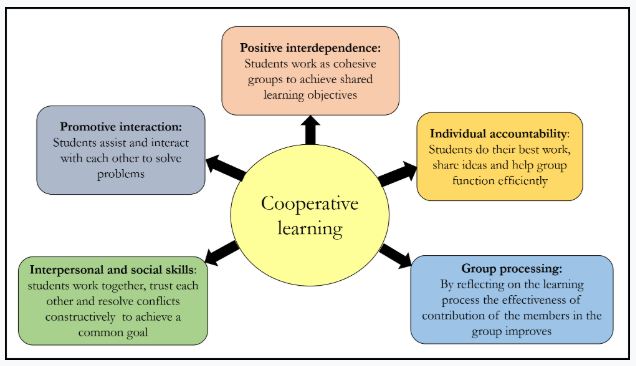
(Eachempati & Ismail, 2017)
The Collaborative and Cooperative Learning Theory focuses on five principals (Pappas, 2019):
- Interpersonal and Collaborative Skills
- Face to Face Interaction
- Beneficial Interdependence
- Individual Responsibility
- Group Processing
The image above addresses each of the 5 principals addressed in the Collaborative and Cooperative Learning Theory.
(n.d.). Retrieved from https://www.youtube.com/watch?time_continue=5&v=BXT2STtm_54&feature=emb_title
21st Century Learning addresses the following; critical thinking, creativity, collaboration, and communication (Applied Educational Systems, Inc, n.d.). Below each area of the Collaboration and Cooperative Learning Theory are linking to a 21st Century Learning Skill.
- Critical Thinking (Interpersonal Skills because it challenges students to brainstorm and reflect together as a unit)
- Creativity (Individual Responsibility challenges each student in the collaborative group to bring their personal skills to the group and contribute to ensure a successful interaction)
- Collaboration (group interaction Processing and Face to Face interaction challenges students to work effectively together)
- Communication (students collaborate together to learn the values of effective communication and take on roles to ensure success and effective representation)
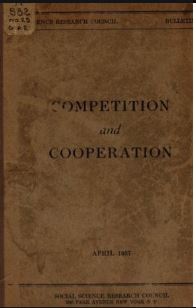
The Cooperative and Collaborative Learning Theory was developed by Mark Arthur May and Leonard William Doob. May and Doob published the book Competition and Cooperation.
Learning strategies that can be used in a traditional classroom setting that encompasses the areas of Collaborative and Cooperative Learning Theory include the following:
- Think-Pair-Share
- Jig Saw
- Small Group Discussion
- Problem Based Learning (Science Lab)
These learning tools and strategies meet all the areas that collaboration and cooperative learning theory focuses on.
Through viewing this site I hope I have provided insight on the Collaborative and Cooperative Learning Theory. This theory is a basic principal that can easily be implemented into classrooms on a daily basis. Through exploration of the theory I learned many technical parts to the theory and education that I am doing in my classroom that did not think had a name to it. It was as if I was putting a name to a face, putting a name to a strategy that I did not know existed.
Applied Educational Systems, Inc. (n.d.). What Are the 4 C's of 21st Century Skills? Retrieved from https://www.aeseducation.com/career-readiness/what-are-the-4-cs-of-21st-century-skills
Eachempati, P., KS, K. K., & Ismail, A. R. H. (2017). Cooperative learning through jigsaw classroom technique for designing cast partial dentures-a comparative study. MedEdPublish, 6.
(n.d.). Retrieved from https://www.youtube.com/watch?v=cnkKHL_dyGE
(n.d.). Retrieved from https://www.youtube.com/watch?time_continue=5&v=BXT2STtm_54&feature=emb_title
Pappas, C. (2019, September 23). Instructional Design Models and Theories: Cooperative and Collaborative Theory. Retrieved from https://elearningindustry.com/cooperative-and-collaborative-theory