Home

Quality Assurance ePortfolio
Academic Year 2016-2017
California State University, Chico
Proposal Summary: The Quality Assurance Program at Chico State works in tandem with a number of resources offered through the Office of Faculty Development, including the Center for Excellence in Learning and Teaching (CELT), Academy e-Learning (AeL), Course Redesign with Technology (CRT), and a number of FLCs focusing on pedagogy. What QA specifically provides through the use of the QOLT instrument is a series of tools that offer faculty innovative ways to redesign their course, while proposing objective and research-based standards for evaluating quality. During the AY 2016-2017 Chico State piloted QA as a Faculty Learning Community, as opposed to the one-on-one model utilized in previous cohorts.
Campus Need for Quality Assurance |
QA Program Overview
- The FLC was organized around the major broad areas of the QOLT instrument. As part of the FLC, faculty discuss SLO writing and tools for assessment and alignment in the first couple of meetings. One of the FLC meetings is fully dedicated to accessibility and universal design. Other meetings include: student engagement and interaction, student feedback and self-assessment, instructional material, and use of technology.
- A total of 16 faculty members went through the QA FLC (8 in Fall 2016, 8 in Spring 2017). Faculty came from all kinds of disciplines and colleges, including: Economics, Sociology, Political Sciences, Foreign Languages, Media Arts and Design, Business and Information Systems, History, Child Development, Social Work, Management, Agriculture, Accounting, and Finance.
- The courses redesigned include both lower and upper division, core courses and electives, GE courses and major-specific courses, introductory and capstone classes, and bottleneck courses. The formats include hybrid, blended, flipped, and fully online courses.
- Each faculty member received a stipend of $500 upon the completion of the minimum objectives established in the Memorandum of Understanding each faculty signed: write measurable student learning outcomes, finalize a fully accessible syllabus, complete at least three modules in the course redesign.
Campus Need for Quality Assurance
- Increase QA/QOLT visibility on campus
- Align goals for wise use of technology with broader pedagogical objectives
- Extend quality assurance from single course redesign to broader curricular needs
Proposal Goals Based on Need
- By structuring the QA program on campus as a Faculty Learning Community, faculty had a chance to experience the QOLT instrument and the process of course redesign at a much deeper level, benefitting from exchanging ideas and best practices with their peers. Being part of a close and more structured cohort allowed faculty to create connections with colleagues outside their departments and colleges, creating a broader network in which to discuss the QA program. This aspect and an overall change in the way the campus community was informed about the QA/QOLT FLC application process has greatly increased its visibility on campus, therefore our immediate goal is to continue pushing this model forward.
- The FLC is structured in a way that puts technological resources at the service of pedagogical needs. The goal is to stress the importance of establishing clear and measurable student learning outcomes and to then find the best technological means to achieve them.
- One major goal of the 2016-2017 QA/QOLT program has been to highlight connections between individual courses' SLOs and broader department and college goals. This focus has created fertile ground for new applications for 2017-2018 that seek to redesign cross-listed courses in various disciplines (English and Nursing, for example), or propose various course redesigns as part of a broader curricular need (Liberal Studies Program).

Quality Assurance Lead(s)
- Chiara Ferrari, QA Faculty Lead
- James Aird, Instructional Technology Consultant (TLP QA contact)
- Zach Justus, Interim Director of Faculty Development
Supporting Campus Partners
- Laura Sederberg, Manager of TLP
- Claudine Franquet, Instructional Technology Consultant (TLP)
- Christine Sharrio, Instructional Technology Consultant (TLP)
- Marjorie Shepard, Instructional Technology Consultant (TLP)
The Faculty Lead works in tandem with ITC James Aird and the rest of the TLP staff to plan the FLC meetings, organize presentations for faculty, and provide one-on-one mentorship in the course redesign process. Please see below for links to additional campus resources.
CELT - Center for Excellence in Learning and Teaching
TLP - Technology and Learning Program
DLT - Distributed Learning Technologies
ARC - Accessibility Resource Center
Quality Assurance/Quality Online Learning and Teaching (QOLT)
Background on Quality Assurance Efforts (2016-2017)
- The new QA Lead has completed the Q1 and Q2 training and is now a certified CSU QOLT reviewer.
- The QA Lead was accepted with other CSU colleagues to present at the 2017 QM conference about the benefits of Faculty Learning Communities in relation to Quality Assurance.
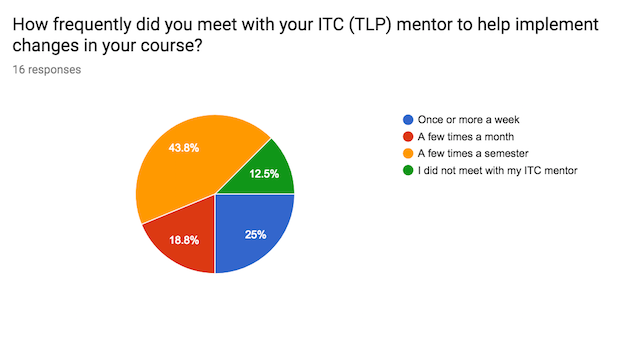
- The QA Lead is building a more systematic training process via the QOLT instrument with the help and involvement of TLP and Faculty Development. The new streamlined process achieved through the FLC allows for specific goals to be established as a cohort, and therefore it facilitates accountability. Getting TLP more involved in the mentorship process has also been proven successful: the great majority of faculty met regularly with their ITC to get help for their course redesign (as the chart below shows).
Quality Assurance Project Results |
Successes
- The switch to a Faculty Learning Community model has allowed for more interaction and sharing of ideas among the faculty members, something that was greatly appreciated by the participants.
- The campus QA program has increasingly achieved a prominent role on campus for the resources and the close mentoring it offers for online course redesign. In addition to facilitating interaction among faculty, another benefit of the FLC model has been to push forward broader conversations about quality assurance, which have encouraged entire programs to apply to the FLC for curriculum redesign (beyond single courses).
- The QA program has seen a strong participation of lecturers and adjunct instructors (50%), in addition to tenured and tenure-track faculty (50%). QA has therefore provided resources to a population that generally receives fewer incentives to improve pedagogy.
Challenges
- The FLC format for QOLT is new on our campus and it has been somehow challenging to determine what goals are reasonable for the faculty participants. The QOLT lead has discussed goals and ideas with TLP to determine the best way to develop next year’s FLC. We appreciate the possibility to discuss progress, concerns, and questions at our monthly CSU virtual meetings, and we look forward to more possibilities to share best practices in QA FLCs.
- It can be challenging to fit together the "canned" materials in the Q1 course with the slightly more comprehensive curriculum we have arranged to deliver to our participants face to face and through the local FLC. At times faculty have difficulties understanding the relations between Q1 and the content covered in the FLC, while other times the content seems redundant. This challenge could be addressed by either including QOLT leads in the design of Q1 (which should include goals related to the FLC objectives), or allow different campuses to run local versions of Q1, maintaining the main objectives and standards of the course, while matching the content of each local FLC).
- Some challenges also include the training of qualified mentors that can help faculty throughout their redesign. One goal for next year is to create clearer goals and expectations for mentors and to train them to become true assets in the QA process. This includes training faculty both as mentors and as reviewers.
Ideas/Lessons Learned
- After developing two separate FLCs in Fall 2016 and Spring 2017, it became clear that QA needs a longer time to be fully successful and allow faculty the proper time for their course redesign. In 2017-2018 Chico State will offer one year-long FLC, instead of two semester-long FLCs.
- The faculty lead should encourage instructional technology consultants to participate more regularly in the FLC meetings and organization, to both utilize the ITCs' expertise and create a stronger bond between them and the faculty members participating in the FLC.
- Encourage faculty to complete the Q1 course before the FLC starts, in order to be able to rely on a clear understanding of the QOLT instrument once the cohort meets.
Tasks/Resources Completed (2016-2017)
Required minimum goals:
- Finalize clear and measurable SLOs (93.8%)
- Finalize a fully accessible syllabus (81.3%)
- Complete at least three modules in the course redesign (81.3%)
Additional goals:
- Meeting the Core 24 (56.3%)
Three faculty members have also completed a self-evaluation of their course and will go through the EOI campus recognition over Summer 2017.
(Expanding the FLC from two semester-long cohorts in 2016-2017 to a one year-long FLC in 2017-2018 will allow all faculty to prepare to meet the Core 24 as a minimum goal and to ideally go through a formal review of all QOLT instrument standards).

Participating Faculty/Team Feedback
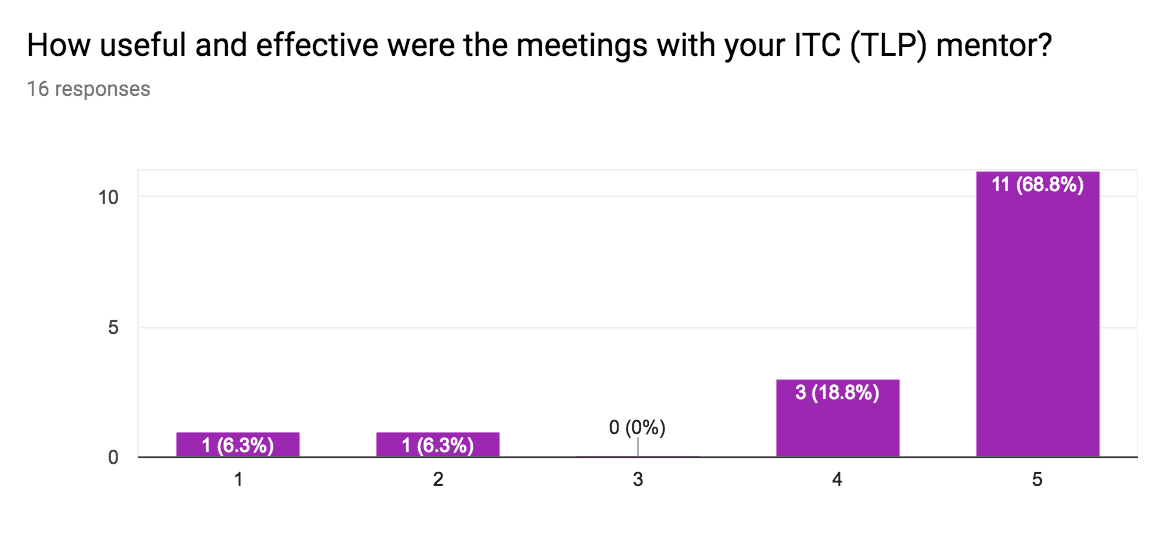
- Most faculty have found that meeting with the ITCs was extremely beneficial towards their course redesign, as the chart below shows.
- Faculty have expressed frustration with taking the Q1 course during the semester. The great majority of faculty suggest requiring faculty to complete the Q1 course before the FLC begins.
- Faculty have suggested incorporating a more systematic process of peer evaluation as a direct benefit of the individual course redesign presentations.
For additional feedback, please refer to the video testimonials posted in this eportoflio.
Next Steps for Quality Assurance for 2017-2018
- Increase accountability for the faculty members participating in the FLC, by setting specific goals and milestones for the disbursement of funding, specifically: 1. Complete the Q1 course before the FLC starts in the Fall ($200), 2. Attend the FLC in the Fall 2017 semester, completing measurable SLOs, a fully accessible syllabus, and at least three modules in the course redesign ($500), 3. Finalize the course redesign to meet the Core 24 in March 2018 and then present the final work to the entire FLC at end of April 2018 ($500). The ultimate goal is for all participants to complete a self-evaluation and be encouraged to participate in the local EOI recognition.
- Create a more robust and better-trained network of mentors that can help faculty members through their course redesign. There is now a broad enough body of former QA participants from which the QA Lead can recruit.
- The Faculty Lead will work with TLP to update and revamp the QOLT repository, to make sure the tools available match the actual needs of the faculty, while also addressing Chico State strategic priorities.
- The Faculty Lead will work with the new director of Faculty Development, Josh Trout, and the Faculty Development Advisory Board to update and better organize the websites for Faculty Development, CELT, QOLT, and Academy eLearning in order to facilitate navigation, ensure consistency of design, and eliminate redundancy of content.