Home

Enhancing Online Quality Assurance at Cal State LA
2014 - 2015 Academic Year
Cal State LA
Proposal Summary: At Cal State LA, we wanted to continue to integrate QOLT and QM rubric standards into all of CETL’s Moodle and educational technology workshops. We also increased our communication and outreach regarding QOLT and QM training opportunities. We hoped to offer 80 QM workshop grants to faculty, staff and administrators who wish to take QM training for their own professional development.
This year, CETL also partnered with the College of Professional and Global Education (PaGE) to assist facutly with redesigning their courses to be fully online for summer session 2015. The hope is that this intensive effort, which included weekly meetings with campus instructional designers, would result in quality online courses that would eventually be offered state-side.
MERLOT II
MERLOT is a collection of free and open online teaching, learning and faculty development services contributed and used by an international education community. The MERLOT collection of open resources spans across a wide variety of disciplines and education levels. What sets MERLOT apart is a combination of peer reviews, member comments, learning exercises and other valuable information and metadata associated with the materials.
Campus Need for Quality Assurance |

Campus Need for Quality Assurance
In this year's quality assurance proposal, we wanted to continue to integrate QOLT and QM rubric standards into all of CETL’s Moodle and educational technology workshops. We also increased our communication and outreach regarding QOLT and QM training opportunities. We hoped to offer 80 QM workshop grants to faculty, staff and administrators who wish to take QM training for their own professional development.
This year, CETL also partnered with the College of Professional and Global Education (PaGE) to assist facutly to with redesigning their courses to be fully online for summer 2015. The hope is that this intensive effort, which included weekly meetings with campus instructional designers, would result in quality online courses that would eventually be offered state-side.
Proposal Goals Based on Need
- Integrate QOLT and/or QM rubric standards into all of CETL’s Moodle and educational technology workshops.
- Offer 80 QM workshop grants to faculty, staff and administrators who wish to take QM training for their own professional development.
- Pilot a Faculty Learning Community (FLC) for faculty interested in flipped, hybrid or online course redesign.
- Partner with PaGE to offer an RFP for faculty who wish to redesign a course sequence to be fully online.
- Identify and support faculty who are willing to participate in the CSU CourseMatch program, serve as a QM peer reviewer, and/or submit courses for QM peer review.
Quality Assurance Lead
- Beverly Bondad-Brown, Ph.D. - Associate Director for Educational Technology in CETL
Additional Quality Assurance Partners
- Catherine Haras, Director of CETL
- Jeff Suarez-Grant, Instructional Designer
- Maria Fernandez, Instructional Designer
- Judy Impiccini, Program Developer of PaGE
Encouraging the Use of Quality Assurance Rubrics
A main goal this year was to encourage the use of Quality Matters and QOLT rubrics. To achieve this goal, we redesigned our series of educational technology workshops and incorporated best practices within each workshop. This allowed faculty to be exposed to best practices while they were learning the technolgy tools. Thus, even faculty who were not interested in fully online or hybrid courses were already organizing their Moodle course shells using QM standards.
We also started a CETL T.E.C.H. (Technology Enhanced Certificate Holder) program for faculty. Faculty who completed a series of educational technology workshops received a T.E.C.H. certificate that they could include in their RTP file.
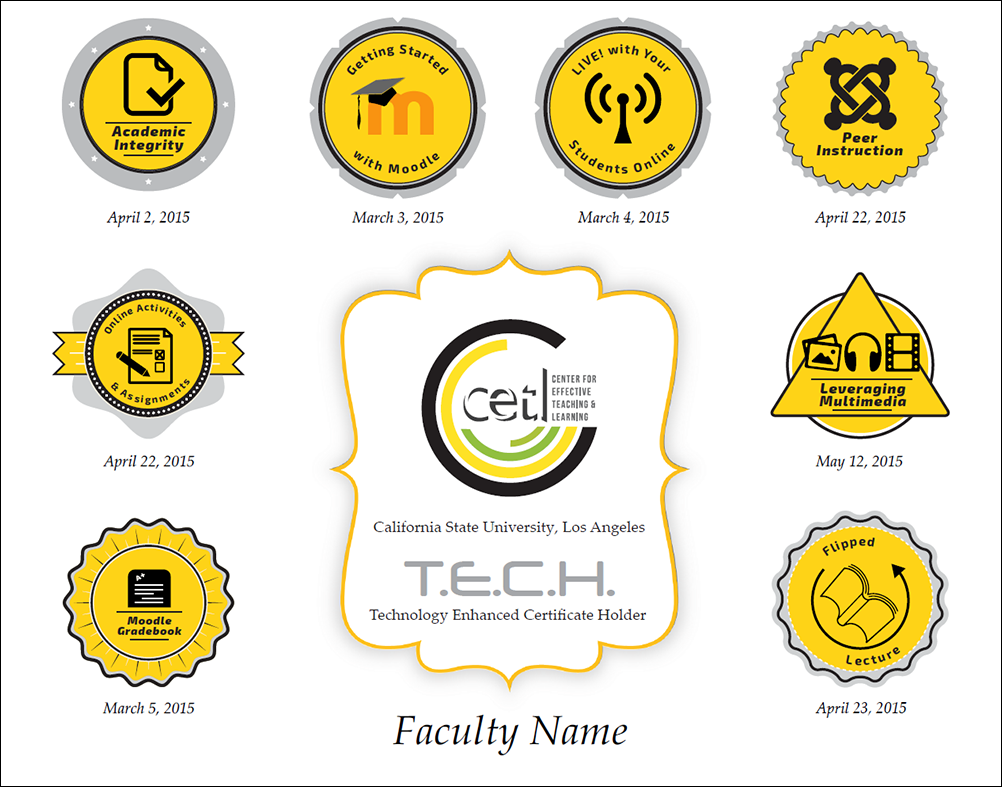
Sample CETL T.E.C.H. certificate
Quality Assurance Project Results |
Tasks/Resources Completed 2014 - 2015
- Developed new Flipped, Hybrid, Online Institute (4 Fridays plus final presentation day)
- Provided 61 QM grants to 41 faculty, staff, administrators
- Two CETL Instructional Designers became Certified QM Peer Reviewers
- Developed 6 new fully online courses using QM Rubric
- Offered 2 CSU CourseMatch courses
Participating Faculty Feedback
Faculty feedback on QM workshops:
The most valuable thing I learned in this workshops is:
- Alignment of assessments with student learning outcomes and objectives.
- Creating an online class that is excellent requires a lot of thoughtful planning. Online courses can be as rigorous, or more, than face to face classes when done right. I loved the class - it really set me up to convert my class.
- Fostering interactive communication among students is a monumental challenge, and forcing it may not be the best solution.
- The most significant things I learned in the workshop was why and how all components of a course must be aligned.
- The value of detailed instructions. Online instructions for each activity with step by step instructions on how to proceed are needed in the online format. We cannot assume that all students will intuitively know where to start or the order of activities listed.
- To examine connections between students learning outcomes and course assignments, particularly to achieve deeper student learning.
- The structure was a good example of transparency, a pedagogical concept that has been the focus on another project I am working on with colleagues on campus and AAC&U.
- I will revise my syllabus slightly to be more explicit about certain goals and redesign a form to be more aligned with the grading rubric. I am still considering ways in which I can make greater use of Moodle.
Successes
- Presentation at regional QM conference with invitation to present at national QM conference.
- 61 QM grants awarded to 41 staff/faculty/administrators.
- Six new fully online courses ready for summer session and move to state-side. We expect these courses to be ready for CourseMatch and QM peer-review within a year.
- A successful Flipped/Hybrid/Online Course Redesign model and curriculum over 4 days during the quarter. We feel we can now scale this programming outside of quarter breaks.
Ideas/Lessons Learned
- Building capacity is a slow process. Early on, you will get early adopters, but keep providing the services and eventually the mainstreamers will come. We are now getting the attention of faculty who have never used CETL services in the past. Trust that word of mouth goes a long way--and can be slow to spread.
- Start introducing best practices when newer faculty are eager to learn the technology. By integrating the best practice with the technology training, there are no surprises when a faculty member wants to develop a hybrid or online course. They will already be exposed to the QM or QOLT rubric and standards.
- To our surprise, faculty appreciate the importance of alignment in their courses. QM workshops were a great way for faculty to learn from those outside the University the value of course alignment.
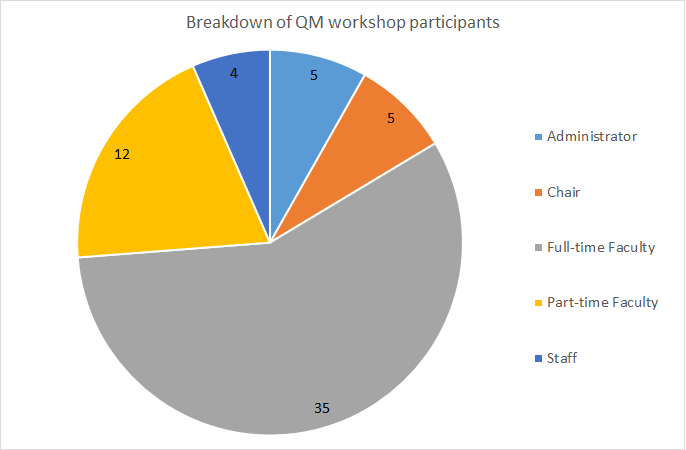
2014-2015 Stats
61 Individuals who have recieved at least 1 QM training
41 QM workshop grants given
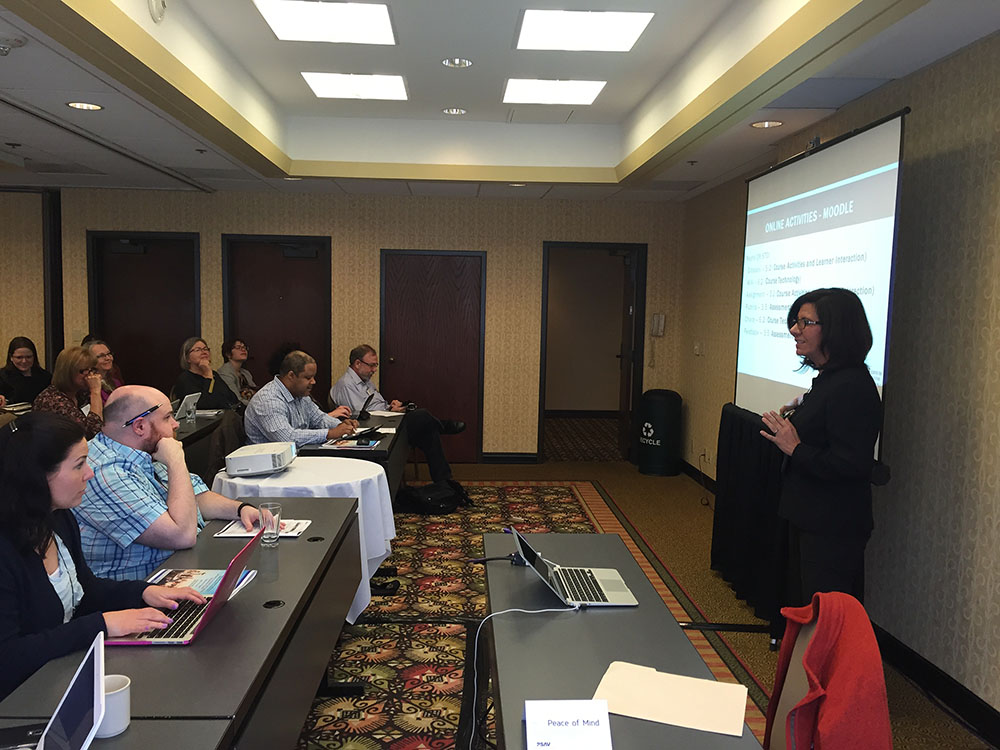
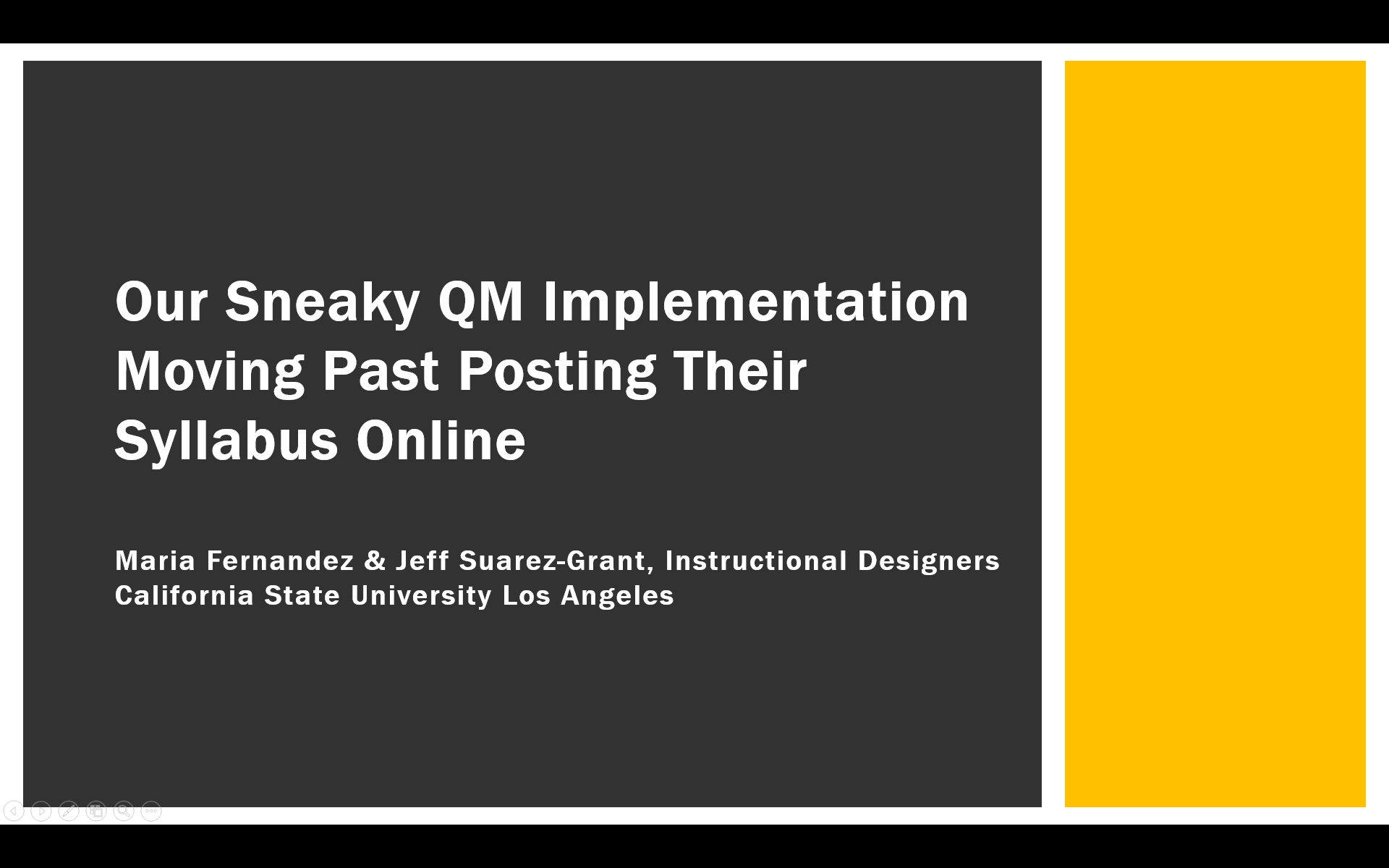
Presentation at QM regional conference (April 9-10, 2015).
Next Steps for Quality Assurance for 2014-2015
- Offer an additional 55 QM workshop grants to interested faculty, staff and/or administrators.
- Funding a CETL Faculty Fellow who will help mentor faculty who wish to develop a fully online course.
- Continue with PaGE Online RFP to assist up to 6 faculty with fully online course development for summer 2016.
- Encourage 2-3 faculty to either get their course QM certified, or become QM peer reviewers.