Home

Deepening Student Engagement and Satisfaction in an Online GE Science Course with Active Learning
CSU, Monterey Bay
Dr. Natalie Zayas Delgado
2016-2017
Project Abstract:
The project is a continuation of previous projects on increasing student engagement in online courses. Continuing the project adds to the data, student input and engagement activities. The project becomes more of an Action research project by changing the course as the students give their feedback. This continuation gives the instructor a better picture of how engagement is working, or not, in this online course. Students are impacted in that their learning should be more engaging as the course changes based on student input. The redesign strategy included having students create eportfolios for the course and projects to add a more reflective process to assist them in engagement with their own learning and process of learning and engaging with the course materials. For students to engage with the instructor and each other Google surveys are used to check in on their learning and engagement.
Project Description for Sustaining Success |
Background
- This project is a continuation of other projects, Increasing Student Engagement and Satisfaction in an Online GE Science Course with Active Learning and The effectiveness of virtual labs in a general education environmental science course. Hands-on group labs were created for an active experience that included collaboration in response to student feedback in the previoius projects.
- For this project, the addition of students creating videos to show their learning as a way to engage them with each other was incorporated into the course.
- The addition of a Lifestyle Project where students apply content knowledge to their everyday lives as a way to engage them with the course and in their daily lives.
- The project includes students creating an eportfolio as a reflective piece at the end of the course. Students are able to showcase their work, group lab projects, their Lifestyle Project and reflect on their learning and engagement.
How Did you Sustain Course Redesign Success?
- Success in this project is shown in pass/fail rates. For me, higher pass rates means more engagement with course materials.
- Sucess is also measured in student feedback. Success is student feedback showing 80% or more of the students felt more engaged with the course materials and can articulate this in their feedback.
- The previous projects showed success and gave valuable student feedback information that was incorporated into this project. This project took the work a step further by adding the lifestyle project and eportfolio as a way for students to engage with the materials in a different manner. These projects provide students a way to think about their learning process and internalize the course materials.
- To sustain the success, I continued using labs and projects that have worked in previous courses to provide engagement for students. I also added new projects and used technology for students to present their projects in various formats.
Project Activities
- Videos were added as a result of previous project student feedback. The course now has an assignment of an introduction video and another video where students incorporate their learning of ecosystems into a video they produce. The students share with each other and learn from each other and get to know each other. The videos also serve as a method for students to "get to know each other" for group project selection.
- LifeStyle Project: this project incorporates course content into students' lives by having them monitor their footprint in regards to various areas of course content such as energy, transportation, water usage, food, consumption and waste. Students design a proposal on how to implement and monitor changes to 2-3 of these areas. They complete the project and include video and images, analyze their data, great visuals to represent their data and the project is culminated into a Prezi or other presentation to be shared with classmates.
- Eportfolio: the eportfolio is a space where students share information about themselves, pre-assessment and post-assessment data, their group lab projects and life style project. They also reflect on their learning in the course for content, the online environment and their engagement with the course. Many students have added a tab for this course to pre-existing eportfolios creating a deeper eportfolio of their college learning experience.
- The School of Natural Sciences and CSUMB has benefitted in having a course continually resdesigned for student engagement. The course continues to be popular and there are two sections that fill quickly. The course is also offered during winter and summer sessions,contributing to FTEs and a course that can be accessed by students outside of CSUMB.
- The course has helped the instructor as it has built on my understanding and learning about teaching online for better student engagement and learning.
About the Project Team
- Dr. Natalie Zayas Delgado, faculty, College of Natural Sciences, course developer and instructor
- Candace Ledesma, Student Assistant
- CSU, Monterey Bay, College of the Natural Sciences
- Students in this course are primarily non-science majors as this is a GE course. Some students are environmental studies students as this course fulfills MLO1 for environmental studies students.
Tracking Implementation Success |
Timeline, Milestones, and Goals
- Major milestones and goals were to create the Google survey tool and use it successfully. This was successful and students have been able to use the tool without any problems. Candace Ledesma, a student assistant, created the Google survey tool.
- The survey has been used in a Spring, Summer, Fall, Winter and Spring course.
- Assignments were created and implemented during the spring semester of 2016. Editing due to student feedback and instructor observations occured during the summer of 2016. Assignments rolled out in their newer version during the fall semester of 2016 and spring 2017.
Project Outcome
- Outcome: Improve student engagement for better learning and understanding while increasing pass rates for the course.
- Outcome was assessed based on student feedback in the survey and pass/fail rates.
- Implementation, revisions and student engagement has worked well in the course. Involving students in the revision process is critical to the success of project.
Inclusive Pedagogy Considerations
- Accessibility
- Principle I: Representation: Students read, view videos, engage with assessment materials, discussion forums, hands-on activities and reflection.
- Principle II: Expression: Students learn in multiple modalities throughout the course and have the ability to express themselves and show their learning through multiple methods. Learning and activities are scaffolded from recall to deeper thinking activities.
- Principle III: Engagement: Students have a choice in how to express their learning through video, the Lifestyle Project and eportfolio. In the group projects, students decide as a team how to complete and represent their data. By allowing for choice, students become the decision makers of their learning process while guided by the assignments.
- The Lifestyle Project and group labs have relevance to everyday life. This allows learners to engage with materials that are part of their everyday world through their own actions, the media and word situation.
- Affordability
- The textbook used in the course is The Habitable Planet which has no cost to students.
- The American Association for the Advancement of Science (AAAS) and Science magazine have awarded The Habitable Planet Web site its SPORE prize, the science prize for online resources in education.https://www.cfa.harvard.edu/news/fe201014 and Science article
- Diversity
- Having the course online with a low cost supports the CSU Diversity Statement by providing a course that is available across time and distance. The low cost of the course materials allows students the ability to take and complete a course within a reasonable budget.
- Students of diverse backgrounds are supported through the pedadgogical stragegies of active learning and self-reflection by having (1) diverse groups to learn with and from; (2) by providing a method of students to engage with materials and videos that incorporate diversity through ethnicity and culture, and socio-economic status.
- By providing for student engagement, students learn with others, yet have the ability to do individualized learning. Effective teaching stragtegies. http://www.facultyfocus.com/articles/effective-teaching-strategies/10-ways-to-promote-student-engagement/
- According to Zeichner (1992), there are twelve key elements for teaching for ethnic and language minority students. The following were elements used in this course redesign:
- Instruction focuses on students' creation of meaning about content in an interactive and collaborative learning environment.
- Teachers help students see learning tasks as meaningful.
- Curricula include the contributions and perspectives of the different ethnocultural groups that compose the society.
- Teachers provide a "scaffolding" that links the academically challenging curriculum to the cultural resources that students bring to school.
Survey Results
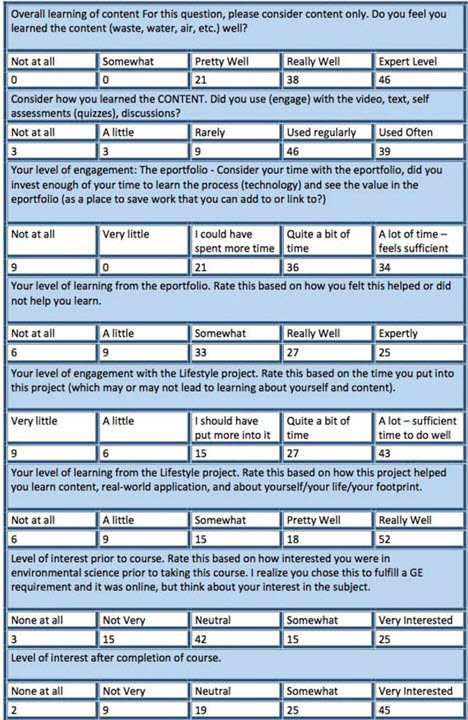
Students completed surveys to self-report on their engagement with the course. Results are shown in the table below.
My conclusion is that the majority of students self-report engagement with content and projects. Interest in the course content increased after the course. There was less self-reporting of learning from the eportfolio than from other projects. The Lifestyle Project self-reporting of learning was highest.
Faculty Impact and Commitment |
Scholarship and/or Professional Development Activities
- This project is resulting in a presentation to be presenting at the International Conference on Education in Hawaii in January of 2018.
- A paper is also being written and will be submitted for publication to online journals.
Commitment
- Outcomes and Benefits
- The outcomes were assessed by pass/fail rates and student feedback on the survey.
- Using a four semesters of data increased the student feedback and assisted Dr. Zayas Delgado in determining the best changes to make to the course and which projects to keep in the course.
- The outcomes were assessed by pass/fail rates and student feedback on the survey.
- Collaboration Outcomes
- Dr. Zayas Delgado and Candace Ledesma, Student Assistant worked together online and in person. Candace created the survey based on the course, her knowledge of students and the course projects as she had taken the course and the faculty's general questions.
- Dr. Zayas Delgado reviewed and edited the survey.
- Collaboration worked with online and in person as the faculty member and the student had already developed a positive relationship.
- Redesign Institute
- Redesign institutes and webinars provided information and ideas in trying various technologies.
- At the 2015 Summer Institute Dr. Zayas Delgado met with representatives from online lab and simulation companies. She signed up and worked with them to develop technologies.
- The faculty member has worked with many technologies and decided to work with Skyepack as Skyepack allows for embedding video and text in "chunks" with assessment questions following instead of having student read large amounts of text prior to self-assessing. Skyepack has been a positive addition to the course. Students have enjoyed it and it has only cost $20.00.
- Redesign institutes and webinars provided information and ideas in trying various technologies.
Course Redesign Sustainability on Your Campus |
Project Summary
- The project incorporated student feedback on assignments throughout the semester. Students submitted feedback on Google surveys and on a final Google survey. They were allowed to submit anonymously, however, most freely emailed feedback from time to time.
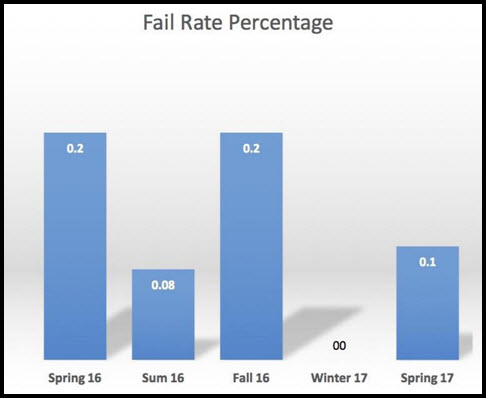
- Overall, fail rates were low but did drop. Students self-reported on engagement. This self-reporting showed high engagement with the LifeStyle Project having the highest self-reporting of learning and high engagement. Students reported high engagement with course materials, reading, video, discussions. Interest in the course content increased during the course of the semesters.
Project Reflection
- Working with students based on their feedback gives students a voice in their course.
- Students' voices need to be heard for faculty to redesign courses. We use our content knowledge, technology knowledge, education and pedagogical knowledge to develop our courses, yet listening to students helps us create rich learning environments.
- The course has been offered online since 2006 and continues to be offered four times a year for winter, spring, summer and fall sessions. The course has been popular and fills quickly. If I were not available or able to continue teaching the course, it is set up in a way that other faculty could facilitate the course, making it sustainable.
Lessons Learned
- I have been teaching online since 2005. I created this course and have revised it often. This course has been the subject of my course redesign using UDL and many online pedagogies and technologies. The positives of this project is to incorporate other projects and using the redesign over four semester to gather more data.
- For those who are or are considering redesign of your course:
- Realize that there is always room for improvement
- Listen to your students
- Be open to new ideas
- Always follow sound pedagogy
- Learn new technologies
- Read research and view other redesign eportfolios for ideas and research.
- Trust your expertise
- Tell students you are trying new assignments, projects, technologies and you need their feedback.
- Remember that it is okay for something to not work out.
- Enjoy the process
Student Feedback with my comments in bold/italics below them:
I feel that the period for recording of the baseline datas was too short and not representative of our lifestyles to compare it to the results of the Lifestyle Project.
To address this, I added in extra time for baseline data. This was a comment that helped me change the course quickly for better data and projects.
I would say although a lot of reading the information was good.
This is a common comment, even in face-to-face courses. I have in my syllabus and state it in early emails and throughout the semester that the online course does not have traditional lectures, therefore the readings and videos cover what would take the time of a lecture and outside of class readings. Happily though, students commonly comment that the reading materials are beneficial.
The class materials and assigments were high-quality, interesting and relevant. The projects and individual assignments served to keep me engaged and help me stay focused on my own eco-practices. I suggest that there be some face-to-face element to the class, in order to "check-in" and establish a little more clarity about what is expected and required for certain assignments. This could be in a one-time optional class meeting, via a brief skype or "e-chat", or through an assistant who is available when necessary, perhaps. That said, it is an online course and perhaps I am requesting more personal interaction than it is practical to have.
I have always offered Zoom, Blackboard Collaborate or Skype meetings. I now offer in-person meetings. I tried a scheduled meeting but often found no one showed up. Now I have students email me with three days and times that work for them (within time frames that work for me) and we arrange to meet. These meetings are beneficial to the students who need the in person contact to explain projects.
I liked the interactive components such as the "how many earths does your lifestyle use" activity. Those were helpful to see the big picture and relate it to myself.
This is the type of comment that shows me that an activity was engaging for a student and they can see the connection to their life.
Honestly everything was alright, one of my problems with the course was the group project. I understand the lesson of the assignment where we have to interact with people we have never seen before, but where I could not find a group to be in till the second week of the project being assigned. My partner also had problems with finding a group. I do not know how this could be fixed, but I feel that this concern should be addressed.
I have since changed the group project so that students have activities in the first three weeks to get to know each other. They review the group projects and in discussion forums discuss them and pick teams. There are still a few each semester who do not participate, making it difficult for them to be in a group.
Group project should be completed in the beginning of the semester, and so both things are not being finished at the same time.
This was a comment that made sense to me. I moved the group project up to around midterm so students have plenty of time, but can also show their understanding of the scientific process and content knowledge through this project.
The eportfolio and lifestyle project were a waste of time. I wish that we just had an assessment instead.
This was the first time I received a comment like this. This does not fit into my teaching philosophy or good pedagogy. Comments like these, when extremely rare, I note but do not consider heavily. If this comment was repeated over time and/or by many students, I would reconsider projects versus multiple choice type assessments.
I think everyone on our planet should take this course. It teaches everyone about the dangers of over consumption.
This is a reoccurring comment at the end of the course each semester by many students. This comment also shows me students have been engaged and have connected course content to their lives.