
Manual scavenging: an indelible blot on urban life
Manual scavenging: an indelible blot on urban life
INTRODUCTION
1.1 A brief Introduction
Before unfolding the various aspects of the current research on inhuman practice of manual scavenging, it is really important to make a mention of the Preamble of the Constitution of India. It promises equality of status and of opportunity to its every citizen. It further promises to assure dignity of every individual. We gave our self this Constitution around six decades ago but perhaps it is misfortune of millions of people to whom it failed to reach. It is usually said about my beloved country that two kinds of countries which reside here, one is ‘India’ and the other one is ‘Bharat’.
‘Bharat’ is that misfortunate child who had always faced discrimination from his own guardians as well as from the society as a whole. He is the one who is mostly ignored for the sake of betterment of its sibling ‘India’. Development has always reached to ‘India’ first and it might have also reached to ‘Bharat’, as and when it got lucky. I shall perhaps stop using the terms like ‘misfortune’ and ‘luck’, as these are generally used as tools to shift the onus of blame for the failure on something which is beyond human control. A better term would be ‘lack of will’. Thus, it’s not the misfortune of ‘Bharat’ but lack of will of his guardian ‘Government of India’ which perhaps because of its double standards, has always ignored ‘Bharat’ to the extent that it has acquired the state of invisibility.
A part of this invisible ‘Bharat’ has always been under the state of nausea because of the stench it is always surrounded with due the nature of work it has been involved into since ages. The current project aims to highlight the state of those people who constitute a part of that part, and are, therefore, still involved in the age old filthy work.
The work of ‘Manual Scavenging’ in India means the manual lifting and removal of human excreta, at both private homes as well as at the departments maintained by public authorities.[1]
A manual scavenger manually removes excreta from "dry toilets" i.e. toilet without the modern flush system. As is evident from the name, a “dry-latrine” or “dry-toilet” is a latrine which does not have facility of water i.e. the one other than a water seal latrine. Such latrines have no water facilities and there is generally no drainage channel to let the human excreta pass through. It is constructed with four walls. The dry-latrines which have been constructed in private houses are called individual or private latrines. In such latrines, the cleaning of human excrement is done by hands. The excrement is manually carried to the place of disposal. The persons who are involved in the work of carrying human excreta to the place of disposal are called ‘Manual Scavengers’.
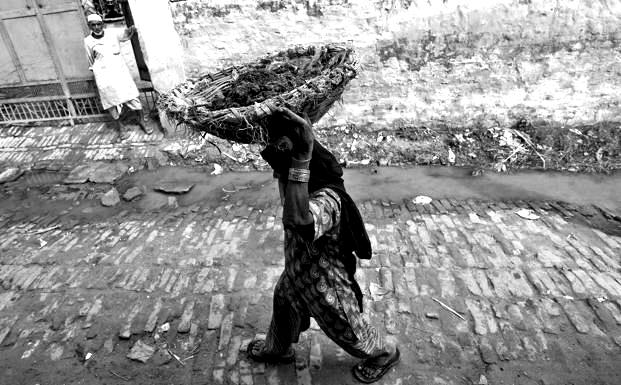
Manual Scavenging is a disgrace to dignity of an individual. It hurts the self-respect of an individual to the core and it also hurts the humanity at large. It has been more than 60 years since the time India gave itself a Constitution. Few of the main objectives of the Constitution of India are to give equality of status and opportunity to its citizens and to assure dignity of every individual.[1] For the purpose of fulfillment of these objective the Constitution contains various provisions in it like Article 14, 17, 21 etc.
There are also two major Acts which were formed with an intention of eradicating the problem of manual scavenging. One of these Acts came into force in 1993. It is called ‘The Employment of Manual Scavengers and Construction of Dry Latrines (Prohibition) Act, 1993’ (hereinafter 1993 Act). The 1993 Act provides for the prohibition of construction or continuance of ‘dry-latrines’ and it further provides for the prohibition for the employment of ‘Manual Scavengers’. But the situation persists despite the fact that this Act is being into enforcement since last two decades.
Though situation has improved but manual scavenging is still not eradicated completely in many parts of India. The Indian Railways, which is the third largest railway network in the world, continues to be the biggest violator of this Act. Most of the rehabilitation schemes of the government failed due to inadequate data, faulty surveys, lack of funds and above all the lack of will. Because of increase in ‘Social Activism’ during last few years, the pressure on the Government increased and a new Act came into force on September 18th, 2013- The Prohibition of Employment as Manual Scavengers and their Rehabilitation Act, 2013 (hereinafter 2013 Act).
After long years of inaction, the Government of India, by enacting the 1993 Act, have at least acknowledged the fact that manual scavenging is still into existence in the country
The act provides for the prohibition of employment of manual scavengers as well as for their rehabilitation. Though, the Act has many loopholes but the Act is another important step in the decades old struggle for eradicating the inhuman practice of manual scavenging and for restoring the dignity of all those people who have been involved into this filthy work.
1.2 Research Methodology
1.2.1 Methodology
For the purpose of current study the project has been designed as a doctrinal study. The primary resource which I would be using is The Constitution of India. I would also be referring to two Legislative Acts which came into force for the purpose of eradication of this inhuman practice, namely, The Employment of Manual Scavengers and Construction of Dry Latrines (Prohibition) Act, 1993 and The Prohibition of Employment as Manual Scavengers and their Rehabilitation Act, 2013. Reference would also be made to The Untouchablility (Offences) Act, 1955, The Protection of Civil Rights Act in 1976, The Scheduled Castes and Scheduled Tribes (Prevention of Atrocities) Act in 1989, Protection of Human Rights Act, 1993 (No. 10 of 1994), and The Employment of Manual Scavengers and construction of dry latrines (Prohibition) Rules, 1995. Apart from the above stated Acts, the Supreme Court of India has also delivered some landmark judgments with regard to eradication of Manual Scavenging, which would be duly referred to.
The secondary resources would be mainly in form of various books which have been written in the past bringing into light the adverse conditions of Manual Scavengers in different states of India and highlighting the failure of Central and State Governments in completely eradicating manual scavenging and rehabilitating the Manual Scavengers. Apart from this, various committee reports and articles would also be referred to.
1.2.2 Hypothesis
The inhuman practice of manual scavenging has its roots in the caste system and the Government of India, despite of passing various Acts in this regard, has failed to completely eradicate this ill practice. It has also failed to properly rehabilitate the manual scavengers because of its faulty schemes and above all, the lack of will. The inhuman practice of manual scavenging is still prevalent in many States and Union Territories of India and various institutions including Indian Railways.
1.2.3 Formulation of Research Questions
I have formed the following research questions for the purpose of present research:
- What is the historical background of inhuman practice of manual scavenging?
- How far the legislative acts have been successful in order to eradicate the inhuman practice of manual scavenging?
- What role has the Indian Judiciary played to curb the menace of manual scavenging so far?
- What are the initiatives taken by the Central and the State Governments and Non-Governmental Organisations (NGOs) since last few decades with regard to eradication of the inhuman practice of manual scavenging? How far the rehabilitation work has been done?
- What is the situation in Indian Railways with regard to manual scavenging?
1.2.4 Literature Review
Literature available for the study of present topic is mainly in the form of various books, journals and articles written in this regard.
Some of the literature can be listed as under:
- “Manual Scavenging in India: A Disgrace to the Country” by B.N.Srivastava (1997)
In this book, the author, a Social Activist, based on his more than 35 years of experience, has tried to answer many questions related to manual scavenging. An attempt has been made by the author to trace out the origins of scavengers in India, their social and economic status, caste organizations, cultural heritage and territorial distribution. The author has also done an evaluative study of the initiatives taken by the Central and State Governments and other prominent NGOs. The book also highlights the progress made for the liberation and rehabilitation of Manual Scavengers.
- “India Stinking: Manual Scavengers in Andhra Pradesh and their work” by Gita Ramaswamy (2005)
The book is an attempt by the author to understand, observing the daily routine of Manual Scavengers, what forces them to continue working as Manual Scavengers. The author also highlights the major contribution made by the “Safai karamchari Andolan”, an NGO actively involved in trying to curb the menace of manual Scavenging.
- “Endless Filth: The Saga of the Bhangis” by Mari Marcel Thekaekara (2005)The book highligts the stat of Manual Scavengers around the country and also in Gandhi’s Gujrat. The author also analysis the complexity of the important task of rehabilitation of the manual scavengers.
- “Unseen: The truth about India’s manual Scavengers” by Bhasha Singh (2014)
The book was first published in Hindi as Adrishya Bharat in the year 2012. In this book, the award-winning journalist Bhasha Singh, based on over 10 years of research, unveils the horrific plight of Manual Scavengers across eleven states in India. The book also records the ongoing struggle of Manual Scavengers for self-empowerment. The author digs deep into historical perspective of manual scavenging and also highlights the situation of Manual Scavengers in Indian Railways.
1.2.5 Objectives of Research
The objective of the research can be stated as under:
- To study the historical background of the manual scavenging in order to analyse the root cause of the problem
- To study various legal provisions with regard to manual scavenging
- To analyse the judicial response towards the problem of manual scavenging
- To analyse the initiatives taken by the Central and the State Governments since last few decades with regard to eradication of practice of manual scavenging and to find out how far the rehabilitation work has been done
- To analyse the situation of manual scavenging in Indian Railways, which is supposedly the biggest employer of Manual Scavengers in the country
- To find out the probable solutions in order to completely eradicate the manual scavenging in India and reassuring the dignity of every individual who has been involved in the manual scavenging work, as it has been promised in the Preamble
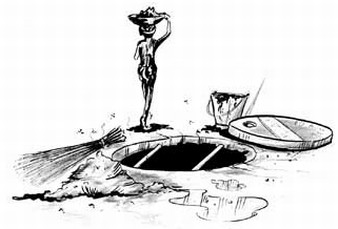
Manual Scavenging: A Disgrace to the Nation
The work of ‘Manual Scavenging’ in India means the manual lifting and removal of human excreta, at both private homes as well as at the departments maintained by public authorities.[1]
A manual scavenger manually removes excreta from "dry toilets" i.e. toilet without the modern flush system. As is evident from the name, a “dry-latrine” or “dry-toilet” is a latrine which does not have facility of water i.e. the one other than a water seal latrine. Such latrines have no water facilities and there is generally no drainage channel to let the human excreta pass through. It is constructed with four walls. The dry-latrines which have been constructed in private houses are called individual or private latrines. In such latrines, the cleaning of human excrement is done by hands. The excrement is manually carried to the place of disposal. The persons who are involved in the work of carrying human excreta to the place of disposal are called ‘Manual Scavengers’.
Manual Scavenging is usually done in two ways:
- Manual cleaning of ‘Dry-Latrines’, where human excreta is left on a stone or a plate or mud or in a bucket or pot and then the scavengers take the excreta to some other place for the purpose of disposing it off.
- Manual cleaning of ‘Sewage Pits’ or ‘Septic-Tanks’, at both privates and in municipalities, where a person has to open a manhole, enter into it and clean it manually.[2]
The work of cleaning dry latrines, both at private homes and public places is usually done by women, whereas the work of manually cleaning the sewage pits or septic tanks is done
by both men and women.[1] In some places 95% of the total manual scavengers are women and in other places it goes up to 98%.[2]
Modern toilets generally do not need manual cleaning of the excrement as they have a flush system. They are generally connected to sewer lines so there is no need to manually carry excrement to the place of disposal. However, there are some toilets which have water flush attached to them, but still manual scavengers are employed to clean them. This is because they are not connected to a sewer lines due to absence of sewer lines in the area. They are generally connected to a tank which has to be cleaned manually. The tank is required to be manually cleaned and emptied in every few days, depending upon its size and usage. The filthy task of cleaning such tanks is usually performed at nights, i.e. when everybody around is inside their houses in their deep sleep and without having to feel disturbed by the vile smell that spreads around. More than one person is required to clean these tanks.
From north India right down to the coastal regions of the country, such tanks exist in mind boggling numbers.[3] Since the work of manually cleaning the sewage pits or septic tanks is usually performed at nights, it is very tedious task to identify such tanks.
2.2 Manual Scavenging vis-a-vis Health
Health of a Manual Scavenger is at serious risk at every stage. The situation will be more clear after discussing the health factor in detail.
In western countries, the nexus between human excrement and diseases have already been established since 18th century.[4] It is well established and accepted that human excreta is a carrier of various bacteria which causes harmful diseases. It acts as a principal vehicle for the transmission of various harmful diseases. It is known to cause
diarrhoea, endemic malaria and it is also known to cause some serious respiratory diseases. Respiratory diseases and endemic malaria are considered to be the main causes of deaths of infants in developing nations of the world, such as India, Pakistan, Bangladesh and Sri Lanka. [1]
The working conditions of the people engaged in manual scavenging have virtually remain same as it was a century ago. By virtue of their occupation of cleaning and removing human excrement, they are always exposed to many serious health related issues.
They are always exposed to harmful gases like ‘Methane’[2] and ‘Hydrogen sulfide’.[3] People engaged in this are always in grave danger of contacting no. of diseases skin diseases as well. Infections like ‘leptospirosis’[4] and ‘helicobacter’[5] are very common among these people engaged in the occupation of cleaning and removing human excrement. Such people are also prone to ‘intervertebral disc herniation’ and ‘cardiovascular degeneration’ because of adverse conditions in which they work.
One can imagine the risk that is involved in the daily routine work of manual scavengers. Throughout their life they are under the danger of getting infected by millions of bacteria and viruses.
Around 90% of all the people engaged in disposal of human excrement have not been provided even the basic equipments such as gloves, masks, boots, brooms, baskets etc. which may keep them protected from these harmful viruses and bacteria to some extent. In absence of these equipments the people involved in scavenging have to perform this dangerous task by bare hands, inhaling various harmful gases and running a risk of getting in direct contact with no. of harmful diseases. Even the municipalities in India are not well equipped with these safety tools. The sewage workers, under absence of any such safety and protective equipment, have to enter into manholes or sewages in order to clean the whenever they are clogged. The working conditions in which sewage workers has to do the work of cleaning a sewage are very shocking as they are usually provided with only a rope and a vessel (usually a bucket). They have to enter into manholes or sewage with the help of that rope, and use that basket for cleaning purpose. One can imagine the forceful inhalation of various harmful and poisonous gases by them in such conditions.
There are many more diseases including infection by ‘campylobacter’[1], ‘cryptosporidiosis[2], ‘giardiasis’[3], and ‘meningitis’[4] to add to the list. ‘Hepatitis A’ and ‘tuberculosis’ is also said to be caused by working in these conditions. The list is endless.
However, no matter how many types of safety tools are used for the purpose of scavenging, one cannot deny the indignity that a manual scavenger has to go through by mere nature of her occupation. Apart from the above mentioned harmful disease, a person
2.3 Nameless Existence
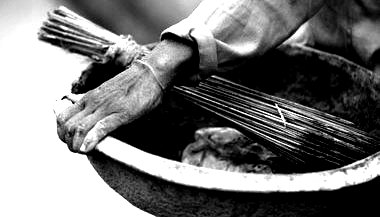
Manual Scavening[1]
‘Balti-waali’ of Uttar-Pradesh becomes ‘Tina-waali’ in Bihar. ‘Tokri-waali’ of Haryana and Punjab becomes ‘Dabbu-waali’ in Bengal.[2] They are never known by their real names, rather they are known by the names of tools they use to perform their daily work of manual scavenging.[3] In Andhra-Pradesh they are called by the name of ‘Thottikar’ which means the ‘dust-bin’ and in Odisha they are known as ‘Paaki’ or ‘Peeti’ which means ‘excrement’.
Most of manual scavengers are not even used to the sounds of their real names. They have got accustomed to their derogatory secondary names as much as the society has got accustomed to their undignified work.
In Anantapur of Andhra-Pradesh, sixty year old C. Narayanaswamy got used to the sound of her name only in fiftieth year of her life, as she had always been addressed as ‘Thotamme’ i.e. Manual Scavenger throughout her life.[1] There are millions more like C.Narayanaswamy who have inherited these derogatory terms as their second names over the period of time.
Apart from the above mentioned names which were acquired by tools they use, there are many more names which these manual scavengers have always been associated with. Unlike above mentioned names, these are caste based names. They have always been known as ‘Bhangi’ in most of the parts like Delhi, Uttar-Pradesh, Haryana and Assam. They are also known as ‘Balmiki’ in many parts of the country including Delhi, Haryana, Punjab and Uttar-Pradesh. In Tamil Nadu, they are called ‘Thotti’, in Assam as well as in Hyderabad and Delhi they are called ‘Methar’, in Coastal Andhra-Pradesh they are called ‘Paki’, in Punjab they are also known as ‘Mira’, ‘Chuhra’, ‘Balashahi’ and ‘Lalbegi’, in Delhi they are known as ‘Chuhra’ and so on.
Indeed, manual scavenging and caste discrimination go hand in hand.[2]
The upper castes in the so-called-hierarchy of the society have always considered themselves to be superior from those which are at lower level. They have always enjoyed a wide range of options when it comes to their occupations, whereas, the ‘Dalits’ were traditionally handed over with the occupations which the upper castes felt to be non-desirable. The occupations in which ‘Dalits’ have been involved into since ages are that of cleaning and sweeping and that of removal of human excreta. Likewise, they have also been doing leatherwork and the work related to removal of human as well as cattle corpses. Within ‘Dalits’, the manual scavengers are at further lower level. If we categorise them as per the so-called-hierarchy of the society, they can be called as 'Dalits'.
2.4 Census of India, 2011
According to the data collected by 2011 Census of India[2], there are more than 26 lacs toilets in India which come under the category of dry latrines. According to the Census, there are 7,94,390 dry-latrines of which 73% lie in rural areas and 27% lie in urban areas. In addition to this, there are 13,14,652 toilets in which the human excrement is flushed in the open drains, which, in reality, has to be cleaned by manual scavengers only. The Census further claims the presence of 4,97,236 such toilets where the animals clean all the filth by eating. This is a completely unreliable statement as it is practically not possible to have all the filth completely eaten out by animals. So, even such toilets have to be cleaned only by human intervention. This takes the toll to 26 lacs. Thus, one can imagine how many persons must be engaged in the work of manual scavenging for cleaning these 26 lacs dry-latrines. The data is a slap on the face of all the State Governments, which have time to time denied the presence of manual scavenging in their States.
This was the state of manual scavenging in India in 2011, i.e. 18 years after the legislative Act came into force for the purpose of prohibiting construction of dry-latrines and the employment of individuals as manual scavengers in the country. Recently, in Sep. 2013, another legislative Act was passed by the Government with an aim to prohibit the employment people as manual scavengers and also providing for their rehabilitation. After seeing the seriousness of Government in implementing the 1993 Act, it is natural to have serious doubts on the proper implementation of 2013 Act as well. For many, it is seen as another legislative step of the Government in order to cover its past failures.
The above mentioned figures are the official figures. Many Non-Governmental Organizations claim the unofficial figures to be much higher than these. They claim the existence of manual scavenging in most of the States of India. It is claimed that there are still more than 3.4 lacs individuals engaged in the work of manual scavenging, throughout the nation.[3] Apart from these, there are thousands of sewage workers who enter into manholes/sewages/drains in order to clean them. With massive increase in urbanization, the situation is getting worse each year. With most of its train coaches having dry-latrines, one can also not deny the presence of manual scavenging in Indian Railways. Apart from Indian Railways, the practice is also prevalent in many Public and Private Institutions, including Hospitals and Cantonments. The 2013 Act itself is a proof of existence of manual scavengers throughout India. Had there been no presence of the inhuman practice of manual scavenging in India (as denied by most of the States), there wouldn’t have arisen a need for a new legislative Act in this regard.
2.5 India versus other South-Asian Nations
All South-Asian nations enjoy better access to sanitation in comparison to India. The percentage of population in India, without ‘improved sanitation’ is highest in comparison to other neighbourhood nations. By ‘improved sanitation’ it means a kind of toilet which have an access to adequate excreta-disposal facilities including connection to a septic tank system and a sewer line, a water-flush toilet, or an improved pit latrine.[4]
According to World Health Organisation:
“Improved sanitation facilities are defined in terms of the types of technology and levels of services that are more likely to be sanitary than unimproved technologies. Improved sanitation includes connection to a public sewers, connection to septic systems, pour-flush latrines, simple pit latrines and ventilated improved pit latrines. Not considered as improved sanitation are service or bucket latrines (where excreta is manually removed), public latrines and open latrines.”[5]
The table below shows the position of India in comparison to its neighbour countries. The table clearly shows that even in the year 2010, only 34% i.e. around 1/3rd of India’s population has an access to improved sanitation where as in Pakistan around half of the population has an access to improved sanitation. The figure in Bangladesh is 56%; where as Sri Lanka provides 92% of its population an access to improved sanitation. In spite of an Act passed in 1993 in order to prohibit the use of dry-latrines, India has shown a marginally improvement of only 6 % during the last decade. It must be noted that India still holds a very low HDI (Human Development Index) rank. India is ranked 136 among all the nations in the world.[6]
According to UNICEF, in rural India only 21 per cent use improved sanitation facilities.[8] Further, it observed that India is home to 638 million people (63.8 Crores) defecating in the open.[9] It constitutes 50 percent of the total population of India where as in Bangladesh only 7% and in China only 4% of the population defecate in the open.[10]
2.6 Historical Perspective
In Europe, the manual scavenging supposedly came into existence at the time when the public toilets appeared for the first time i.e. in the year 1214 AD.[11] Water closet was first invented in the year 1596 and water-flush type toilet system came into existence in the year 1870[12]. Subsequently it became common in the western world and by the mid of 20th Century all surface toilets were completely abandoned in the Western Europe.[13]
In India, there are many conventions with regard to how this inhuman practice of manual scavenging came into existence. Some put the blame on the age old Manusmriti, which classified the various castes and created a hierarchy and some put the blame on the Mughals, which supposedly made a similar division amongst the people. Some also believe the British to be the reason behind this.
The practice of manual scavenging must have come into existence when the caste system was created and developed though many historical periods have shown the evidence of toilets with facilities of flush and water, such as the excavation at Lothal, which is around 60 KMs away from the city of Ahmedabad, has revealed the existence of water toilets at the time of Harappan Civilization.[14]It was found out that in the Harappan Civilization, every house used to have a toilet with water and flush facility, which was further connected to well planned drains covered with burnt bricks. This is about the time as old as 2500 BCE.
Many believe that this inhuman practice of manual scavenging came after the Mughals came into India. This is supposedly a weaker argument as it should not be forgotten that the caste system in India was born of Hinduism and this inhuman practice has a direct connection to the caste system.[15]It is believed that the need of female privacy in Mughals gave rise to this practice as the need arose to make arrangements for females to defecate at their houses. Such a belief, undoubtedly, fails to take into consideration the age old culture of Hindu caste system which was prevalent in India for much before the arrival of Mughals.
Naradiya Samhita or Narad Samhita, a post-vedic text, contained several duties to be performed by the slaves. One of the fifteen duties specified in Naradiya Samhita was to maintain cleanliness though disposing of human excrement (Nagar; 1980:9).[16] In Vajasaneyi Samhita, a reference has been made to Chandals and Paulkasa to be slaves who were designated the task disposal of human night soil (Nagar; 1980:8).[17] Supposedly, these two names were also mentioned during Budhhist period.
Under the Maurya period, the city of Pataliputra[18]used to have a Nagrak or a city mayor whose main job was that of supervising the work of scavengers and sweepers.[19] These scavengers had to manually dispose of the human excrement. The sanitary conditions of the city was improved under Chanakya, who was the principal advisor to the Emperor. He advised to make it mandatory to have a kitchen and bathroom at every home and even advised to impose penalties or fines on those found defecating themselves in the open (Vachaspati; 1977:305, 350).[20]
History reveals that, with the time, a new class was formed in the Indian society which was known as Bhangis or Mehtars.[21]The class became a hereditary occupational group with a fixed role, i.e. of disposal of human excrement, and this sub-caste of scavengers acquired the lowest stratum of the Indian society.[22]
It is also believed that the inhuman practice of manual scavenging is result of massive urbanization in India at the time of Mughals and later at the time of British.[23] Subsequent urbanization resulted into more use of dry latrines and hence it made it very common. Further, the creation of ‘Manual scavenger’ as an official post during the British period has supposedly contributed to the continuation of this undignified job. The British officially hired the people of lowest of the lowest communities, for the job of manual scavengers in various institutions such as Municipalities, Railways, Courts, Army etc.[24] By doing this it legitimized and systemized the practice of manual scavenging in India. Instead of taking proper steps in order to eradicate this practice, they further institutionalized the inhuman practice of manual scavenging.
It is very difficult to find out when exactly the inhuman practice of manual scavenging started in India but it can be very rightly observed that this practice took an organized shape and form in the British era. It was in the British era that the practice of manual scavenging spread to every nook and corner of the country in an institutionalized manner. This period resulted in manifold increase in the number of people engaged in the work of manual scavenging.
The situation kept getting worse because of a contributory factor which was the readily availability of people of a particular community to do the task of removing human excrement. Adding to this there was neither any technical motivation nor any need to innovate for proper and improved sanitation facilities.[25]And further, manual scavengers have always been economically and socially backward in the society, they could never take any initiatives to get rid of this filthy work.
In India and in some parts of its neighboring countries Pakistan, Sri Lanka, Nepal and Bangladesh, this inhuman practice is still widely prevalent in one form or the other and is based on castes of the people
[1] Id., at 264.
[2] Census-Info India 2011, Houses, Household Amenities and Assets,
http://www.devinfo.org/indiacensus2011/libraries/aspx/home.aspx (May 15th, 2014, 11:07 PM).
[3] Can 'Toil-o-preneurs' solve India's sanitation woes,
http://www.rediff.com/money/report/column-can-toil-o-preneurs-solve-indias-sanitation-woes/20130916.htm (May 16th, 2014, 4:50 PM).
[4] RAMASWAMY, supra note 1, at 15.
[5] Population with sustainable access to improved sanitation,
http://www.who.int/whosis/whostat2006ImprovedWaterImprovedSanitation.pdf (April 29, 2014, 7:26 PM)
[6] 2013 Human Development Report (14 March 2013),
http://hdr.undp.org/en/2013-report
[7] According to United Nations Human Development Reports
[8] According to a study by UNICEF in the year 2008.
http://www.unicef.org/india/wes.html (April 29, 2014, 9:31 PM).
[9] Id.
[10] Id.
[11] N.Meenakshisundaram, Manual Scavenging Act and Municipal Waste Water Workers in India - Policy and Practice (2012), http://www.indiawaterportal.org/sites/indiawaterportal.org/files/manual_scavenging_act_and_municipal_waste_water_workers_in_india_-_policy_and_practice.pdf (May 7, 2014, 12:26 AM).
[12] Id.
[13] Id.
[14] SINGH, supra note 8, at 265
[15] Id.
[16] PATHAK BINDESHWAR, ROAD TO FREEDOM: A SOCIOLOGICAL STUDY ON THE ABOLITION OF SCAVENGING IN INDIA 37 (2000)
[17] Id.
[18] Now known as Patna (in Bihar)
[19] PATHAK, supra note 56
[20] Id., at 38
[21] Id., at 39
[22] Id.
[23] N.Meenakshisundaram, supra note 51
[24] Id.
[25] Id.