Preface
This lab manual supports the course SS 221 Soil Health and Plant Nutrition at Cal Poly. In this course, students learn about the major nutrient cycles and crop nutrient requirements in the context of soil health. The course covers the principles of nutrient stewardship for sustainable crop production and protection of environmental quality. The course also helps prepare students to become a Certified Crop Advisor. This 4 unit course is taught in a quarter system, with three 50 minute lectures and two 3-h laboratory activities per week. SS 221 is typically taught every quarter, and over 100 students take this course every year.
At Cal Poly, a 10-acre lemon orchard serves as the context for hands-on learning experiences. The lemon orchard was planted in 1996 and currently hosts a cover crop trial as part of a research project funded through the California Department of Food and Agriculture Healthy Soils Program. The trial includes 3 treatments: a control where the orchard floor is kept fallow, a non-legume cover crop treatment, and a legume cover crop treatment. The research is integrated with the curriculum for SS 221, and provides students with an opportunity to observe impacts of cover crops on soil health first-hand. The course content in this lab manual could be easily modified to fit a case-study relevant to your campus.
SS 221 Student Learning Outcomes
Upon completion of SS 221, students will be able to:
- Understand the basic concepts of plant nutrition (including plant nutritional requirements, nutrient absorption and translocation, and diagnosis of plant nutritional status)
- Learn how basic soil properties and processes affect availability of essential nutrients to crop plants
- Learn the sources, properties, and uses of common fertilizer materials
- Develop an awareness of the environmental impacts of fertilization practices
- Know which laboratory analyses are used to evaluate the fertility status of a soil sample obtained from an agricultural field
- Interpret soil test reports, analyze data from a fertilizer rate trial, and integrate the results into a recommendation for the use of nutrient sources to satisfy crop requirements in a manner that is environmentally, socially, and economically sound
This manual is a dynamic document. Updates to the manual are made as course content is modified to optimize student learning. This lab manual is an Open Educational Resource, and can be used and adapted for your teaching purposes. Note that his lab manual is not a peer-reviewed publication. Even though all contributors took great care to check the correctness of the information presented, we cannot guarantee that there are no errors in the resources provided. Note that the main purpose of this manual is to teach concepts related to soil health and fertility. While you may find a lot of the reference values provided in this manual useful, this lab manual is not meant as a database for fertilizer recommendations.
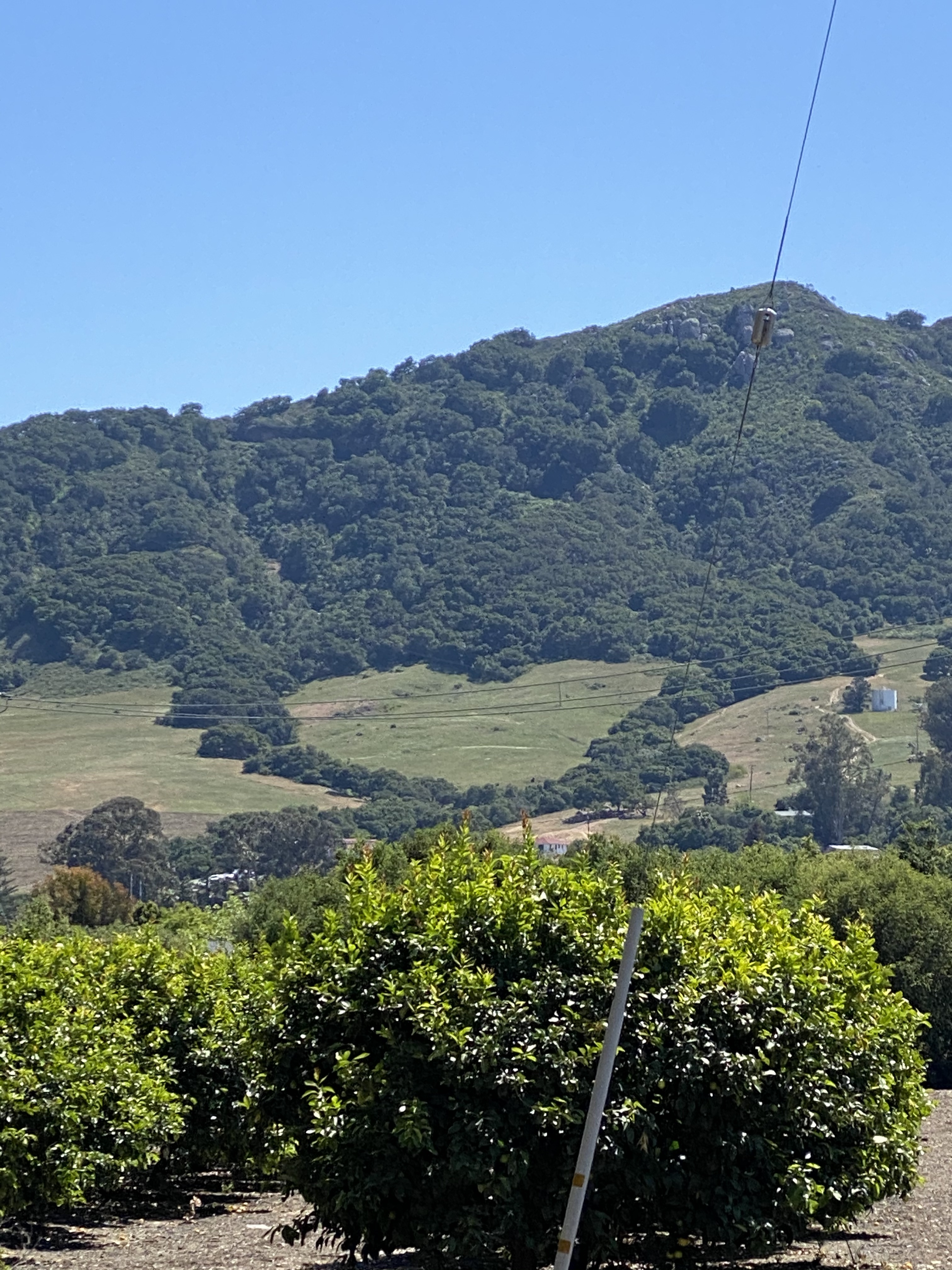
View from the Cal Poly lemon orchard, where the course SS 221 Soil Health and Plant Nutrition is taught. Note the heart shaped tree line in the rangeland above the orchard. A fitting reminder of our love for soil, agricultural, and our natural resources.
If you have any questions or comments about this lab manual or about the course SS 221 Soil Health and Plant Nutrition, please contact Charlotte Decock (cdecock@calpoly.edu)