Ragtime: Scott Joplin
Ragtime: Scott Joplin
This supplemental study and listening guide focuses on the best known composer of ragtime music, Scott Joplin, and his piece, the "Maple Leaf Rag." Some historical background has also been provided as well as information about Joplin's other musical works.
Ragtime music is a pre-jazz style, which means that some of its elements serve as the roots of jazz. Emerging in the 1890s in African American communities in the Heartland states, such as St. Louis, Missouri, ragtime was fully composed music for solo piano. It soon became popular in the South and Mid-West. Ragtime was often composed by minorities and women and played as dance music in saloons, brothels, bars, and theatres. Although it required skilled and expressive piano playing, it was not considered as serious music. Scott Joplin (ca 1867-1917) was the most famous ragtime music composer; however, he was not the inventor of this pre-jazz style or the first musician to have ragtime piece published. As of 2021, the first ragtime piece that was known to be published was Black minstrel show entertainer Ernest Hogan's (1865-1909) "La Pas La Ma" (1895) in St. Louis, Missouri--at the time, the home town of Scott Joplin. Just a few other early composers of ragtime music include May Aufderheide, Charlotte Blake, Eubie Blake, James Reese Europe, Sadie Koninsky, James Scott, Adaline Shepherd, and Percy Wenrich. Many composers continued writing rags and rag-inspired music after ragtime's height of popularity (1890s-1910s); just a few are Irving Berlin, George Gershwin, W. C. Handy, James P. Johnson, Jelly Roll Morton, and Fats Waller (in addition, classical music composers such as Claude Debussy and Igor Stravinsky also found inspiration in ragtime music). More details about Joplin and recording ragtime may be found in the next sections (scroll down).
What makes ragtime music a pre-jazz style? From ragtime and other pre-jazz styles like the blues, jazz embraced its used its sense of rhythmic swing as well as syncopation. Ragtime music was meant to be danced to, and a two-step style dance was named after the popular style. Music that uses rhythmic swing aims to encourage people to dance. Though rhythmic swing has other more complex meanings, especially later in jazz, the basic concept is to emphasize certain beats to create a swinging or dancing feeling. For ragtime and many kinds of jazz musicians, it's generally more important to play with rhythmic swing than to strictly follow the notation of the rhythm. Ragtime is composed in duple meter, which means that beats are grouped in twos. Because it is solo piano music, the left hand must furnish the bass while the right hand plays the melody. The register of an instrument is all of its pitches, from lowest to highest. Piano, like other instruments, has a lower register (the low notes half) and an upper register (the high notes half). While the pianist plays a straightforward duple meter with the left hand, the right hand plays a flowing melody that employs syncopation. The simplest definition of syncopation is to emphasize, stress, or place accents on the weak or unexpected beats. In duple meter, the first beat (the downbeat) usually gets the expected accent; however, with syncopation, the accent shifts over to the unexpected, weaker second beat:
Expected: 1 2 | 1 2 | 1 2 | 1 2 |.... (the first beat, the downbeat, gets stressed and is highlighted);
Unexpected: 1 2 | 1 2 | 1 2 | 1 2 |.... (the second beat, or weaker beat, gets stressed and is highlighted here; this is an example of basic syncopation)
The simple example of syncopation places an emphasis on the weak beat. Some ways to hear this emphasis is that the accented beats sound heavier, slightly louder, and slightly lengthier than the other beats. A more complex example of syncopation is also used. Not only can syncopation take place on the beat, it can take place in between the beats. These are called the and beats or off beats. For beginning music students, complex syncopation is difficult to grasp; however it can be heard. Take, for example, Joplin's "The Entertainer" (1902), which was played by the composer himself. Play this piece (the link appears below) for a couple moments, then find the duple meter beat first (listen to the low register, the bass or left hand--keep in mind that the left hand really plods along to the meter, very steadily). Second, clap, tap, or say the beats (count 1 2 | 1 2 | ...). Once you've found the beat, then stress beat two (count 1 2 | 1 2 |...) by saying the beat louder or clapping or tapping more heavily on it. Once you can feel the simple syncopation, then keep counting and notice what the right hand is doing. As it plays the melody, it sometimes plays on the left hand's beat and other times it seems to flow in between the beats. That flowing feeling that goes in between the beats is the sensation of the more complex syncopation. It may take a couple times to find both the simple and complex examples of syncopation:
Scott Joplin, "The Entertainer"
Scott Joplin's "The Entertainer", Published in 1902 and Performed Here by James Brigham in 2018. Source: Musesource.com (https://musescore.com/james_brigham/the-entertainer) and Wikimedia Commons. Attribution: Scott Joplin, James Brigham. License: Public domain.
As with most ragtime pieces, "The Entertainer" should be performed at a moderate speed. The tempo is the speed of music. Ragtime music is a lot of fun to play and therefore musicians sometimes rush. The moderate tempo encourages people to dance in addition to the piece's used of rhythmic swing.
Another reason that ragtime is a pre-jazz musical style is that its melodies became sources for early jazz pieces. Dixieland, which took place as early as the late 1890s in New Orleans, used ragtime melodies for band arrangements. The syncopation used in ragtime was often described as "ragged rhythms." Dixieland musicians also created jazz by taking popular tunes, marches, and spirituals by "ragging" their melodies.
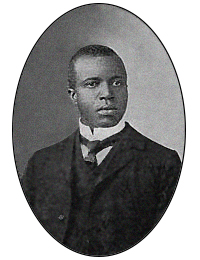 Portrait of Scott Joplin. First published in St. Louis Globe-Democrat newspaper, June 7, 1903.
 Source: Library of Congress. Attribution: Unknown. License: Public domain.
Details on Joplin's life remain unclear, though music scholars have been able to piece information together. Joplin was born around 1868 in Texas. According to Edward A. Berlin in King of Ragtime: Scott Joplin and His Era, 2d ed. (Oxford, 2016), Joplin's father, Giles Joplin, a former slave born in North Carolina, was a railroad worker, and his mother, Florence Givens, a freeborn Black woman from Kentucky, was a laundress (Berlin 2016, 3). Because of the transient nature of Giles Joplin's work, the family moved at least a couple of times before settling in 1880 in Texarkana. Shortly afterwards, Joplin's parents separated; however, Giles Joplin remained in contact with his six children after moving in with another woman.
Joplin's family was musical: his father played violin and his mother played banjo and was also a singer. It is likely that Scott Joplin's earliest music instruction came from his parents and he may have started playing piano at a younger age before living in Texarkana. By 1881 or 1882, his mother purchased a piano for him (Jerry L. Atkins, "Early Days in Texas," Rag Times [Sept. 1972], 1, cited in Berlin 2016, 4). Several school teachers contributed to Joplin's musical instruction, but his most important teacher at the time was Julius Weiss, a German-born American Jewish teacher, who taught music among a variety of subjects. Joplin, a serious and talented pianist, was one of several students that Weiss taught for free. Through Weiss, Joplin received some classical music training as well as opportunities to explore and play folk music. The two remained lifelong friends (Berlin 2016, 5-6).
By the end of the 1880s, Joplin, who was following the footsteps of his family by also becoming a railroad worker, quit is job to become a professional traveling performer. He worked mostly in the South; however, in 1893, he attended the World's Fair in Chicago, which introduced and promoted ragtime music to a broad audience and led to ragtime dance's becoming a national dance craze. Joplin continued his career as a traveling musician, but in 1894 he made his home in Sedalia, Missouri, where he taught piano lessons, performed in saloons and brothels, and began composing and publishing ragtime music. In 1897, his first rag, titled "Original Rags," was published by Carl Hoffman in Kansas City, Missouri.
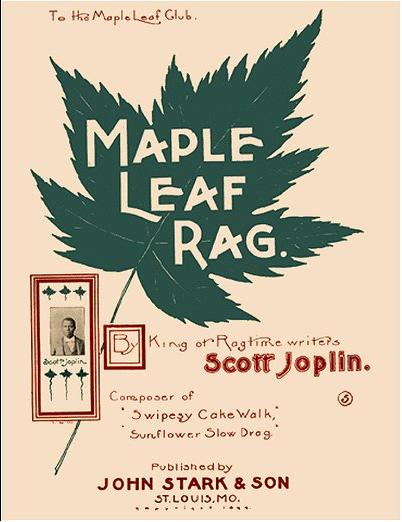 Copy of Sheet Music for "Maple Leaf Rag,"
 Published in U.S. Pre-1923.
Source: Wikimedia Commons.
Attribution: Scott Joplin, published by John Stark.
License: Public domain.
His next published rag, "Maple Leaf Rag" (1899), would become his greatest success in his lifetime. Joplin approached several publishers before attaining a contract with John Stark in St. Louis, Missouri. It took a few months before the piece began to sell steadily and Joplin's royalty agreement was for just one cent of any sale that had to be above twenty-five cents (Berlin 2016, 69). The publisher continued reissuing the song, using various sheet music covers and editions. The revenue from the sales of "Maple Leaf Rag" provided Joplin with a continuous yet modest income.
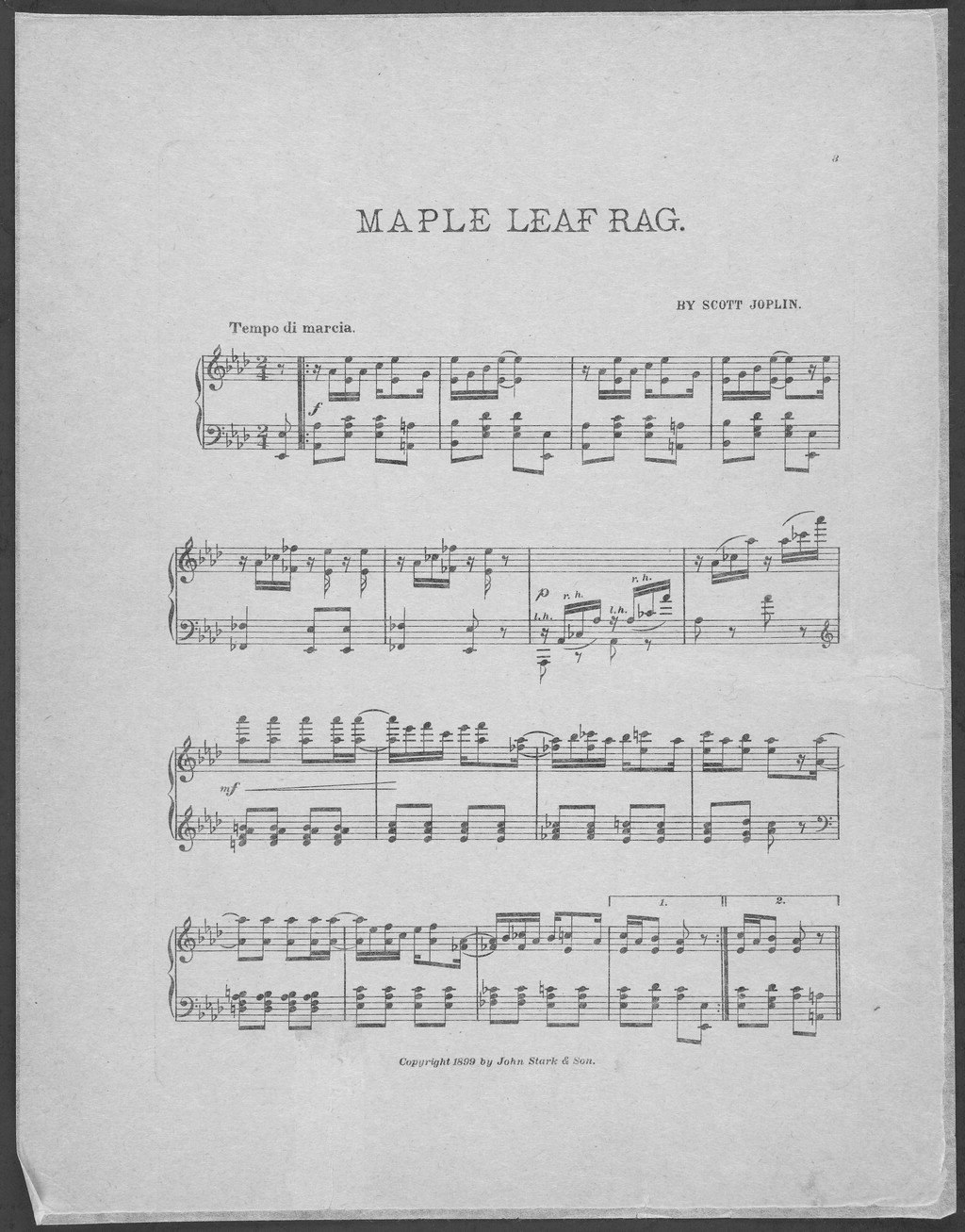 "Maple Leaf Rag," First Edition Sheet Music, Part 2 of 4.
 Source: Wikimedia Commons and Library of Congress.
Attribution: Scott Joplin, published by John Stark.
License: Public domain.
The eventual success was enough to encourage Joplin to continue composing rags and, in 1900, he moved to St. Louis--the creative epicenter of ragtime music. One of his residences has become a museum, the Scott Joplin House:
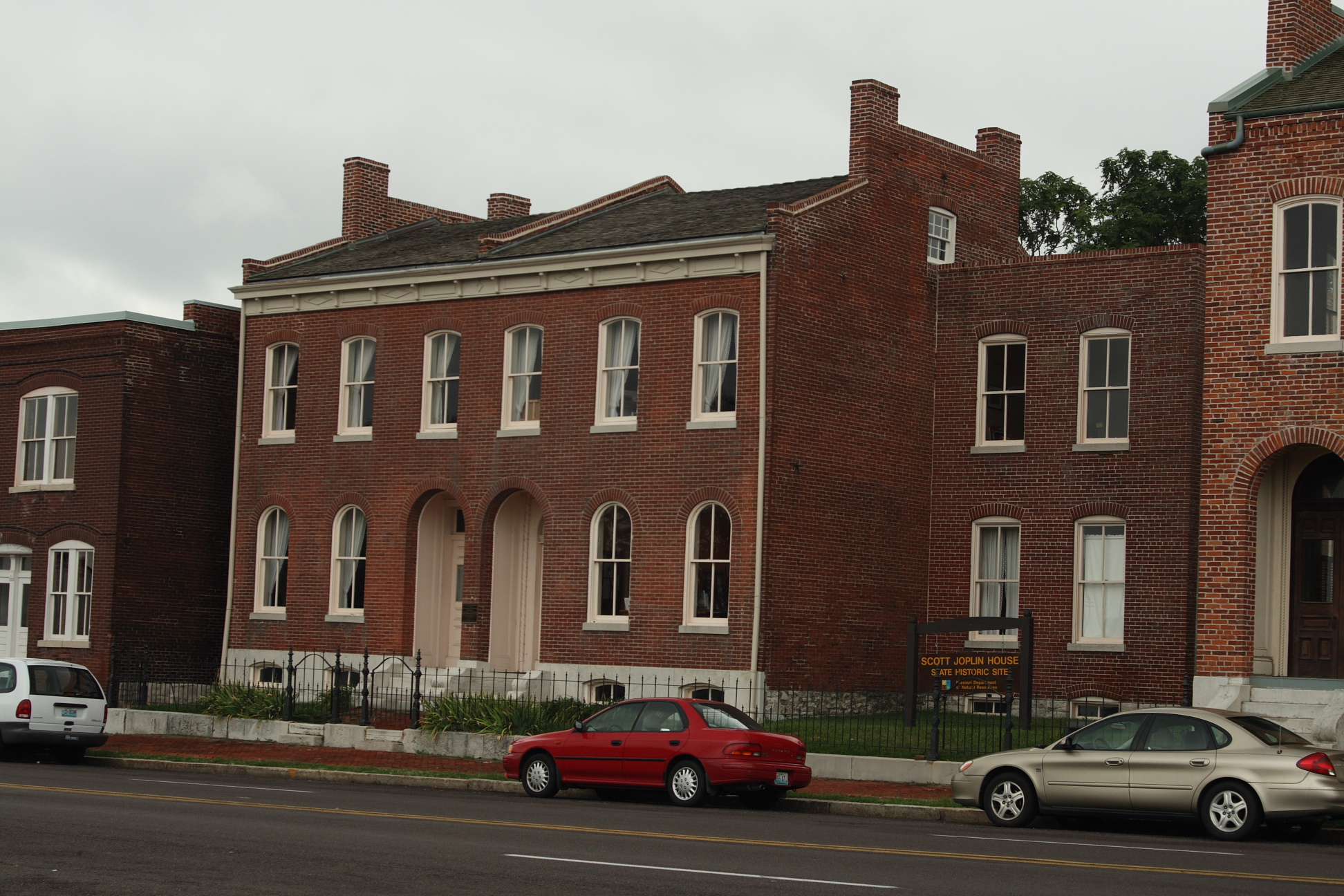 Scott Joplin House.
 Source: Flickr and Creative Commons.
Attribution: Matthew Black.
License: CC BY-SA 2.0.
The museum continues to preserve rooms in Joplin's house, kept the way he likely had them when he lived there with items that date from his time, including an upright piano in his living room.
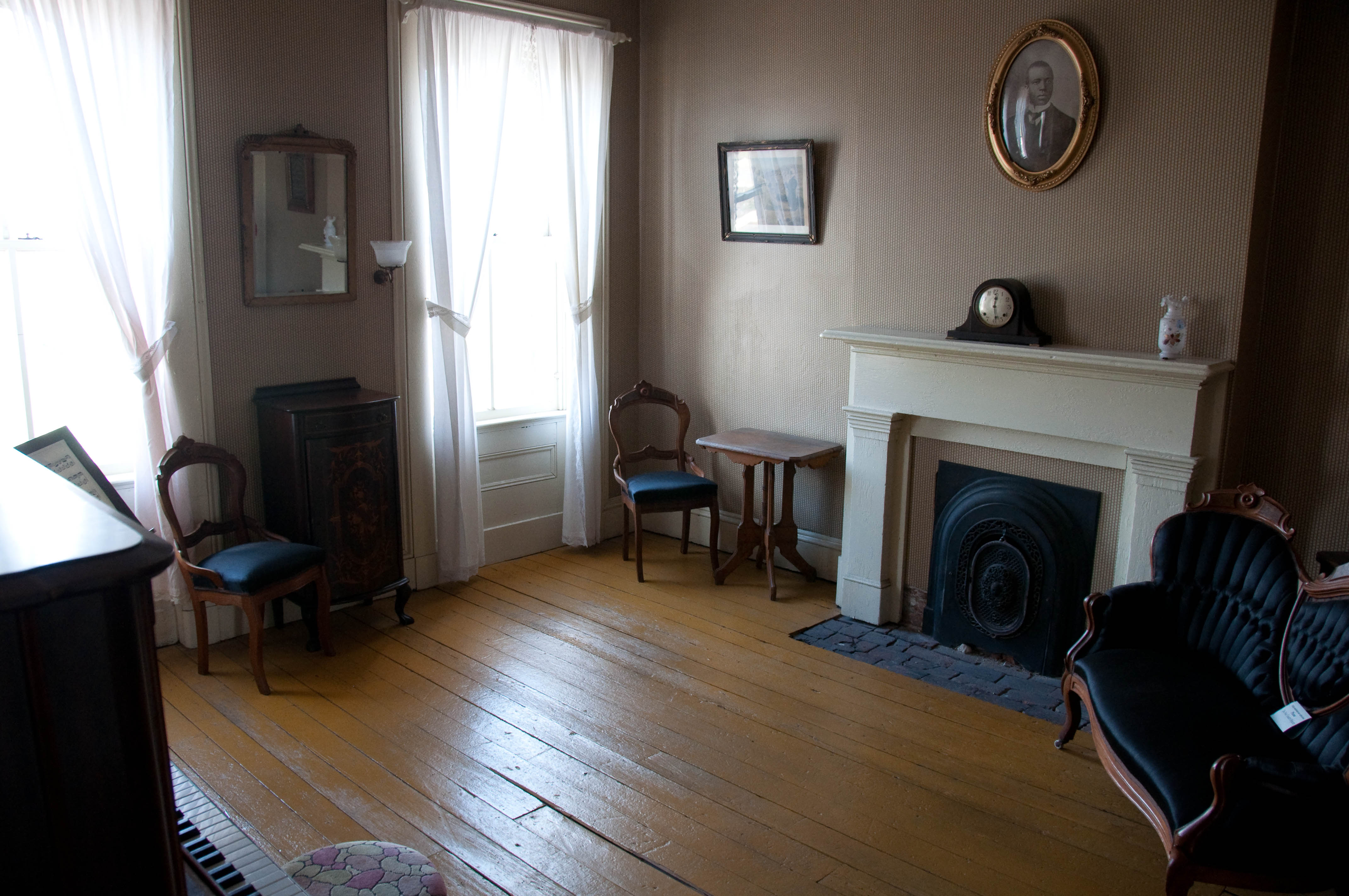 What Scott Joplin's Room Might Have Looked Like.
 Scott Joplin House (Inside).
Source: Flickr.
Attribution: Herkie (Dave Herholz).
License: CC BY-SA 2.0.
In St. Louis, he composed "The Entertainer" (1902) and focused more on composition and teaching, no longer performing in saloons and brothels.
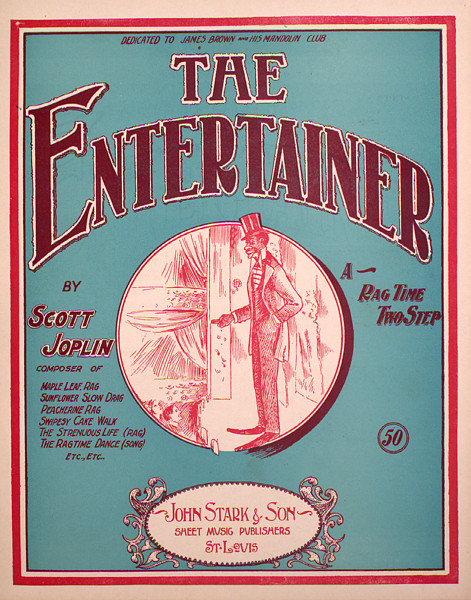 "The Entertainer" Sheet Music Cover.
 Sheet Music Published by John Stark & Son, St. Louis, 1902.
Source: Wikimedia Commons.
Attribution: Scott Joplin, published by John Stark & Son.
License: Public domain.
Included below is the opening page of "The Entertainer," which begins with the instruction "not fast." Although ragtime music requires a lot of skill and coordination, it is also a lot of fun to play. Unfortunately, many musicians play this popular rag at a tempo much faster than originally intended. Generally, ragtime music favors a moderate tempo--about the speed of a casual walking pace.
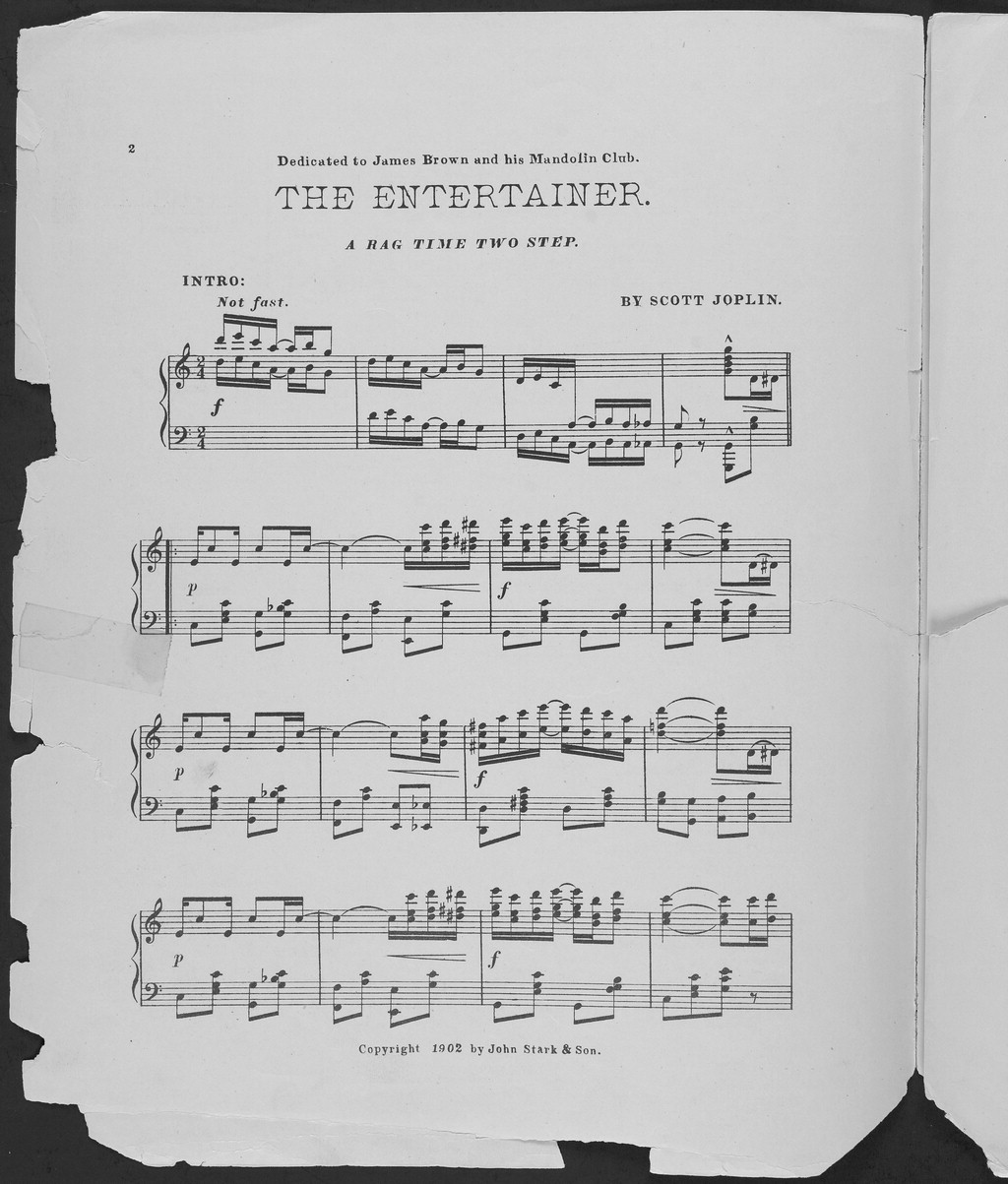 "The Entertainer" (Sheet Music), Page 2 of 5.
 Sheet Music Published by John Stark & Son, St. Louis, 1902.
Source: Wikimedia Commons and Library of Congress.
Attribution: Scott Joplin, published by John Stark & Son.
License: Public domain.
Listening to "The Entertainer" can help with understanding and appreciating ragtime music. Played at the correct moderate tempo--as Joplin instructs, "not too fast"--it's easy to notice that this piece has an introduction with multiple sections, which is typical of a rag. Because it is a bit slower than "Maple Leaf Rag," the piece that is the focus of the listening guide here, a steady beat of the left hand in the first section after the introduction is demonstrated. Also shown is how both hands use the piano's register: not only is the low hand playing the bass and low register of the instrument; it sounds like it bounces between a bass pitch and chords (two or more pitches played at the same time). Because of the straightforward sound of the left hand, stressing duple meter, syncopation can be identified. As with any rag, beat 2 receives the accent or stress. This is the simple syncopation. The more complex syncopation can be heard with the right hand part, which at times flows over the left hand part and plays in between the left hand's beats. On the sheet music page shown above, the right hand part has notes that continue on over the measure or bar lines. The syncopation of the right hand part also runs over the bar lines; the right hand continues on from the previous measure rather than playing a note on the expected downbeat of the next measure. You may listen to "The Entertainer" here:
Scott Joplin's "The Entertainer," performed by James Brigham in 2018.
"The Entertainer" (1902), performed by James Brigham (2018). Source: Wikimedia Commons. Attribution: Scott Joplin, James Brigham. License: Public domain.
It may seem that his success from "Maple Leaf Rag" was one reason why Joplin no longer worked in these venues, but another possible reason may have been, according to Berlin, that around this time he was experiencing deteriorating piano playing skills due to contracting syphilis, a sexually transmitted infection (Berlin 2016, 130). Recordings made of Joplin's piano playing years later demonstrate that the infection ultimately affected his piano playing. The following is a recording of his "Maple Leaf Rag," performed by Joplin in 1916, just before his health declined rapidly.
Piano Roll Recording of Joplin Playing "Maple Leaf Rag" in 1916.
MIDI conversion by PlayerRoll. Re-recorded as audio by Major Bloodnok using Cubase. The original Piano Roll had been scanned and converted to a MIDI file by PlayerRoll, but the work remains in the public domain. This is one of a number of rare recordings by Joplin. It also demonstrates the deterioration of his health, specifically its impact on his piano playing. Source: Wikimedia Commons. Attribution: Scott Joplin. License: Public domain.
Better examples of the piece may be easily found on the Internet, including on this page in the Listening Guide below, under the heading "Maple Leaf Rag."
As mentioned in the previous section (scroll above), even though ragtime music required skilled and expressive piano playing, it was not received as serious music. Even though "Maple Leaf Rag" eventually sold steadily and became highly influential, years later, Joplin's St. Louis publisher, John Stark, included this unsigned cartoon on the back cover of white composer Joseph Lamb's "American Beauty Rag" (1913), which parodies ragtime piano playing and Joplin's "Maple Leaf Rag":
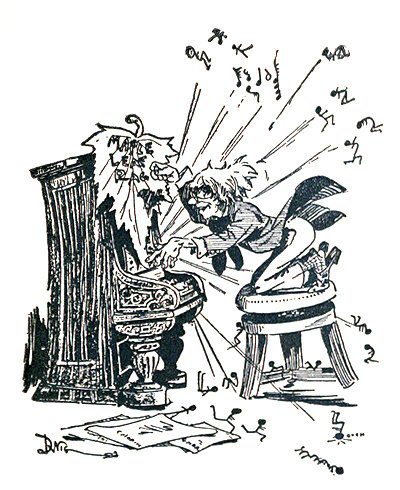 Cartoon of a Man Playing Scott Joplin's "Maple Leaf Rag."
 Advertisement on the back cover of the sheet music for Joseph Lamb's "American Beauty Rag."
Source: Wikimedia Commons and Library of Congress.
Attribution: Unknown, published by John Stark.
License: Public domain.
The reception of ragtime music varied despite its popularity and the national ragtime dance craze. While a diverse audience enjoyed the music, many dismissed it as a kind of low-class music. In addition to brothels and saloons, where the music was played, rags were also used in both white and Black minstrel shows, early nineteenth-century entertainment that was racist. In a variety of skits, dances, and songs performed in front of audiences, minstrel shows used blackface to generate, promote, and normalize racist stereotypes of African Americans. Rags did originate independently from minstrel shows; however, the association with these show persisted. Publishers printed covers of ragtime music with extremely negative depictions of Black people, exaggerating physical features. Even though ragtime music was also composed by white musicians, sheet music covers like this one for May Aufderheide's "Dusty" (1908) were created and used to sell the music:
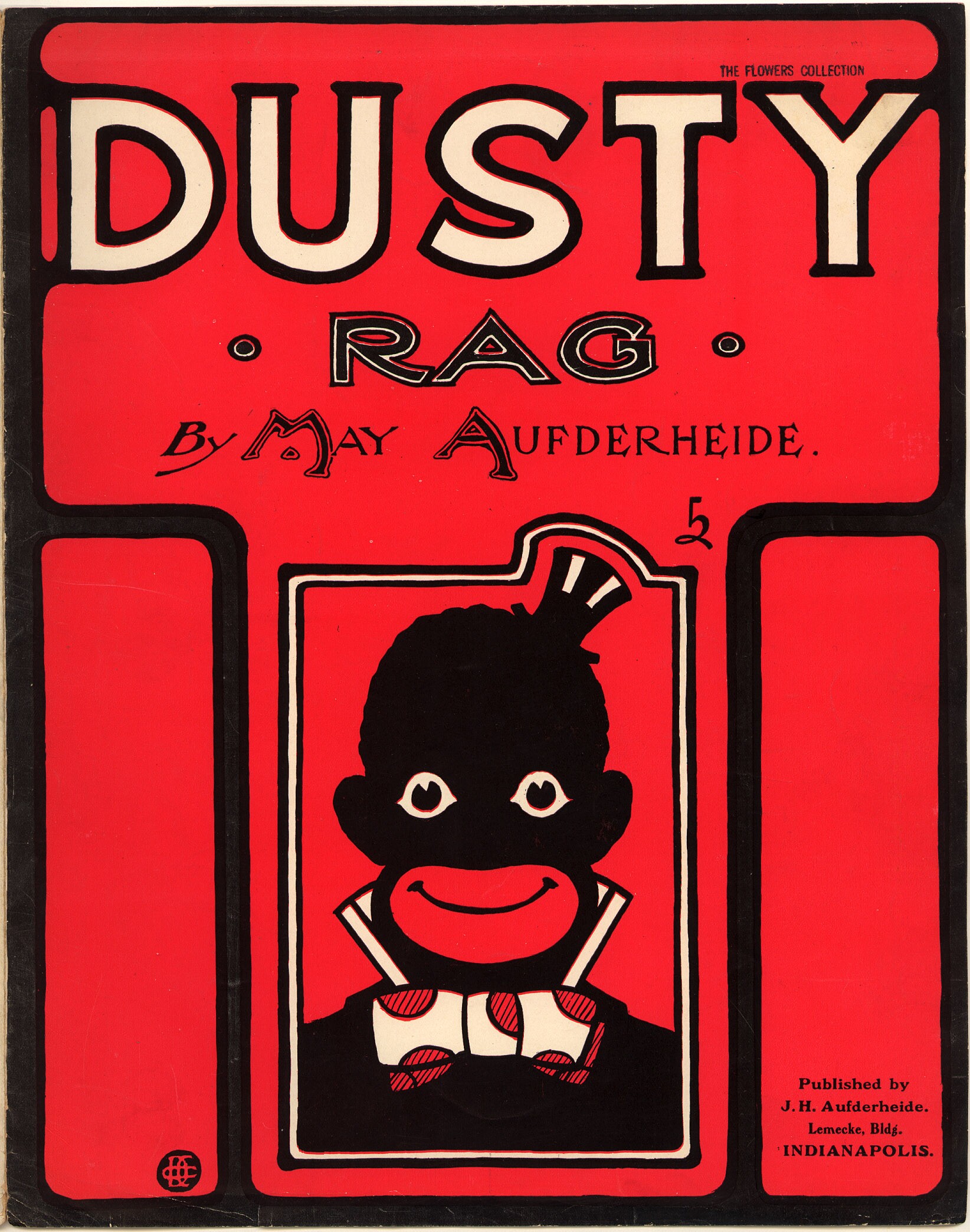 "Dusty Rag" (sheet music) page 1 of 4.
 Published in 1908.
Source: Duke University Historic Sheet Music Collection and Wikimedia Commons.
Attribution: May Aufderheide, Cecil Duane Crabb, published by J. H. Aufderheide.
License: Public domain.
The ragtime two-step dance traces its roots to the cakewalk, a kind of dance that was originally a slave practice on Southern plantations that involved dancing to music to win a prize, often a cake. Inspired by another musical practice on these plantations, the ring shout, the dancers moved in circles, shuffling their feet. The cakewalk is often described as a "grotesque dance." Rather than awarding the prize to the most beautifully executed steps, it was awarded to the best comical mockery. The dances subversively poked fun at slave owners--sometimes the slave owners would attend the cakewalks and not be aware that they were the ones being laughed at and imitated. Composed after "The Entertainer" in 1902, Joplin wrote "The Ragtime Dance." This piece, discussed briefly below (scroll down to see the cover of the sheet music), included lyrics by Joplin himself that mentions the cakewalk.
Joplin himself always had ambitions to compose serious concert music. He composed his first opera, A Guest of Honor, registering the work for copyright in 1903 before submitting a finished composition. His opera was inspired by Black civil rights leader and educator Booker T. Washington's 1901 visit to the White House, where President Theodore Roosevelt hosted a dinner for him, later receiving criticism for having done so. With his earnings from "Maple Leaf Rag" and other rag publication, Joplin formed a small touring company, who performed the opera. In either Springfield, Illinois or Pittsburg, Kansas, the box office receipts were stolen and Joplin was unable to pay the bill for the company's lodgings. The score for A Guest of Honor was confiscated among Joplin's belongings and remains lost. An advertisement for a performance of A Guest of Honor mentions that the work was a ragtime opera, suggesting that it contained rag music:
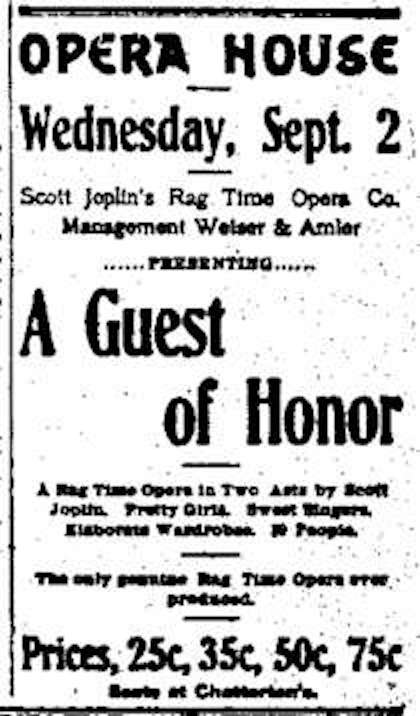 1903 Advertising poster for A Guest of Honor by Scott Joplin.
 Source: Wikimedia Commons. Attribution: Unknown. License: Public domain.
In 1907, Joplin moved to New York City with the ambition to work on a second opera and find a producer there. He completed Treemonisha in 1910 but was unable to find a producer, so he financed the production himself. Unlike A Guest of Honor, the score for Treemonisha is found and survives.
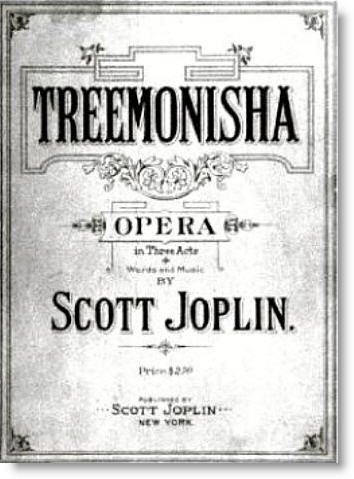 Cover of sheet music to the opera Treemonisha by Scott Joplin.
 Sheet music self-published in New York City in 1911 by Scott Joplin.
Source: Wikimedia Commons. Attribution: Scott Joplin. License: Public domain.
The three-act opera, which is a serious European-inspired work, just uses ragtime music for its dance episodes. Another kind of African American music, the spiritual, is also used. The heroine whom the opera is named after, becomes a freedwoman and learns how to read. She returns to her community, a slave plantation that is isolated in a forest in Texarkana, and tries to lead through literacy and education. But conjurers who prey on ignorance and superstition initially convince her community to not follow her and they kidnap Treemonisha. Just before she gets thrown into a wasp's nest, she is rescued. The opera concludes happily as she returns to her community to learn that they have captured the conjurers. Treemonisha convinces her community to release them. Understanding the value of literacy and education over ignorance and superstition, the community asks for her to become their leader. Joplin's libretto is much weaker than his music, though his opera contains a powerful message about education and celebrates African American culture and music. Joplin never lived to see a staged production of this opera. In 1915, he paid for a read-through, which took place in front of an audience and critics at Lincoln Theater in Harlem. The critics panned the performance and the opera fell into obscurity until the early 1970s.
In 1917, Joplin died of dementia resulting from syphilis at Manhattan State Mental Hospital. He was about 48 years old. Joplin was buried in an unmarked pauper's grave. Many years later, in 1970, pianist Joshua Rifkin released Scott Joplin: Piano Rags, which received critical acclaim and sold over a million copies. In 1974, the Academy Award-winning American motion picture The Sting, which prominently featured Joplin's rags in its score helped spark a resurgence in popularity.
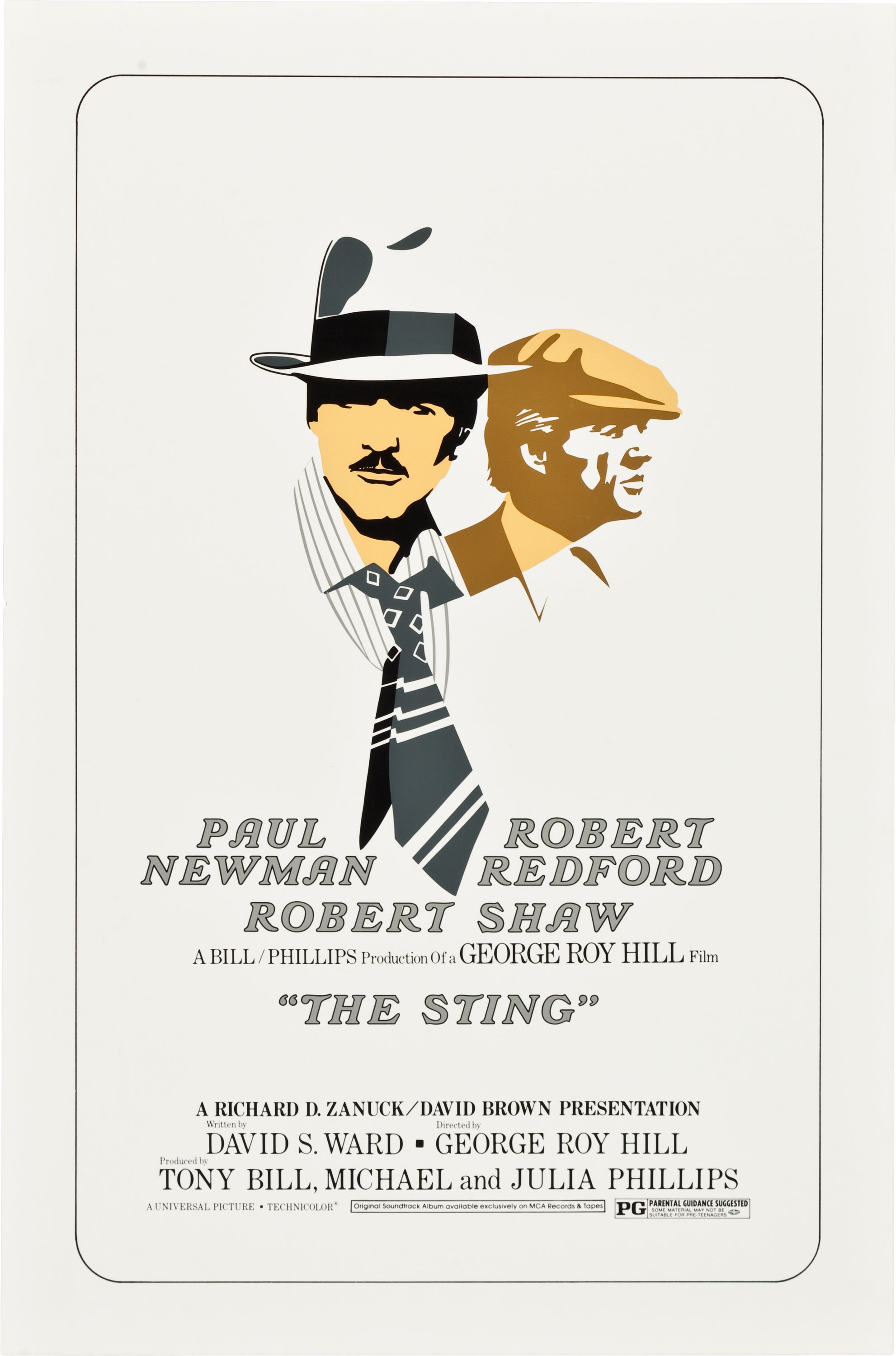 An Alternate Poster for the American Theatrical Release of the 1973 film The Sting.
 Source: Wikimedia Commons, Scan by Heritage Auction.
Attribution: Unknown. License: Public domain.
The rag that became the most popular from this film was "The Entertainer," which was discussed earlier in this resource (scroll up). A link to a recording has also been provided.
Joplin's grave received a marker and, in 1976, he was awarded a special Pulitzer Prize in Music. In 1979, he also received a star on the St. Louis Walk of Fame.
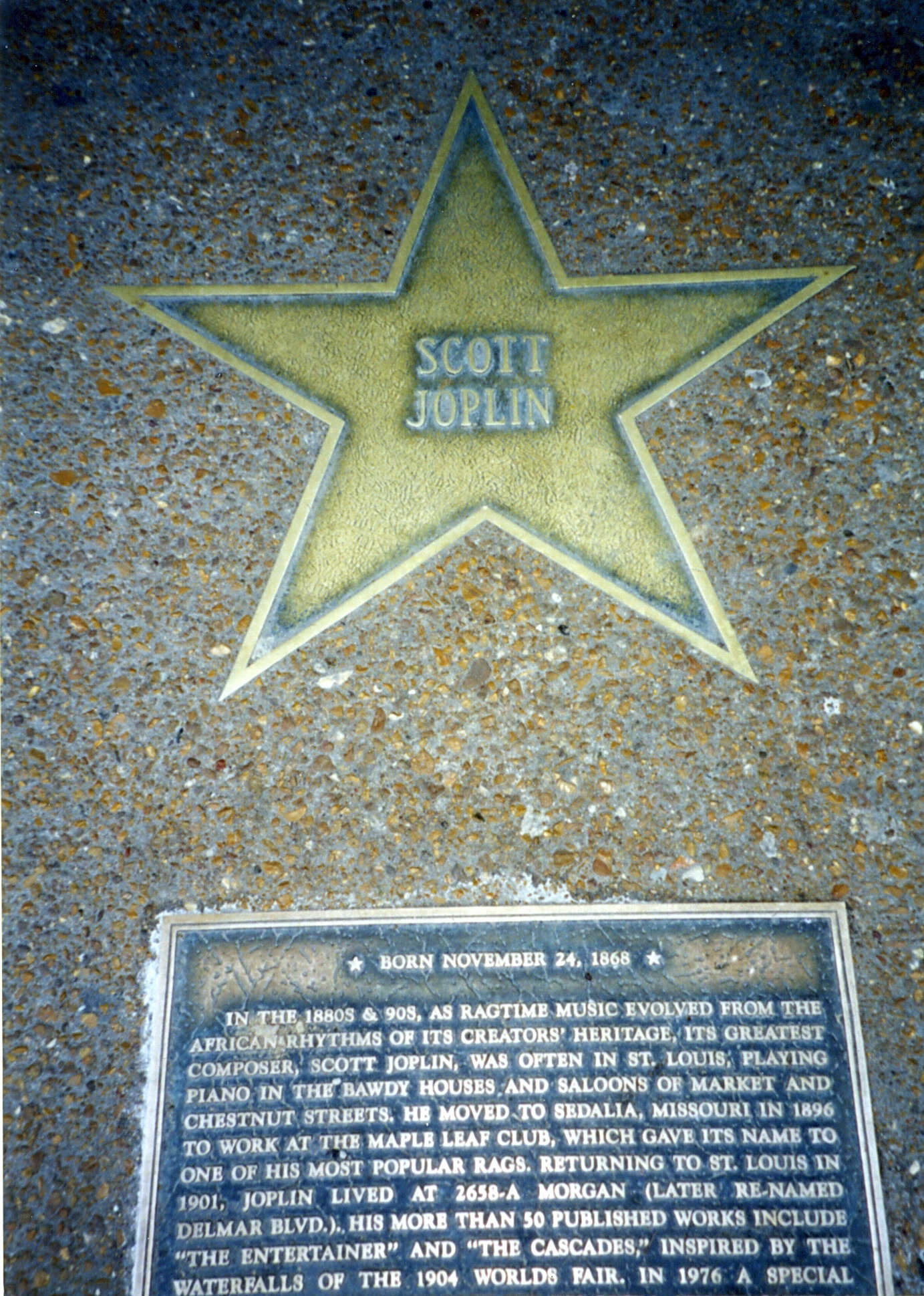 Scott Joplin's Star on the St.Louis Walk of Fame, 6504 Delmar Boulevard, St.Louis, MO.
 Source: Wikimedia Commons.
Attribution: E. Coman.
License: CC BY-SA 3.0 and Gnu Free Documentation License.
There is also a historical marker that commemorates Joplin's life in Texarkana, but the marker has become the target of racist vandalism:
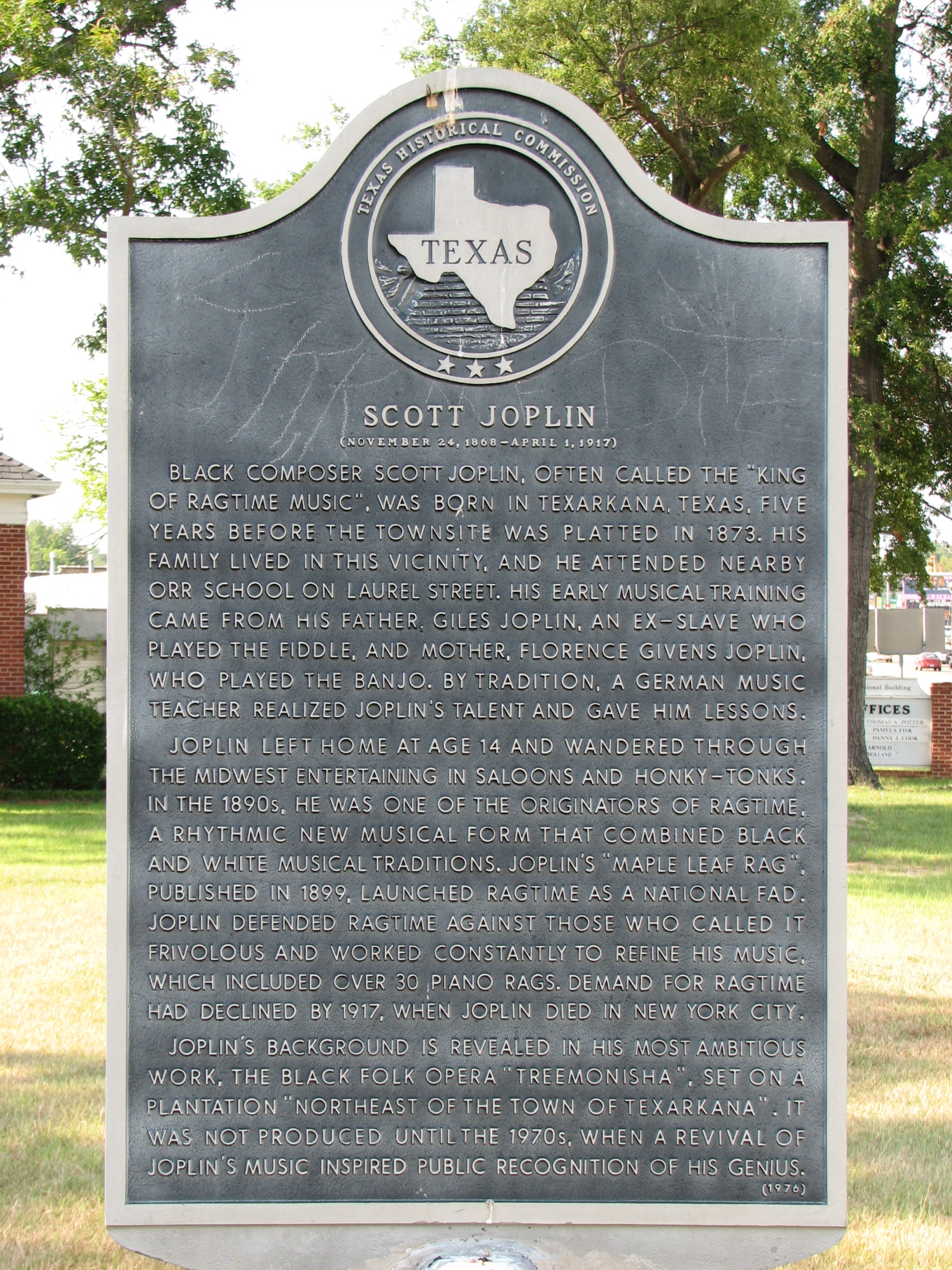 Scott Joplin Texas Historical Marker.
 Source: Wikimedia Commons and Flickr.
Attribution: QuesterMark.
License: CC BY-SA 2.0.
For years, Joplin's Wikipedia entry has also been vandalized and is known among music historians and scholars as being one of the most vandalized entries for a composer.
During the early 1900s, Joplin was recorded playing his songs on a mechanical recording piano, which produced piano rolls. The upright piano shown here was built slightly after Joplin's time; however, opened completely, the rolls can be seen, in addition to other parts of the recording piano's "antomy"--including its strings, hammers, and pedal connection.
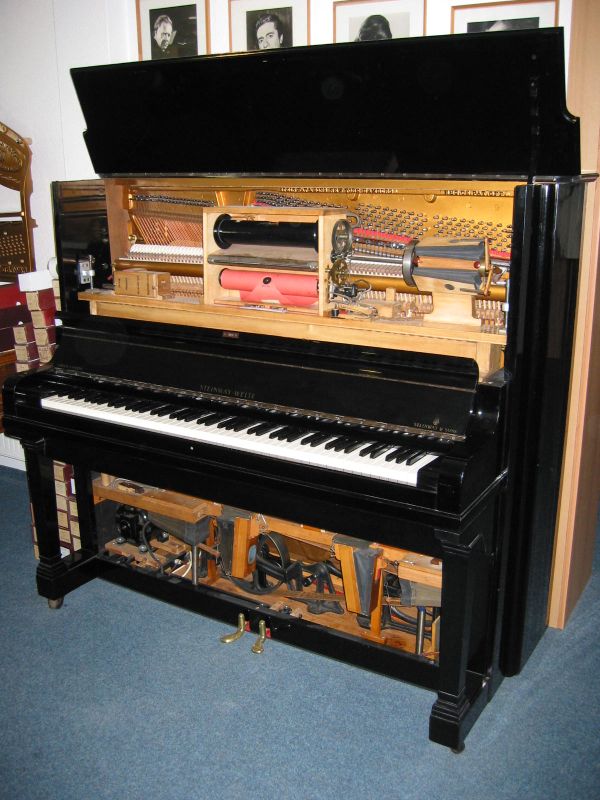 Steinway-Welte Klavier 1919 (Reproducing Piano).
 Source: Wikimedia Commons.
Attribution: KarlKunde.
License: CC BY-SA 3.0 and Gnu Free Documentation License.
Recordings made from the rolls that Joplin made have been selected in 2002 by the National Recording Preservation Board of the Library of Congress as "culturally, historically, or aesthetically significant." Below is a close-up of the roll on a player piano. The roll, which is made out of paper, is perforated where the notes were played and recorded.
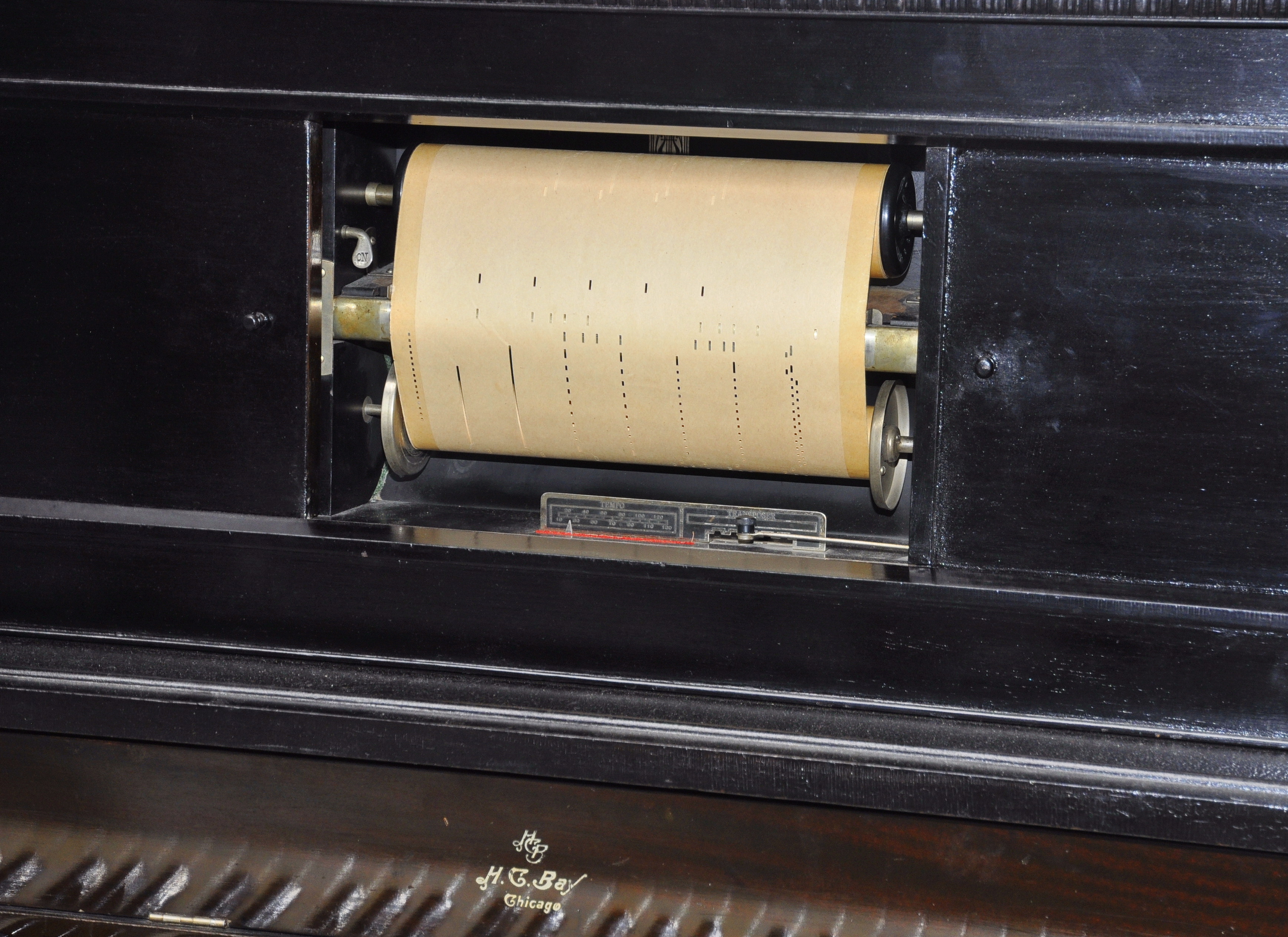 American Player Piano with Rolls H. C. Bay, USA, from 1909-1917.
 Source: Wikimedia Commons and Museum of Science and Technology Belgrade.
Attribution: Miloš Jurišic.
License: CC BY-SA 3.0.
Ragtime music consists of several sections of music that get labelled according to their melodies by letter. "Maple Leaf Rag" is typical for its multiple sections as well as for its use of duple meter and syncopation (see A Brief Introduction to Ragtime Music by scrolling to the beginning of this page). The sections are AA BB A CC DD.
It takes a couple times before some melodies or main tunes can be identified from memory. Listen for the first section and how it repeats. Letters represent a completely different melody, so after the A sections repeat, the new music is labeled as B and it also repeats. Section A returns, but only once. The piece concludes with completely different music from the beginning A and B sections and the new sections are labeled as C and D, which also repeat. Another word used for these sections is strain. "Maple Leaf Rag" differs from most rags for its use of four rather than three strains (or sections). Listen for these strains now in this example of the piece:
William J. Leslie's Recording of Joplin's "Maple Leaf Rag"
Recording of Scott Joplin's "Maple Leaf Rag." Source: Wikimedia Commons. Attribution: Scott Joplin, William J. Leslie. License: Public domain.
In comparison to "The Entertainer," "Maple Leaf Rag" is more complex and challenging to play, yet it contains syncopation that can be identified. Listen for the emphasis on beat 2 in the pianist's left hand or lower register. Even though the left hand moves a lot, it plods along and gives the piece its steady beat. Remember, ragtime music is meant for dancing. Counting the beat and finding its simple syncopation is a way to listen to the piece actively. Swing a little bit while clapping, tapping, or saying the beats and stressing beat 2. More complex syncopation can be heard, too. Notice how the right hand's melody flows over the left hand's beat, sometimes falling in between the beats. For listeners with some musical background, the complex syncopation is created by note lengths that are shorter than the beat. Tied notes are also used. Typically, dotted notes will also be used to create complex syncopation.
"Maple Leaf Rag" has a left hand piano part that is harder to hear than "The Entertainer"; however, the steady left hand reinforces the beat and serves as the bass of the piece. Syncopation is challenging to sense and may require some listening practice, so don't be discouraged if you cannot observe it right away. Play the piece a few times, think about it, and play it again later. If it is still difficult to observe, listen to "The Entertainer" (discussed in this source) to see how syncopation works in that piece.
Ragtime is a two-step style dance that focuses on the steady beat of the left hand. After "Maple Leaf Rag" and close to the time that he published "The Entertainer," Joplin published a rag that was titled "The Ragtime Dance" (1902):
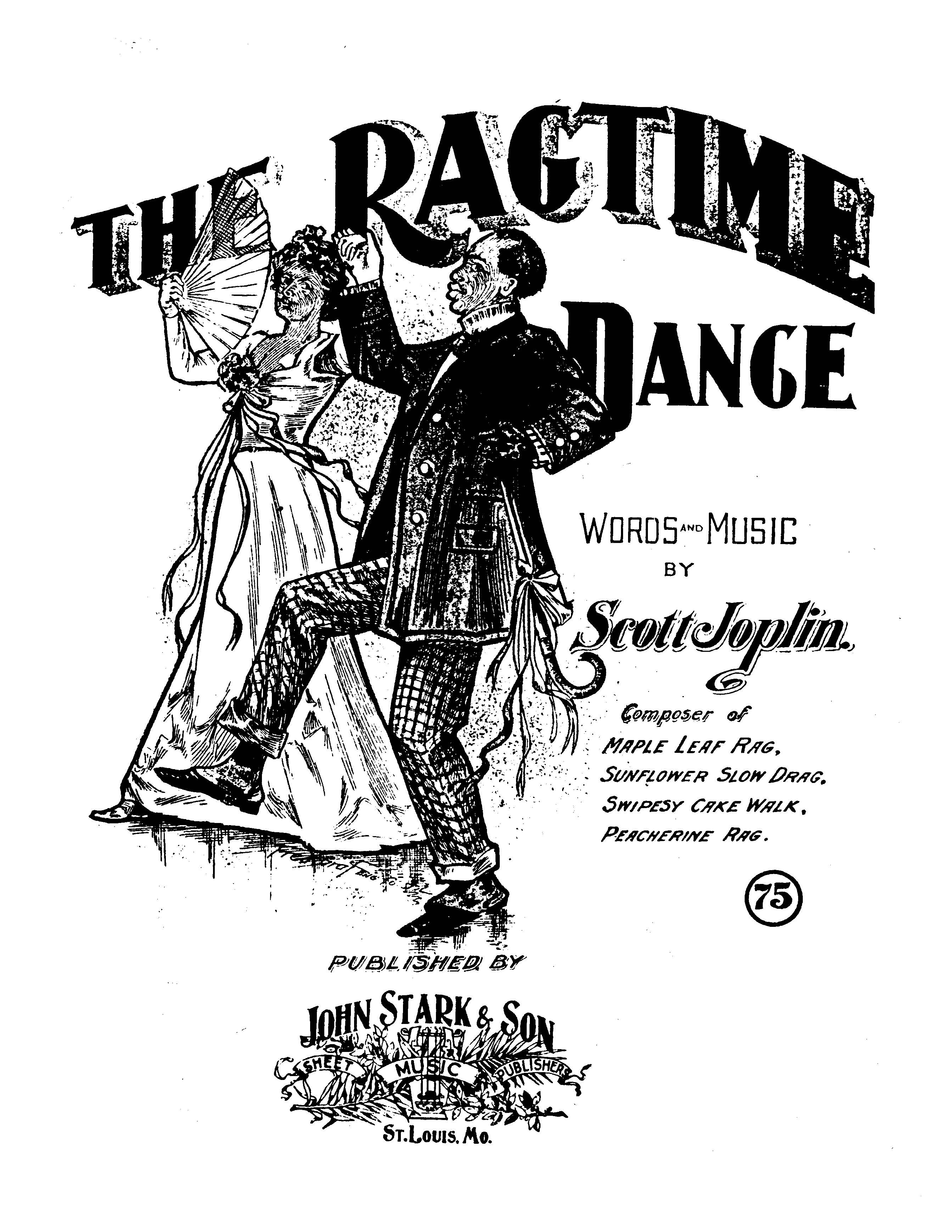 Sheet Music Published by Stark Music Co., 1902
 ("Ragtime Dance" by Scott Joplin).
Source: Wikimedia Commons.
Attribution: Scott Joplin, Stark Music Co.
License: Public domain.
Ragtime music such as "Maple Leaf Rag," "The Entertainer," and "The Ragtime Dance" have also been traditionally used as repertory to accompany tap dancing. The steady beat and moderate tempo help to reinforce the rhythm of the steps of both kinds of dancing. A set of tap steps known as the "shim-sham" is common knowledge among tap dancers, who use "Maple Leaf Rag" and other rags as a point of reference for a steady beat. Like the cakewalk, the shim-sham employs shuffling and dancers break when the music breaks between some sections.
The following information is listed here by order of appearance on this page (from top down to bottom):
Acoustic Guitar with Seashell. Source: Wikimedia Commons. Attribution: Melissa Ursula Dawn Goldsmith. License: CC BY-SA. https://commons.wikimedia.org/wiki/File:Acoustic_Guitar_with_Seashell_Inlay.jpg.
Scott Joplin's "The Entertainer", Published in 1902 and Performed Here by James Brigham in 2018. Source: Musesource.com (https://musescore.com/james_brigham/the-entertainer) and Wikimedia Commons. Attribution: Scott Joplin, James Brigham. License: Public domain. https://upload.wikimedia.org/wikipedia/commons/b/bd/%22The_Entertainer%22_%281902%29%2C_by_Scott_Joplin.mp3.
Portrait of Scott Joplin. First published in St. Louis Globe-Democrat newspaper, June 7, 1903. Source: Library of Congress. Attribution: Unknown. License: Public domain. http://lcweb2.loc.gov/diglib/ihas/loc.natlib.ihas.200035815/default.html and https://commons.wikimedia.org/w/index.php?curid=4867462.
Copy of Sheet Music for "Maple Leaf Rag," Published in U.S. Pre-1923. Source: Wikimedia Commons. Attribution: Scott Joplin, published by John Stark. License: Public domain. https://commons.wikimedia.org/w/index.php?curid=6568621.
"Maple Leaf Rag," First Edition Sheet Music, Part 2 of 4. Source: Wikimedia Commons and Library of Congress. Attribution: Scott Joplin, published by John Stark. License: Public domain. https://commons.wikimedia.org/w/index.php?curid=4647300 and http://lcweb2.loc.gov/diglib/ihas/loc.natlib.ihas.200033264/full.html.
Scott Joplin House. Source: Flickr and Creative Commons. Attribution: Matthew Black. License: CC BY-SA 2.0. https://live.staticflickr.com/1421/1383091365_179af02df2_b.jpg and https://search.creativecommons.org/photos/3bffd821-f5d5-4381-9dcd-f48b140275f1.
What Scott Joplin's Room Might Have Looked Like. Scott Joplin House (Inside). Source: Flickr. Attribution: Herkie (Dave Herholz). License: CC BY-SA 2.0. https://live.staticflickr.com/2786/4439478291_a4d31f4781_b.jpg and https://www.flickr.com/photos/44038067@N00/4439478291.
"The Entertainer" Sheet Music Cover. Sheet Music Published by John Stark & Son, St. Louis, 1902. Source: Wikimedia Commons. Attribution: Scott Joplin, published by John Stark & Son. License: Public domain. https://commons.wikimedia.org/w/index.php?curid=4073800 and https://commons.wikimedia.org/w/index.php?curid=4073800. The source also provides another link, which contains further information on Joplin: See http://www.ragtimepiano.ca/rags/joplin.htm.
"The Entertainer" (Sheet Music), Page 2 of 5. Sheet Music Published by John Stark & Son, St. Louis, 1902. Source: Wikimedia Commons and Library of Congress. Attribution: Scott Joplin, published by John Stark & Son. License: Public domain. https://commons.wikimedia.org/w/index.php?curid=4954819 and http://lcweb2.loc.gov/diglib/ihas/loc.natlib.ihas.200033252/contactsheet.html.
"The Entertainer" (1902), performed by James Brigham (2018). Source: Wikimedia Commons. Attribution: Scott Joplin, James Brigham. License: Public domain. https://commons.wikimedia.org/wiki/File:%22The_Entertainer%22_(1902),_by_Scott_Joplin.mp3.
Piano Roll Recording of Scott Joplin playing "Maple Leaf Rag" in 1916. MIDI conversion by PlayerRoll, and found at http://www.pianola.co.nz. Re-recorded as audio by Major Bloodnok using Cubase. The original Piano Roll had been scanned and converted to a MIDI file by PlayerRoll, but the work remains in the public domain. This is one of a number of rare recordings by Joplin. It also demonstrates the deterioration of his health, specifically its impact on his piano playing. Source: Wikimedia Commons. Attribution: Scott Joplin. License: Public domain. https://commons.wikimedia.org/wiki/File:Maple_Leaf_Rag_-_played_by_Scott_Joplin_1916_sample.ogg.
Cartoon of a Man Playing Scott Joplin's "Maple Leaf Rag." Advertisement on the back cover of the sheet music for Joseph Lamb's "American Beauty Rag." Source: Wikimedia Commons and Library of Congress. Attribution: Unknown, published by John Stark. License: Public domain. https://commons.wikimedia.org/w/index.php?curid=4951428 and http://lcweb2.loc.gov/diglib/ihas/loc.natlib.ihas.200035803/enlarge.html.
"Dusty Rag" (sheet music) page 1 of 4. Published in 1908. Source: Duke University Historic Sheet Music Collection and Wikimedia Commons. Attribution: May Aufderheide, Cecil Duane Crabb, published by J. H. Aufderheide. License: Public domain. https://commons.wikimedia.org/wiki/File:Dusty_Rag_1.jpg.
1903 Advertising poster for A Guest of Honor by Scott Joplin. Source: Wikimedia Commons. Attribution: Unknown. License: Public domain. https://commons.wikimedia.org/w/index.php?curid=67167675.
Cover of sheet music to the opera Treemonisha by Scott Joplin. Sheet music self-published in New York City in 1911 by Scott Joplin. Source: Wikimedia Commons. Attribution: Scott Joplin. License: Public domain. https://commons.wikimedia.org/w/index.php?curid=6269128.
An Alternate Poster for the American Theatrical Release of the 1973 film The Sting. The film's stars, Paul Newman and Robert Redford, are illustrated in a minimalist Art Deco style. The most famous poster associated with the film is this design by illustrator Richard Amsel. A second alternate poster was illustrated by Charles Moll. Unlike this poster, both of the other designs were published with a valid copyright notice and remain under copyright. Source: Wikimedia Commons, Scan by Heritage Auction. Attribution: Unknown. License: Public domain. https://commons.wikimedia.org/w/index.php?curid=85942342.
Scott Joplin's Star on the St.Louis Walk of Fame, 6504 Delmar Boulevard, St.Louis, MO. Source: Wikimedia Commons. Attribution: E. Coman. License: CC BY-SA 3.0 and Gnu Free Documentation License. https://commons.wikimedia.org/w/index.php?curid=20944331.
Scott Joplin Texas Historical Marker. Source: Wikimedia Commons and Flickr. Attribution: QuesterMark. License: CC BY-SA 2.0. https://commons.wikimedia.org/w/index.php?curid=23927014 and https://www.flickr.com/photos/0ccam/2812379689/.
Steinway-Welte Klavier 1919 (Reproducing Piano). Source: Wikimedia Commons. Attribution: KarlKunde. License: CC BY-SA 3.0 and Gnu Free Documentation License. https://commons.wikimedia.org/w/index.php?curid=729892.
American Player Piano with Rolls H. C. Bay, USA, from 1909-1917. Source: Wikimedia Commons and Museum of Science and Technology Belgrade. Attribution: Miloš Jurišic. License: CC BY-SA 3.0. https://commons.wikimedia.org/w/index.php?curid=76924696.
Recording of Scott Joplin's "Maple Leaf Rag." Source: Wikimedia Commons. Attribution: Scott Joplin, William J. Leslie. License: Public domain. https://commons.wikimedia.org/wiki/File:Maple_Leaf_RagQ.ogg.
Sheet Music Published by Stark Music Co., 1902 ("Ragtime Dance" by Scott Joplin). Source: Wikimedia Commons. Attribution: Scott Joplin, Stark Music Co. License: Public domain. https://commons.wikimedia.org/w/index.php?curid=8399136.