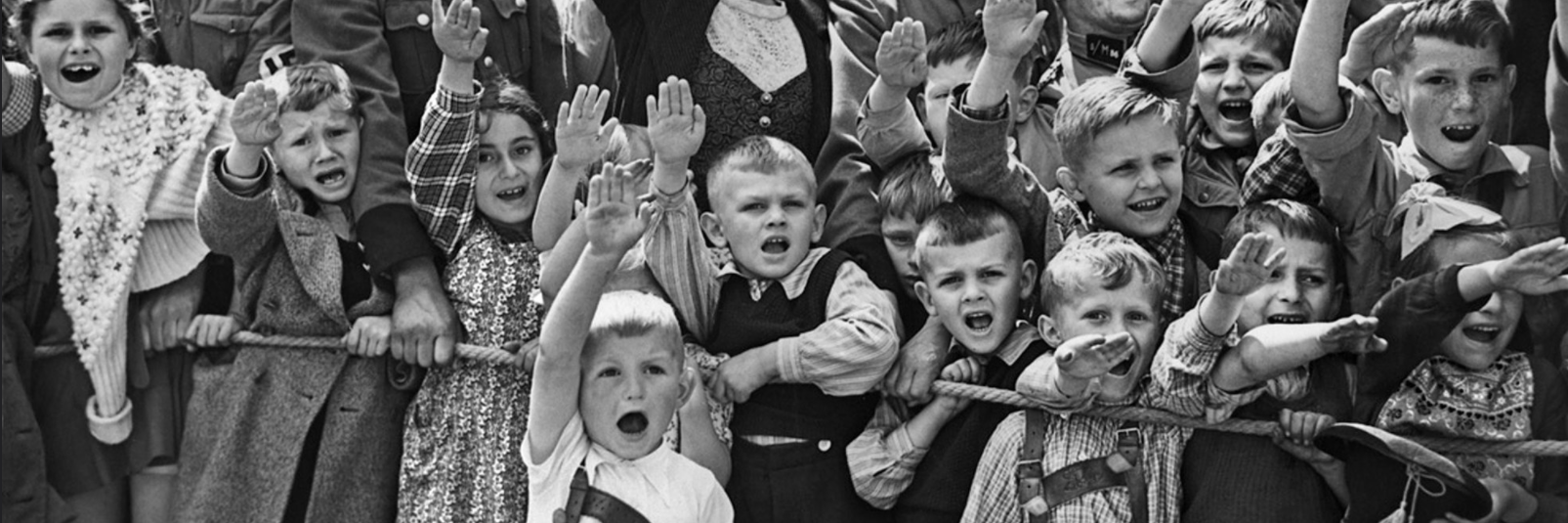
How has this affected German youth?
How has this affected German youth?
Introduction to the story of Henry Metelmann, a former Hitler Youth. Metelmann's parents were relatively anti-Hitler and anti-Nazi. His father even referred to them as the "brown pests." (1:37)
A continuation of Metelmann's story shines light on how he was influenced by Nazi education and propaganda. Even as Metelmann recounts his time involved in Nazism, there is a sense that he is reminiscing rather than testifying, implying that the indoctrination may still have its hold on him all these years later. His facial expressions seem to hold pride, a sense of happiness, especially when he speaks about how excited he was to join and participate in the Hitler Youth.
A former Hitler Youth leader meets a survivor of the Shoah. Ursula Martens, the former Hitler Youth, joined the group at age 16. 88 years old at the time of the interview, Ursula still sings songs from her time involved in Nazism.
Her attitude seems to be a mixture of regret and a slight bit reminiscent--or perhaps an indifference toward her past. While she shows pride in overcoming her Nazism, saying this is a fitting "end" to her life as she ends it on a better note, she still says she "wouldn't feel bad" if Erika Jacoby, the Shoah survivor, was mad at her for her past. While perhaps just a poor choice in words, it does depict a sense of indifference.
Heil Hitler: Confessions of a Hitler Youth
A video testimony of Alfons Heck, a former Hitler Youth.
"Twice a week we were taught racial science, which was a specific instruction to be able to differentiate us from so-called inferior races. That's when I heard for the first time the term 'master race'" (3:52)
"We were surrounded by newspapers that told us that the Jews had made war on us for the last 4,000 years." (4:36)
[At a Nuremberg Hitler Youth rally] "Hitler said we will be one people, one nation, and you, my youths, you are going to be that people and that nation. After he had uttered this sentence, I belonged to Hitler, body and soul." (9:28)
“The idea of facing death, at no time was that terrifying, because our fanaticism had prepared us for that possibility for years. The thing that you could do for Germany most was either to win or to die. It was better to die than to live in slavery.” (20:29)
"Could it happen again today? Of course it can. Children are like empty vessels. You can fill them with good. You can fill them with evil. You can fill them with hate. And you can fill them with compassion.--So the story of the Hitler Youth can be repeated, because, despite Auschwitz, the world has not changed for the better all that much." (27:33)
Heck shows the danger in targeting the youth. Impressionable minds, the youth can be taught the most vile, harmful ideologies and accept them as correct, as an absolute truth. While no fault of their own, it led to children, such as Alfons Heck, not even fearing death. He and other Hitler Youth would have rather died than lose the war for their country and their Führer.
Nazi indoctrination and anti-Semitic beliefs in Germany
"Between 1933 and 1945, young Germans were exposed to anti-Semitic ideology in schools, in the (extracurricular) Hitler Youth, and through radio, print, and film. As a result, Germans who grew up under the Nazi regime are much more anti-Semitic than those born before or after that period: the share of committed anti-Semites, who answer a host of questions about attitudes toward Jews in an extreme fashion, is 2-3 times higher than in the population as a whole."
"Whereas many historians believe that Nazi propaganda and schooling prepared the ground for the Third Reich's excesses, scientific studies of indoctrination have typically found few systematic effects."
"Germans who grew up under the Nazi regime were therefore exposed to a wide range of indoctrination methods. Using data from the German General Society Survey (ALLBUS), we show that these individuals are still markedly more anti-Semitic today than cohorts born either before or after. They are more inclined to deny Jews equal rights, to represent having them as neighbors or family members, and they believe more often that Jews have too much influence in the world."
This study provides scientifically backed data asserting that Nazi indoctrination has had a lasting effect on the youth raised during Nazi rule. Furthermore, this substantiates any subconscious biases and feelings Heck, Metelmann, or Martens may have still held so many decades later.