Lifelong Learning
I have always seen myself as a lifelong learner. Being an avid reader, it is rather common for me to be reading multiple books across genres at the same time. I have always been keen in learning new skills that not just help me enhance my skills but also equip me with new ones. Learning is not a linear process for me where it stagnates. For me learning is like a roller coaster where I do not know the next bend. This learning and unlearning helped me discover my strengths and weaknesses.
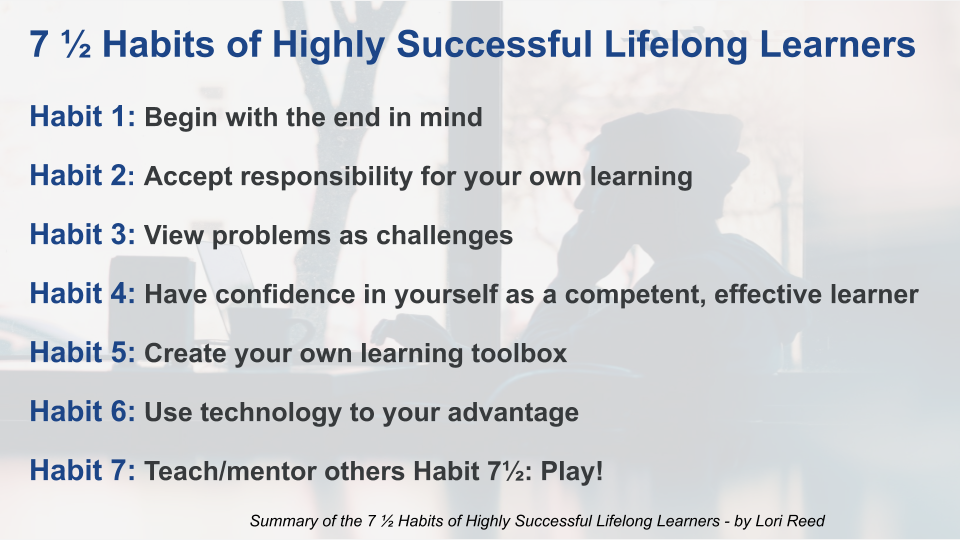
After reading the 7 1/2 habits of successful lifelong learners, I found that I am following habits 1,2,3 and 6 very well. Habit 4 is where I struggle, since I am person with a mix of both growth and fixed mindset. At times my fixed mindset becomes prominent and I undermine my abilities as a learner. I have to practice more on Habits 5 and 7.
I am stimulated to being a lifelong learner because I want to be have a life where wonders do not cease and I always find something new to learn and explore. I do not want to shackled by the beliefs of age and mind that I am too old or incapable of learning or doing something that I find riveting. I am also motivated to continue learning because of the field I work in, school library. The field of Library science requires to keep myself abreast with the latest educational & information tools and trends. I need to don several hats as a librarian which requires constant learning and communicating my learning, discoveries and exploration with students and teachers.
For this discovery exercise, I looked through the EmTech Wiki and discovered two resources which not only enhanced my prior knowledge but also piqued my curiosity.
Digital Literacy is the need of the hour with most of our time being spent on the digital medium. Being a Librarian, I have always been keen to learn more about Digital Citizenship, Digital Literacy, etc. This resource caught my eye for its style and ease of understanding.
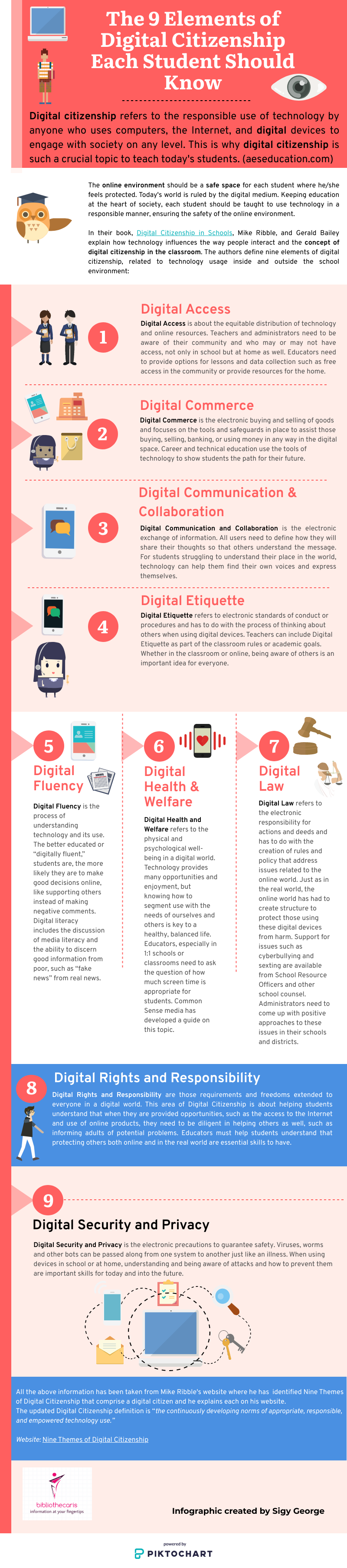
The first resource that I discovered is Mike Ribble's Nine Themes of Digital Citizenship. His website provides information about who is a digital citizen and the qualities that comprise one. He has explained each one of the nine themes on his website. There are additional resources also which can ne used with my students to further their understanding. His explanations are simple and lucid, making them easy to understand and implement. Digital Citizenship is an important topic in today's time of information explosion and digital invasion. A digital citizen refers to a person who has the knowledge and skills to effectively use digital technologies to communicate with others, participate in society and create and consume digital content. The updated definition of Digital Citizenship is
Digital citizenship is the continuously developing norms of appropriate, responsible, and empowered technology use:
-To lead and assist others in building positive digital experiences
-To recognize that our actions have consequences to others
-To participate in a manner for the common good
Under his resources page I found another resource which I found extremely useful to share with students and teachers. It explains what type of digital citizen do we want out students to be. The answer also is provided which is thoughtful and well explained: (From the website)
I write about the “Five Be’s” for being a good digital citizen, and a good citizen in general:
- BE We Not Me. Know that we are better together than we are by ourselves. The digital world is about positive interactions.
- BE an Example. Model good behavior. Be an example of character online and off.
- BE Curious. Ask questions, search for answers, and teach/learn from each other.
- BE a Citizen. Recognize our differences, but be willing to find common ground. Find your voice in a digital world .
- BE Empathetic. Focus on how others may receive your message. Take your time when sharing ideas. Use the THINK model by asking if your message is True, Helpful, Inspiring, Necessary and Kind.
I highly recommend this resource to all Librarians and teachers who wish to educate their students, even themselves about Digital Citizenship, the Netiquettes, etc.
Website: Nine Themes of Digital Citizenship
I created an infographic on the site Piktochart, using the information given on the website. Given below.
Having done a course from Coursera on the topic of Digital Footprint, I have felt it essential to gather as much information as possible to reduce the residues I leave behind after my online presence.
The second resource that I found useful for my learning as well for my students and teachers is an 8 minute video, Four Reasons to Care About Your Digital Footprint. This thought provoking video illustrates the unexplored issues that can arise from our visits around the Internet. In simple terms, it discusses how our online views are tracked by third party companies who trade our details for a big bargain. This happens on a massive scale without our permission and knowledge. It also informs how little control we have over who gets access to such information, the possibility of identity theft, and the potential impact on our reputations.
Youtube Link: Four Reasons to Care About Your Digital Footprint