
Home

Increasing FINA 307 Student Success Rates through a Hybrid Classroom
Project Abstract
FINA 307 (Business Finance) has been identified as a systemwide high-demand low-success course in the CSU. We have restructured FINA 307 into a hybrid course by supplementing traditional in-class lectures with web-based out-of-class learning activities and on-demand help system. To improve the student success rates and narrow achievement gaps, we redesign FINA 307 to accomplish two goals. First, We have developed more engaging pedagogies to make the teaching and learning process more learner-centered, and to inspire students to move from passive recipients of knowledge to active learners. For example, integrate technology into lectures, provide real data with hands-on experience, adopt clicker response system, encourage student study groups, etc. Second, we provide on-demand help, such as, tutoring service, online learning system, homework management system, and video tutorials.
Complete Project Description
This document provides a more through description of the redesign project.
MERLOT Digital Library
A free and open online library of online teaching and learning materials across a wide variety of disciplines and education levels. MERLOT provides you the link to the material as well as peer reviews, member comments, lesson plans, and other quality assurance information.
CSU Course Redesign Website
Review the description of the CSU systemwide initiative supporting faculty redesigning their courses to improve student success.
Statement of the Problem
FINA 307 (Business Finance) has been identified as a systemwide high-demand low-success course in the CSU. The average DFUWI rate of FINA 307 over the past five years is 20.81% at CSU, Chico. We have taken a closer look at the high DFUWI rate and pinpointed the following specific challenges our students are facing. First, some students are academically underprepared for this course because they lack essential skills, especially mathematical skills. Second, more and more low-income full-time students work full-time because household income fell sharply during the economic downturn. These students are in great need of on-demand help. Third, some students start off strong but their performance deteriorates as semester progresses. The reason is that the materials of this course become more and more difficult while students’ overall workload also accumulates as semester progresses. We need to redesign FINA 307 to solve these specific problems to reduce the DFUWI rates.
Our redesign
Our redesign plan is to restructure FINA 307 into a hybrid course by supplementing traditional in-class lectures with web-based out-of-class learning activities and on-demand help system. Aiming at reducing the DFUWI rates and narrowing achievement gaps, we will redesign FINA 307 to accomplish the following two goals:
1. Develop more engaging pedagogies to make the teaching and learning process more learner-centered, and to inspire students to move from passive recipients of knowledge to active learners.
a.Technology integration
b. Real data with hands-on experience
c. Clicker student response system:
d. Study groups
2. Provide on-demand help
a. Student tutoring service
b. Online learning system (Blackboard Learn)
c. Online homework management system (McGraw-Hill Connect)
d. Video tutorials and FAQ (Frequently Asked Questions)
Why will the "redesign" lead to better learning?
Finance courses build upon both qualitative concepts and quantitative models. We endeavor to translate complex financial concepts and mathematical equations into easily understood language. Rather than simply having students memorize formulas or solely rely on the use of financial calculator, we ensure that my students understand the concepts behind financial formulas and models by providing intuitive numerical examples and real-life cases.
We motivate our students to excel in our class by making every class as informative, interesting, and innovative as possible. To help our students learn all the relevant knowledge, we use multiple teaching techniques, such as lectures, discussions, oral presentations, case analyses, videos (both instructional and humorous), and readings on current business news.
We also provide on-demand help, such as posting notes online, providing tutoring service, using online homework management system, outside of the classroom. This approcach gives students with busy schedules more flexibility.
Syllabus BEFORE Redesign
This is the original syllabus before the redesign.
Course and Student Background
We are designing FINA 307 (Business Finance), which is a required core course for all CSU, Chico College of Business students.Students should have taken Introduction to Financial Accounting and Principles of Microeconomic Analysis before they take this course.
FINA 307 (Business Finance) has been identified as a systemwide high-demand low-success course in the CSU. The average DFUWI rate of FINA 307 over the past five years is 20.81% at CSU, Chico.
Most of our students are traditional students, who enter college right after they finish high school. We also have non-traditional students, who return to college years after they finish high school. We do observe that a lot of our full-time students are also working full-time or part-time. Many students are academically underprepared for this course because they lack essential skills, especially mathematical skills.
Accessibility, Affordability, and Diversity
The technologies we are using in our redesign meet section 508 accessibility requirements so students with disabilities can have an equally effective learning experience. Although, currently, our tutorial videos do not have captions, students with hearing problems are able to follow the materials while watching the videos.
Students are responsible to purchase:
1. A financial calculator, which is a necessary tool required by almost all finance programs in the U.S. Students are allowed to use a graphing calculator that they had used for their previous classes.
2. The access to McGraw-Hill Connect, an online homework management system. Connect access code costs about $50. Low-income tudents are allowed to use financial aid to purchase the access code.
3. A clicker, which is required in a lot of courses at CSU, Chico. Thus, students can reuse their clicker in other classes. Low-income tudents are allowed to use financial aid to purchase clickers.
4. A textbook. We allow students to use used book or an older edition, which costs much less than brand-new books. We also provide copies of the textbook in our university library reserve.
Our pedagogical strategies provide equal opportunities to students with diverse cultural, ethnic, and gender backgrounds.
Teaching Tips
A large body of our full-time students are also working full-time or part-time. A big proportion of our students are academically underprepared for this course because they lack essential skills, especially mathematical skills. Therefore, the two biggest challenges we confront are: first, how to better engage our students in class; and second, how to help our underprepared students to catch up with their peers.
Our finance faculty members concur that a key driver for student success and student engagement is curiosity and self-motivation.
We have provided 24*7 on-demand help to assist our working students and underprepared students.
(Please see the complete project description for more details.)
MERLOT Pedagogy Portal
MERLOT's Pedagogy Portal has a collection of online resources on over 25 types of pedagogical strategies. Explore what other faculty and higher ed institutions are doing and recommending for student engagement strategies.
Learning Outcomes and Redesign Activities
1. The student learning outcomes
The objective of this redesigned course is to provide knowledge about the basic issues in corporate finance. At the end of this class, students should:
a. Know the role of the financial manager and the financial markets in which the manager operates
b. Know valuation, the concept that drives financial decisions
c. Become familiar with basic topics in finance, such as financial statement analysis, working capital management, corporate financing, capital budgeting, market efficiency, agency problems, etc.
We have also matched each chapter with the the seven topics that compose the core areas of knowledge of corporate finance.
Order of |
Topics | Chapters |
| 1 | Time Value of Money / Asset Valuation (PV, FV, Payment, interest, periods, Stocks, Bonds…) |
Ch 5, 6, 7, 8 |
| 2 | Risk and Return (Diversification, Total Risk, |
Ch 11, 12 |
| 3 | Capital Budgeting (NPV, IRR …, WACC and COC) | Ch 8, 12, 13 |
| 4 | Financial Statements/Analysis of Ratios | Ch 3, 4 |
| 5 | Financial Markets & Institutions | Ch 1, 2, 14 |
| 6 | Corporate Financing/Financing Choices | Ch 14 |
| 7 | Working Capital Management | Ch 19 |
2. The prerequisite knowledge and skills
The course is designed primarily for the student who has had no previous course work in finance and will provide satisfactory background for students who elect to study Business in more advanced courses. However, we have observed that some of our students are academically underprepared for this course because they lack essential skills, especially mathematical skills. We have created multiple video tutorials on solving problems with algebra to help academically underprepared students to catch up with their peers.
The prerequisite knowledge to this course is introduction to financial accounting and introduction to microeconomics.
3. The step-by-step instructions for completing the redesigned activity
Our redesign project is to restructure FINA 307 into a hybrid course by supplementing traditional in-class lectures with web-based out-of-class learning activities and on-demand help system.
a. Our finance faculty members concur that a key driver for student success is curiosity and self-motivation. Therefore, we have developed more engaging pedagogies to make the teaching and learning process more learner-centered, and to inspire students to move from passive recipients of knowledge to active learners.
i. We have fully integrated technology in the classroom to bring real-life examples, case studies, and recent financial news to in-class lectures. For example, by using modern technology, such as tablet laptop, projector, and web browsers, we use finance.yahoo.com, www.google.com/finance, and etc. to incorporate real-time financial news, stock data, financial statements into class discussions and activities. This practice motivates students, and helps them to maintain their curiosity about finance.
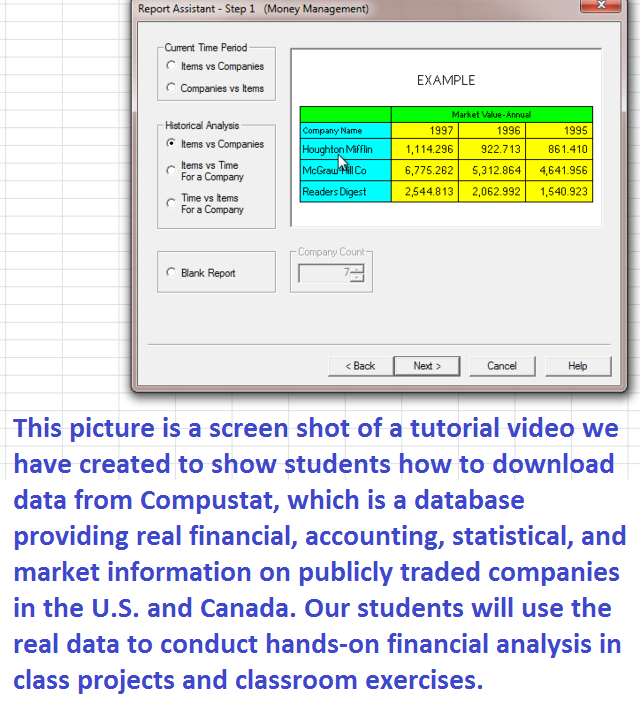
ii. To provide students with hands-on analysis of real corporate financial data, we have purchased the access to Compustat North American database, which has financial, accounting, statistical, and market information on publicly traded companies in the U.S. and Canada. It provides more than 340 annual and 120 quarterly Income Statements, Balance Sheets, Statements of Cash Flows, and supplemental data items on more than 10,000 active and 9,700 inactive companies. Students have access to real data and conduct hands-on financial analysis in class projects and classroom exercises. (We have attached a sample assignment, which requires students to obtain data from Compustat database and use the data to perform risk-return analysis.)
iii. We have implemented the extensive use of clicker student response system in the classroom. Incorporating clickers into in-class activities has: (1) increased classroom participation; (2) enhanced student engagement; (3) provided instant feedback for both students and instructors; and (4) increased the degree of interaction in the classroom. We have also collaborated with our bookstore for arranging a buy-back program to reduce the cost of using clicker. (We have attached a sample of the clicker questions we use in class.)
iv. We have encouraged our students to form study groups. The nature of FINA 307 creates a need for students to work on a lot of practice problems outside of the classroom. We have noticed that most of the successful students actively practice problems, discuss concepts with other students, and constantly teach other fellow students to solve practice problems. Study groups provide a variety of benefits: (1) understanding material in a deeper way; (2) getting questions answered; (3) learning problem-solving skills effectively; (4) developing self-discipline; and (5) building teamwork skills.
b. We have provided 24*7 on-demand help to assist our students, especially working students and underprepared students. The on-demand help includes:
i. The College of Business at CSU, Chico has a formalized tutoring center with a coordinator and multiple student tutors. We have hired two Finance tutors to provide one-on-one or group interactive tutoring sessions and to guide students through the course. Our Finance faculty members have worked closely with the student tutors. In addition to providing help with course materials, tutoring sessions also provide an encouraging environment for students who are too shy to ask questions in class.
ii. We are using Blackboard Learning System to provide students 24-by-7 access to lecture notes, detailed solutions to practice problems, important class announcements, step-by-step instructions on how to use a financial calculator, and up-to-date grades. These learning resources supplement in-class lectures and give full-time working students more flexibility.
iii. We are using McGraw-Hill Connect, a web-based assignment and assessment platform, to assign homework assignment and give students more supplemental learning resources, such as ebook, Powerpoint slides, practice problems, and self-quizzes. Students can choose when they want to work on homework assignments and can get instant feedback and detailed solutions from Connect. Connect automatically grades assignments and uploads grades to Blackboard Learn.
iv. We have created multiple video tutorials on solving problems with algebra. Our students have unlimited access to the tutorials through the semester. Academically underprepared students find this practice very beneficial to their success.
4. Assessments
We will collect outcome data at the end of this semester. (For comparison, we have already collected some survey data in previous semester.) We will use both quantitative and qualitative approaches to assess the success of the redesigned course.
a. Quantitative approach
i. We will conduct analyses to determine the redesign impact on student academic performance, and the DFUWI rates.
ii. We will compare redesigned sections with non-redesigned sections with regard to the DFUWI rates, course grades, and other indicators of student success while controlling for background differences.
iii. If the data is available, we will compare the results of the redesigned course to the CSU systemwide data on course outcomes.
iv. We will conduct an exit survey to gather more information about the students in the redesigned sections. We will use the survey data to describe the DFUWI rates and course grades in defined populations, for instance, low-income students, academically underprepared students, working students, etc., over semesters and years.
b. Qualitative approach
i. We will conduct an exit survey to assess student satisfaction, engagement, learning outcomes, and perception of valuable components.
ii. We will use informal interviews with students to gather their feedback and perception.
How To Make Redesigned Activities Work
Our students are familiar with the use of the Blackboard online learning system, the McGraw-Hill Connect online learning system, and clickers. To successfully adapt our redesign model, it is expected that students have access to an online learning system, an online homework management system, which may be provided by the publisher of the textbook, and a clicker response system. The tutoring service provided by the College of Business at CSU, Chico also provide support to our students. Across many different sections taught by several faculty members, we have standardized the use of the same textbook, the Blackboard online learning system, and the McGraw-Hill Connect online learning system.
Syllabus after redesign
This file is the revised syllabus after the redesign.
Sample Compustat Assignment
This assignment requires students to obtain data from Compustat database and use the data to perform risk-return analysis.
Sample clicker questions
This document shows a sample of clicker questions we are using in the redesigned course.
Our redesigned team has created several tutorial videos as supplementary learning materials for our students. The sample video posted above shows: 1. step-by-step instructions on how to solve an end-of-chapter problem; 2. review on basic algebra.
Student Reactions to Learning with the Redesigned Activities
We have surveyed our students on what they like or dislike about the redesigned course elements. The video above shows our students' views on the use of clicker, Connect online homework, tutoring service, and posted class notes.
Student Testimonials
“I think all the tools are being utilized efficiently.”
“The course introduced me into the finance industry and further increased my knowledge and interest.”
“Connect assignments and practice quizzes/tests were extremely helpful!”
“The two projects we did outside of the classroom were very helpful in tying the classroom information to real world events.”
“The clicker questions helped a lot because of the instant feedback. Then the instructor explain why you got it wrong and how to get the correct answer.
“Finance tutors are very helpful. They are there for long hours and they help me with many things.”
“Online notes are very helpful because I can go back to review the notes after class.”
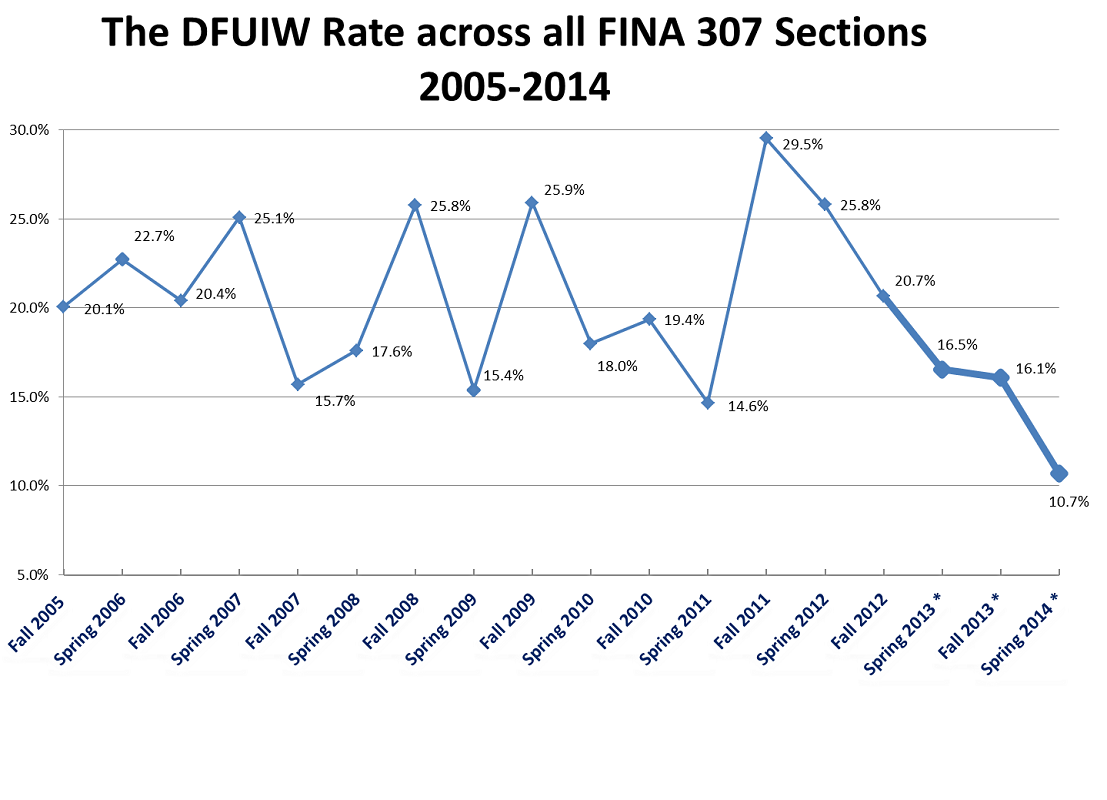
In the above graph:
* Spring 2013: We started using the Blackboard Learning System.
* Fall 2013: We started using the McGraw-Hill Connect.
* Spring 2014: We have fully implemented our course redesign.
Impact on Teaching and Learning
1. Solved Problems
Our redesign strategy has solved some of the problems that we have identified before our redesign. For example, we have proposed to use more engaging pedagogies, such as clickers and real data analysis, to inspire our students to become active learners. Our students have provided very positive feedback on the engaging pedagogies. For example, one student commented that “the two (Compustat) projects we did outside of the classroom were very helpful in tying the classroom information to real world events.” Another student comments that “the (Compustat) reports were helpful in using the data and learning how to interpret what was occurring.” Our students also like that they can receive instant feedback on clicker questions in class. One comment is “the clicker questions helped a lot because of the instant feedback. Then the instructor explains why you got it wrong and how to get the correct answer.” Another comment on clicker questions is “the clicker assignments were also very helpful for memorizing and reviewing the concepts.” 72.41% of our students consider clickers are helpful to student success and learning in this class. 65.00% of the students think Compustat exercises are helpful. 77.27% of the students appreciate that the instructors integrate technology in the classroom to bring real-life examples, case studies, and recent financial news to in-class lectures.
Considering 72.22% of our students work more than 20 hours during a regular week, our redesign has also focused on providing the necessary 24*7 on-demand help to our students. 76.67% of the students think posted class notes benefit their study. 86.21% of the students like the Connect online homework. Among the students who have used tutoring service, 85.71% consider the service is helpful to their success. One student commented that “finance tutors are very helpful. They are there for long hours and they help me with many things.” Another student commented that “online notes are very helpful because I can go back to review the notes after class.”
2. Achieved Learning Outcomes
93.75% of students say that they have learned about the same or more than they have learned in most classes.
93.75% of students think they have learned knowledge and skills that will be helpful in their professional life.
85.94% of students think they have learned knowledge and skills that is valuable to them personally.
3. Improvements on Grades
Before we implemented any redesign element, the average DFUWI rate of FINA 307 over the past five years is 20.81% at CSU, Chico. Starting from Spring 2013, we have implemented some redesign elements. For example, we started using the Blackboard Learning System in Spring 2013, implemented the McGraw-Hill Connect in Fall 2013, and fully implemented our course redesign in Spring 2014.
As indicated in the chart above, the DFUWI rate of FINA 307 has been reduced to 16.5%, 16.1%, and 10.75%, in Spring 2013, Fall 2013, and Spring 2014, respectively. The significantly reduced DFUWI rates indicate that our course redesign does make a big difference to our student success.
About Me
I work for the Department of Finance and Marketing at CSU, Chico. I have received my PhD in finance from Washington State University. My primary research interest focuses on how institutional holding and trading affects security risk. In addition, I intend to investigate how changes in constraints on institutional investors affect institutional ownership and institutional trading, and examine the role of institutional investors in corporate governance.
I believe that learning is a lifetime journey. Therefore, I believe higher education should serve the purpose of not only imparting knowledge but also, more importantly, teaching creative and critical thinking skills as well as problem-solving skills. These skills would prepare students for their future in terms of becoming a life-long learner. Based on my past teaching experience, I find that education is more effective with motivation, interaction, and enthusiasm. The best moments I have experienced from my teaching are when my students shared with me how they benefited from my classes and how much they have learned from my effective teaching.
I will now briefly describe how I have applied my teaching principles in my teaching that contribute to effective education at CSU, Chico. Finance courses build upon both qualitative concepts and quantitative models. I endeavor to translate complex financial concepts and mathematical equations into easily understood language. Rather than simply having students memorize formulas or solely rely on the use of financial calculator, I always ensure that my students understand the concepts behind financial formulas and models by providing intuitive numerical examples and real-life cases.
The approach I motivate my students to excel in my class is to make every class as informative, interesting, and innovative as possible. To help my students learn all the relevant knowledge, I use multiple teaching techniques, such as lectures, discussions, oral presentations, case analyses, videos (both instructional and humorous), and readings on current business news.
I believe it is a teacher’s responsibility to create a supportive environment to facilitate classroom interaction and out-of-classroom interaction. In the classroom, I initiate challenging questions and encourage my students to critically and independently think about and answer the questions. In addition to classroom interaction, I also promote formal and informal out-of-classroom interaction, which I believe will contribute to student learning, social, and intellectual outcomes. My students talk to me about course materials, their career choices, sometimes, even the difficulty they are facing in their personal life. I always provide plenty of opportunities for them to communicate with me, advise them about their career paths, and help them to get through the difficult times.
I believe that teachers’ genuine enthusiasm in teaching carries a great deal of value to the teaching and learning process. I never stop updating my knowledge in the business area. I integrate current technologies in my instruction to help my students tackle challenges in the current informational society.
I am passionate about education because no other career could award me the pure joy of giving, sharing, and receiving.