Home

Chem 100 Virtual Lab
Gita Sathianathan, Ph.D
California State University, Fullerton.
3 Banting, Irvine, CA 92618. Tel: (657) 278-1600
gsathianathan@fullerton.edu
Course Name & Description: Chem 100L Survey of Chemistry Laboratory. Experiments chosen to develop laboratory techniques, chemical principles and their application to environmental and societal problems.
Project Abstract: This is a one unit General Chemistry Lab for non-science majors that is offered online. The course requires students to run eleven virtual labs offered by external vendor, Latenitelabs.com and submit lab reports online. Students ‘enter’ a 3D portal that is representative of the actual lab space and use virtual glassware, instruments and chemicals which resemble the actual lab materials. The Lab requires physical class participation three times during the semester where students come to campus for a three hour Lab lecture sessiom. Students have the opportunity to ask questions and learn how to do the online experiments using Latenitelabs tools, learn how to obtain relavant data to prove hypotheses, analyse results, perform calculations, and discuss how their observations and methodologies help achieve the goal. During Lab lectures, Students are tested on the Chemical principles, protocols, data collection, analyses, calculations and error sources etc with the aid of hand-written exams. Assessment of student learning shows that this method is equally efficient in teaching students the theory and methodology of Chemistry Labs.
GE Credit: 1.0
Keywords/Tags: Virtual Lab - Chem 100 Lab, Introductory level General Chemistry Lab for non-majors.
Instructional Delivery: Hybrid, 80% online and 20% in-class instruction.
Pedagogical Approaches: Learning activities are constructed so that students discover and build knowledge for themselves and develop an understanding of concepts, principles and relationships. They often do this prompted by questions from the program, and/or solving problems by physically manipulating objects and performing experiments in a virtual environment. Students are provided with specific questions, materials to use & some direction on how to find answers.
Class Size: 24
Course Redesign Reason
|
|---|
Background on the Redesign
Why Redesign Your Course?
The main goal is to provide a convenient method for students to achieve the same learning goals as regular in-residence lab students. Another goal was to reduce the physical laboratory space taken up by the CHEM 100L course. The virtual lab provides the opportunity for students to perform similar experiments and learn the objectives of each lab, without taking up valuable physical space which is lacking for large enrollments. The course was/is offered as a regular bench lab and due to lab space issues, an online lab format was tried during the Summer of 2015 with success.
- Course Characteristics:
- Chemistry 100 L is an introductory laboratory course in which students are introduced to basic chemical principles and experimental concepts, and perform experiments chosen to develop laboratory techniques and teach scientific methodology.
The Course teaches the students the basic principles of scientific experimentation methods and the development of analytical thought in discovering new knowledge. Online labs mimic labs done by regular labs, but would use virtual equipment and materials. There online version would have weekly labs that students perform in the regular Lab class in a virtual format. The goals and methodologies are the same, except the virtual labs offer the experience in a 3D virtual reality setting. The lab reports require data collection, short answers to online queries and discussion of results for weekly labs.
The Learning Problem:In this case, the problem was to transition the lab and learning from a physical space to a virtual space.
Course History/Background
- This course is designed mainly for non-majors and has a co-requisite or pre-requisite of Chem 100 lecture class. For many students, this may be the only chemistry class they would take ex. Business majors, Radio & TV majors etc. For others in majors such as health sciences, this opens the door to General Chemistry courses that are required by their majors such as Chem 120 A/B. Chem 100 is a prepatory course for students who have had little or no chemistry in High School and who wish to have a basic understanding of Chemistry principles, methods and techiques.
High Demand / Low Success Issues
CHEM 100L (Survey of Chemistry Laboratory) is a one unit General Education course (category B.3). There are approximately 200 students enrolling in the Lab course per semester. The success rate in this course is quite high, with more than 80-90% of the students passing the course with a C grade or higher. The department offers tutoring services through the Learning Center at the Fullerton Campus on an on-going basis.
(Upload syllabus from pre-designed course here.)
RedesigningChem100L_PresentationCSU
Presentation to Virtual Lab cohorts Feb 2016
About the Instructor and Students
|
|---|
About the Instructor
- Gita Sathianathan
- Taught chemistry extensively at Penn State University, University Park, PA from 1995-2003 as a full time lecturer. Developed new course materials, Created videos for labs, Developed Online Testing programs, and developed new labs for general and organic chemistry courses.
- Currently teaching General and Organic Chemistry lecture and lab classes at the Irvine and Fullerton campuses of CSUF.
Student Characteristics
- The students are from varied backgrounds, such as Business, Kinesiology, Accounting, English, Health Sciences, Art/entertainment, Education and undeclared. The students are very new to the concepts and techniques used in the labs, and need some hand-holding at the initial stages to understand the scientific terminologies, protocols and methods and lab techniques. The lab lectures are designed to fulfill this need.
Advice I Gave My Students to be Successful
- Prepare for the lab by reading ahead and learning the goal, methods, calculations etc.
- Attend all lab lectures and ask questions on any general or specific topics
- Always be aware of the due dates and make sure that there is ample time for re-doing the labs in case of errors
- Make sure everything makes sense when following protocols. Ask the teacher if you have any doubts.
- Pay attendtion to details of the techniques such as measurements, significant numbers, temeratures, volumes, physical and chemical changes, mass measurements etc.
Student Learning Outcomes
|
|---|
Impact of Student Learning Outcomes/Objectives (SLOs) on Course Redesign
| GE Learning Goal 1 | ||
Apply scientific methodology through active experimental methods and experiences laboratory/activity). |
||
How does the course meet the GE Learning Goal? |
||
There are 11 experiments designed to develop their critical thinking, data analyses and fundamental laboratory skills. Emphasis is placed on accuracy of measurements, collection of appropriate experimental results, analyses of data, presentation and discussion of results. Experiments have specific hypotheses that would be proven or disproven by the using experimental results. Students develop arguments based on the results and analyses thereof. Students apply scientific methodology through active experimental methods and experiences and learn the basic chemical principles and concepts applied to achieve the goals of each of the experiments. |
||
| GE Learning Goal 2 | ||
| Evaluate the validity and limitations of theories and scientific claims in interpreting experimental results. | ||
| How does the course meet the GE Learning Goal? | ||
The Lab results are analyzed by comparing with literature values provided. Limits are outlined in the experiments for acceptable experimental error or deviation. Calculations are done to verify the accuracy and precision of the results obtained. Students submit answers to questions online that test the understanding of the data collected, the reasons for the data collection and the interpretation of the results. |
||
| GE Learning Goal 3 | ||
| GE Writing Requirement | ||
| How does the course meet the GE Learning Goal? | ||
| The Online Labs have Lab Reports that must be submitted online in accepted scientific writing formats with scientific notations and correct significant figures. The discussions and conclusions drawn from experimental results must be submitted as resonses to queries appearing in the Online Short Answer sections. In addition, students have written exams during Lab lectures. The exams require that they discuss and analyze the results of their experiment and explain the conclusions of their experiments based on experimental data collected and how they achieved their goals or proved the hypotheses. |
Course Redesign Teaching and Learning Resources
Funding for the course is provided by the Chancellor’s Office Course Redesign with Technology Funding (2014-2015 funding cycle).
Course Redesign ePortfolio Exemplar
An example of an ePorfolio created by faculty at CSU East Bay to exhibit their course redesign project and their findings.
CSU Course Redesign Website
Review the description of the CSU system-wide initiative supporting faculty redesigning their courses to improve student success.
MERLOT II's Pedagogy Portal
The MERLOT Pedagogy Portal is designed to help you learn about the variety of instructional strategies and issues that could help you become a better teacher. The resources you’ll find in the Pedagogy Portal should apply to teaching a variety of disciplines.
MERLOT II
MERLOT is a collection of free and open online teaching, learning and faculty development services contributed and used by an international education community. The MERLOT collection of open resources spans across a wide variety of disciplines and education levels. What sets MERLOT apart is a combination of peer reviews, member comments, learning exercises and other valuable information and metadata associated with the materials.
Resources For Teaching
|
|---|
Resources: Lab Lecture notes for Experiments (PPT files in pdf format)
-
- Powerpoint slides that have detailed information on
- Goals and hypotheses
- Chemical Principles,
- theory,
- experimental protocols,
- results and analyses,
- graphing and calculations,
- discussion of error
- proving the hypotheses
- Powerpoint slides that have detailed information on
are posted for every single experiment.
- The Powerpoint slides have image capture of the actual labs they would be conducting, and for every experimental set-up that they would encounter
- Example problems and calculations take them step-by-step through the processes needed to obtain the needed results. As this is a first year General Education lab, detailed explanations were provided, especially for the calculations.
LabLecture_IntroductionToChem100LandLatenitlabs.com
Introduction and how to get started with online labs
LabLecture_Density Expt
Density: How to find the densities of Solids and Liquids and an Unknown Compound
LabLecture_IdentificationOfUnknowns
LabLecture_SeparationOfMixtures
LabLecture_LawOfDefiniteProportion
LabLecture_TemperatureDependenceOfSolubility
LabLecture_StoichiometryCu-AgReaction
Videos for learning "How to do Experiment' for each of the experiments. These capture the lab lectures given in class to students by video. All the information in the powerpoint slides with emphasis on the Chemistry fundamentals and knowledge needed for accomplishing the goals by explaining scientific concepts, experimental methodology, data analyses, calculations and discussion are elaborated in detail.
Each of the videos is 20-30 minutes long and is made with creating virtual contact with students as in a classroom setiing, to encourage stimulation of ideas and to give them confidence in thoer own skills to accomplish the goals.
The videos were created by the California State University, Academic Technology Center.
HowToVideo_Density
Learn how to experimentally determine the densities of solids and liquids.
HowToVideo_Titrations
Learn how to do a Titration to find the concentrations of unknown substances in water.
HowToVideo_ChemicalReactionTypes
Explore Chemical reaction types
HowToVideo_IdentifyingUnknowSubstances
Video Describing how to perform Density Lab
HowToVideo_MolecularWeightOfAir
Find the molar mass of air using gas laws
HowToVideo_Stoichiometry
Learn how elements and compounds react with each other in a fixed mole ratio
HowToVideo_LawDefiniteProportion
Prove that the elemental ratio within compounds is a constant
HowToVideo_SolubilityvsTemperature
Does the solubility of solutes increase with Temperature? Explore.
HowToVideo_MolarVolumeofAir
How to find the volume of one mole of Air
HowToVideo_SeparationOfMixtures
Learn how to isolate component compounds from a mixture
HowToVideo_IntroductionToLatenitelabs
How to use the Latenitelabs program to conduct experiments
Challenges My Students Encountered
- The major Challenge students encountered was that they missed deadlines due to work or other personal committments.
- The students who missed more than two labs, typically obtained a low grade of D or F. Although there were reminders sent out to students, and the deadlines were posted online on the Latenitelabs index page from day one of class, there were students who had overcommitted their time to other activities and did not complete or at times, attemp labs. This did not happen in regular In-class Labs.
- There were students who had difficulty drawing graphs from data provided. This was overcome by having a practice session during the lab lectures on how to use the tools to produce graphs and find the relavant information such as slope and intercept and decipher their meaning from the graph equation.
- The third exam for the online Lab was administered via Titanium online. Students were all asked to take the exam at the same time and an hour and date was designated for the exam. There were three students who had responses that were identical for some questions. In one of the cases, the resposes were cut and paste from online sites as they had equations written in Mathematica format included. This has discouraged me from administering exams online. All exams last Fall and this semester were administered in class and were hand written type exams.
- Students had challenges visualizing the Lab set-ups. A tour of the actual Labs was not possible as students are not allowed to enter Labs without procuring goggles and lab coats.
Future Plans to Address the Challenges
- Video Clips of actual Lab set-ups would help students visualize the Lab setting. The Experiments can be run in a real lab and video recordings of the actual implementation of the experiment in the Lab could be included on their Titanium Resources page.
- Students are introduced to a lot of new concepts and calculations during the Lab lectures. Some students have difficulties assimilating all the information at one sitting and remembering it for long periods of time before they actually perform the Virtual experiments. It would be beneficial to them to have video recordings of the Lab Lectures available to review later, before they do the online labs from their remote locations. The video recordings could be helpful to do the experiments, prepare for exams, perform calculations etc.
Course Redesign Implementation
|
|---|
Implementing the Redesigned Course
Which Aspects of Your Course Have You Redesigned?
- The Lab course has been completely re-designed from a physical lab at CSUF campus to a virtual lab.
This online course will use virtual experiments designed by Late Nite Labs: http://latenitelabs.com/
- https://moodle-2015-2016.fullerton.edu/course/view.php?id=36733
- The Titanium Course page offeres many resources for the students. Powerpoint slides of Lab lectures and Background information aid students with preparing students for Labs.
- The entire Lab has been modified from Wet Labs to Virtual Labs
Adopted Technologies?
- Latenitelabs.com provide a 3D graphical environment online for students to explore Chemistry
- Online lab lectures provided 3D screen capture and detailed explanations of Labs to help students prepare for labs.
Which Professional Development Activities Have You Participated in During Your Course Redesign?
- CSUF online learning communities for Virtual labs program, Program Managers J. P Bayard (CSU Fullerton) and Beth Weinman (CSU Fresno).
Additional Resources for the Redesign?
- Potential future funding through the CSUF Chancellor’s Office Course Redesign with Technology funding.
Redesign Results |
Exams with very similar content and level of difficulty were administered to both the Wet Labs and the Online Labs. The responses from students for the online exams were more complex and involved more graphing and analyses of results.
The Wet lab exams are administered to all of the multiple sections and are similar in content and level of difficulty. The Online exams had more questions on data analyses and calculations involving the data obtained from the experiments. The Online students were able to grasp the complex analyses and calculations and their performance on the exams were comparable to or slightly better than the Wet lab students. Identical exams were not administered as the Online labs were not identical to the Wet Labs, but were very similar. Also, different skill sets were emphasized during each of the labs. The Wet Labs focused more on techniques and the Online on the theory and analyses of the labs.
Exam Wet Lab |
Average Score Wet Lab | Exam Online Lab | Average Score Online Lab |
| Exam 1 | 71% | Exam 1 in-class exam | 69% |
| Exam 2 | 64% | Exam 2 in-class exam | 74% |
| Exam 3 online-exam | 83% |
Exam2_Chem100LOnlineLabSu2015
Exam 2 Chem 100L Online Lab (in-class hand written)
Exam3_Chem100LOnlineLabFa2015
Exam 3 Chem100 L Online Lab (in-class hand written)
Exam3_Chem100LOnlineLabSu2015
Exam 3 Online Exam Administered Online via Titanium
Exam1_Chem100LOnlineLabSu2015
Exam 1 Chem100L Online Exam (In class hand written)
Exam1_Chem100LWetLabSu2015
Exam 1 Wet Lab (in-class hand written)
Exam2_Chem100LWetLabSu2015
Exam 2 Wet Lab (in-class hand written)
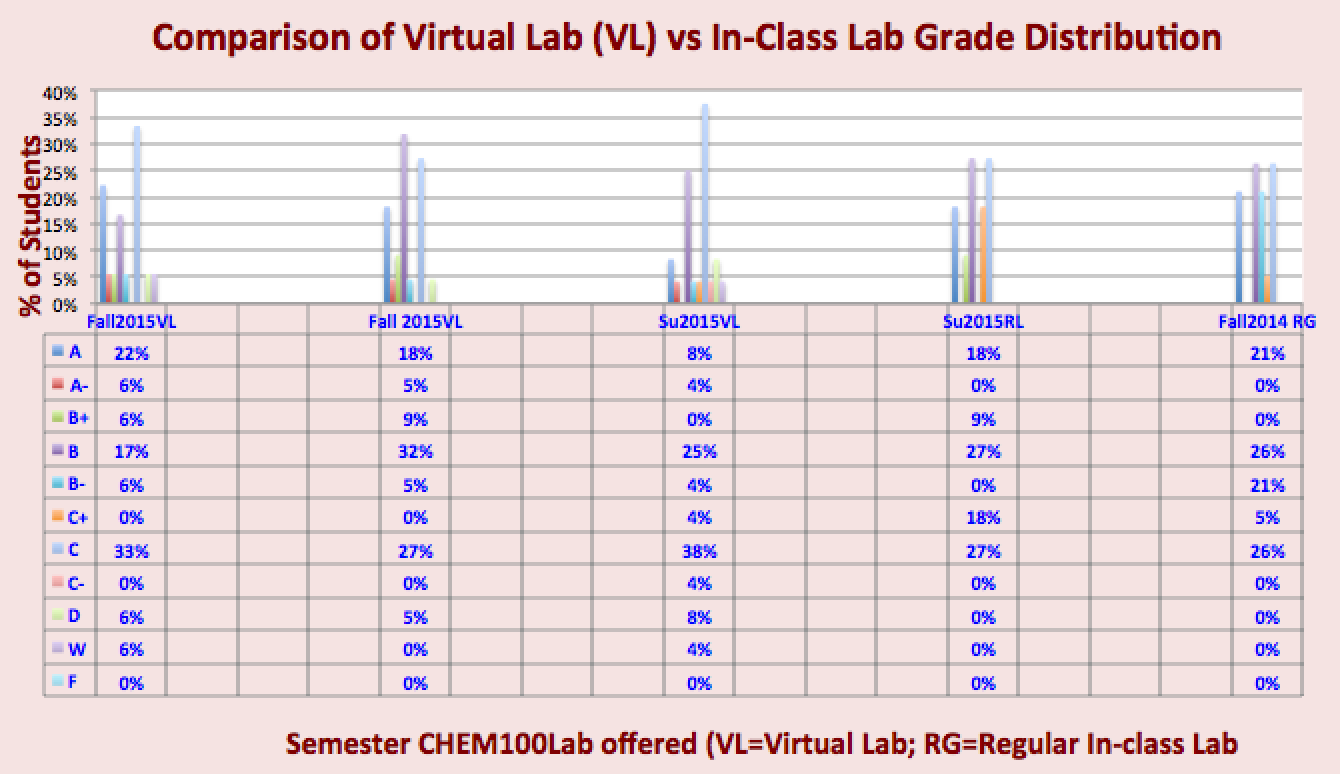
Grade Distribution Comparison Between CHEM 100 Virtual Labs and In-class Labs
- The Online CHEM100 Virtual Lab grades were similar to the Regular In-class Labs. The DWF rates have typically been low for CHEM100L labs in the past. The chart below compares the Grade distribution between the Virtual Labs (VL) and In-class Labs (RL).
Student Feedback
|
|---|
Course Redesign Impact on Teaching and Learning
Assessment Findings
- SOQ (Student Opinion questionaires) are posted below for the class from Summer 2015, when the class was first introduced.
- Comments were mostly positive and students seem to enjoy the class in general.
- The students grade distribution was similar to the Wet Lab grades. Of the 23 students,
- 3 Students earned A's
- 7 students earned B's
- 11 students earned C's
- 2 students earned D's
SOQ from Summer 2015 Chem 100 L class
SOQ from Summer 2015 Chem 100 L class
SOQChem100LCommentsSu2015
Student Comments on the Online Class offered for the first time in Summer of 2015
Student Feedback
Below are some of the comment from the SOQ (Student Opininion Questionaire) conducted by the Chemistry Department online for the Summer of 2015 when the class was offered for the first time at Cal State Fullerton (Irvine Campus branch). All of the comments and SOQ results can be found at the links above i.e. SOQ from Summer 2015 Chem 100 L class and SOQChem100LCommentsSu2015
Gitanjali Sathianathan, CHEM 100L-50
Online lab is a great way, safe and no waste
â—¦ The labs were not extremely difficult, but would still take some independent
learning to carry out correctly. Exams adhere to course contents and
lecture - there was never anything surprising. The reading was very
manageable.
â—¦ Highly suggest continuing these online labs! They were really fun! I had so
much anxiety going into this course for I am not great at chemistry, but
when I found out it was an online chemistry lab course I was able to
actually have fun while doing each lesson and was not stressed at all!
â—¦ It is difficult and time consuming, but overall it is an interesting class
â—¦ She was very encouraging and helpful throughout the class meetings.
â—¦ The labs were very user friendly and easy to navigate through considering I
am not very good at Chemistry!
Reflections
|
Lessons Learned & Redesign Tips
- The Online Labs doe require student attendance of Lab lectures. Students generally fared poorly when they did not attend lab lectures. In addition, the Lab lectures also needs to include a review of the previous experiments before the exam is taken by the students. Students tend to retain information better when reviewed at least twice.
- Online exams via Titanium in unmonitored environments pose the risk of plagiarism between a small group of students although a majority of the students do not reosrt to cheating. Therefore, proctored monitored environments free of electronic devices would be key to administering the exam simultaneously in a fair manner to all students.
Strategies Used to Increase Engagement
- Lab lectures with lots of student engagement. This was by far the most effective and preferred method for students. Four sessions were held which were three hours each and helped cover the details of three upcoming experiments.
- email communication to answer student questions.
- Office hours-for students who had questions on labs or who missed lab lectures due to emergencies, this was a good way of learning about the labs.
Instructor Reflection
- Pros
- Students did receive a good theoretical understanding of how the scientific method is implemented in every experiment.
- Lab lectures essential for communication
- Most of them understood the reason for performing common experimental techniques and how they achieved the goals.
- Were they to implement these in a real lab later, there may be a training period required to teach them to use of the actual glassware and equipment, however, the experimental protocols, methodologies and analyses would be easier for them to undertake after taking this online lab.
- Cons
- The major set-back in this class was students forgetting the online deadlines. Improved with email reminders.
- The program does not have randomized error generation capability. So it is an ideal set-up in a sense.
- Students also don’t learn safety measures or clean up or handle actual lab equipment. Simulated Labs.
- Experiments lack tactile and sensory perceptions.