Home
Math 120: Introductory to Probability and Statistics Redesign
Sam Behseta, California State University Fullerton, Department of Mathematics
Mori Jamshidian, California State University Fullerton, Department of Mathematics
sbehseta@fullerton.edu
Project Abstract
In this project, we consider redesigning the curricular foundations of the introductory statistics course at Cal State Fullerton. This is mainly approached through producing short videos that highlight the major themes of the class. Moreover, we aim to revisit the pedagogical aspects of the intro course in larger classroom settings, through utilization of audio-visula tools, as well as incorporation of R, the most popular statistical programming language. This course redesign will also provide training opportunities for the introductory statistics faculty.
CSU Course Redesign Website
Review the description of the CSU systemwide initiative supporting faculty redesigning their courses to improve student success.
The Need for a Redesigned Introductory Statistics Course
Math 120, the Introduction to Statistics and Probability, is considered a “bottleneck” course. A glimpse at our department data for Fall 2012, Fall 2013, and Spring 2013 reveals that the percentage of students who have failed the course (grades C- to F) during these semesters has been 21%, 27%, and 38%, respectively. This high percentage of failing rate as well as new goals dictated by the new era in data analysis calls for a major redesign of the course.
We are surrounded by massive amounts of data. The abundance of numerical information in our world has sharply increased not only the demand for, but also the value and urgency of familiarizing the current and next generations of college students with statistical literacy. As a consequence, typical introductory statistics courses have to adapt to the fast pace of technological and conceptual advancements, particularly in the areas of summarization, visualization, and analysis of large data. The traditional goals and pedagogical processes of introductory statistics courses will have to be reconsidered so that they would respond to the following immediate goals: a) training our students at the California State University so that not only they acquire statistical literacy, as partially reflected in their successfully passing the course; but also b) providing them with fundamental data analytical tools with which they can navigate through the quantitative aspects of course requirements in their respected majors.
Traditional introductory statistics courses mainly involved manipulation of small data sets and computation of statistical quantities by plugging in numerical values into abstract formulas. The current abundance of data begs employment of new and modern statistical techniques, and the need for students to be able to extract information from large data sets. Fortunately, statistical software is readily available for this purpose. This change of landscape, however, has required significant changes in the curriculum and the learning objectives in introductory statistics courses. In particular the method of plugin and compute a value has given its place to let the computer do the number crunching, and teach students the underlying and applicable statistical concepts. As a simple example, it’s no longer important for a statistics student to learn about the mechanics of producing a histogram, but rather it is crucial to learn how to extract information from a computer generated histogram, and how to set software parameters to produce a histogram that best represents the data. It turns out that the conceptual understanding of statistics is rather difficult for many students and thus new pedagogical approaches are needed; again a redesign in teaching of the course is of utmost importance.
At CSUF (like many other institutions) our Introductory Statistics course (Math 120) is frequently taught by non-tenure track and part-time faculty, some of whom specialize in fields other than statistics and are unfamiliar with the new trends and curricula. Training of these instructors is essential, so that the learning objectives of the course are meticulously conveyed to our students. In a small step in this direction, the Department of Mathematics has recently assigned a coordinator (Mori Jamshidian) to unify the course content and provide guidance to faculty who teach this course. This task is currently being rendered by the coordinator on voluntary basis without any assigned time, and as such the amount of faculty training that takes place is very limited.
Syllabus BEFORE Redesign
This is my original syllabus before the redesign.
Syllabus AFTER Redesign
This is my revised syllabus after the redesign.
On Major Revisions
Currently Math 120 consists of four parts, namely exploratory data analysis, methods of data collection, elementary probability theory, and statistical inference. To fulfill the modern course objectives, we plan to reduce the time allotted to the probability theory and spend more time in the exploratory data analysis, mainly by expanding visualization techniques, summarization of data with uncertainty, and statistical inference. To fulfil these goals, we propose the following technology-based approaches:
Students will be taught how to use the statistical program R for exploratory data analysis and statistical inference. A set of notes written by Jamshidian and Khatoonabadi (2013) and published by Cengage Learning for this purpose will be used in the classroom. These notes introduce the R software, include statistical examples relevant to our local areas of Orange County and Los Angeles County, and include class activities with the aim of teaching the fundamental statistical concepts.
Students will be required to watch a short clip (5 to 10 minutes) before each new topic is introduced. These short clips are to be produced by Sam Behseta and Mori Jamshidian and will aim at planting initial fundamental concepts into student thoughts. These clips are used to trigger initial thought and curiosity about the subject matter to be taught, so that when the material is presented with more details, students are ready to grasp the concepts and to ask questions to better their understanding of the fundamental course objectives. The clips will be enhanced with the modern and accessible technology (through software such as Adobe Captive, HTML, and Moodle) to include interactive learning features such as custom graphics, animation, and audio instructions, allowing for a more participatory experience in this class. These video clips will be available for Mac iOS, Windows, and Android platforms.
The redesigned program will be implemented in large classrooms, with instructors who will be accompanied by knowledgeable teaching assistants who will be carefully selected from our students in the Masters of Statistics Program.
As noted earlier, at this juncture, a considerable majority of the instructors who teach the introductory statistics course at Cal State Fullerton are either our teaching assistants with no intense training in statistical pedagogy, or are selected from non-tenure track part-time faculty with little or no training in the new statistical concepts, especially the aforementioned technological advances. Hence, instructor training is at the heart of this proposal. This training component would entail an all-day workshop focusing on familiarizing the instructors with the statistical software used as well as efficiently utilizing the video clips, and other technological tools. A second all-day workshop will be held, primarily to discuss pedagogical approaches for teaching Math 120 though real-life case studies, while reinforcing the objectives of the new curriculum in conjunction with technological devices.
We propose to divide the training into two portions: Two one-day workshops before the semester starts, and six 1.5 hour biweekly meetings during the semester. Instructors will learn (1) the R program (how to use it and how to teach it), (2) modern statistics curriculum content, (3) modern approaches to teaching statistics, (4) how to utilize the video clips and Moodle in their classes, (5) how to teach difficult exploratory and inferential materials, (6) how to effectively use the notes (by Jamshidian and Khatoonabadi), and (7) how to perform class activity and group work.
Supplemental instruction (SI) has proven to be an effective tool in students’ performance and grades. We recommend that we add an additional unit to the current 3-unit course for SI. This additional unit will be used mainly as a lab component for the course, and will not be a required component. In the SI sessions students will practice the needed computer skills and will go through various exercises to further facilitate their learning.
Why will the "redesign" lead to better learning?
The redesign program will provide a far more interactive environment of learning for our students as compared to the current teaching methods. The redesigned program strives upon keeping the same curriculum intensity and coverage of materials, while bringing the content up-to-date and improving the pedagogical aspects of the course with the pivotal objective of increased passing rate. The video clips will play a crucial role in this program. We will provide a thorough review of major concepts in both exploratory and inferential statistics through: 1- highlighting the main concepts, 2- articulating the aims of each segment of the course, 3- demonstrating efficient problem-solving techniques, and 4- posing thought-provoking problems for further class discussions. This will provide us with an ample opportunity to reinforce the learning objectives of the course during in-class activities.
Additionally, the four steps above will directly contribute to facilitating a more efficient environment for the dissemination of statistical ideas in conjunction with the main learning objectives of the class, namely understanding the varied ways in which mathematics is used in problem-solving, appreciating various applications of mathematics to real-world problems, performing numerical calculations, with knowledge of the underlying mathematics, and draw conclusions from the results, among others.
Course and Student Background
The introductory course typically attracts two groups of students: 1-those who have recently made a transition to university from high-school and due to their high school mathematics credits were able to directly register to this course, and 2- those who have successfully finished the remedial prerequisites for the course. The students in our Math 120 are quite diverse, in their background, spanning a wide-spectrum of majors and disciplines from humanities and social sciences to economics and finance.
Largely, the students are quite competent with technology. They represent a generation who is for the most part is comfortable with performing computer-oriented tasks and challenges, can easily navigate its way through the internet, multiple online links, and online discussion forums -- and more importantly can adopt the alphabet of statistical programming language quickly. As such, technology rarely poses a major challenge to an introductory statistics instructor.
On the Impact of the Redesign Course
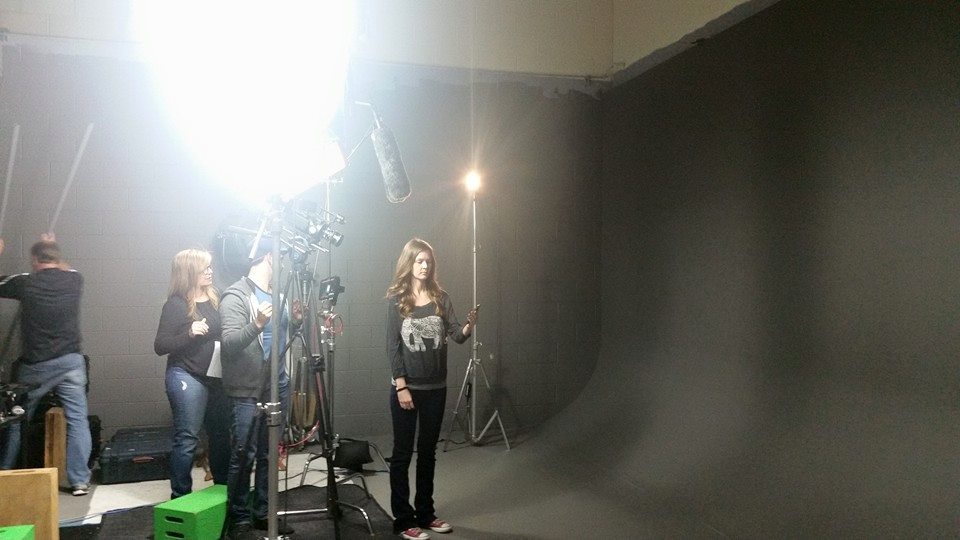
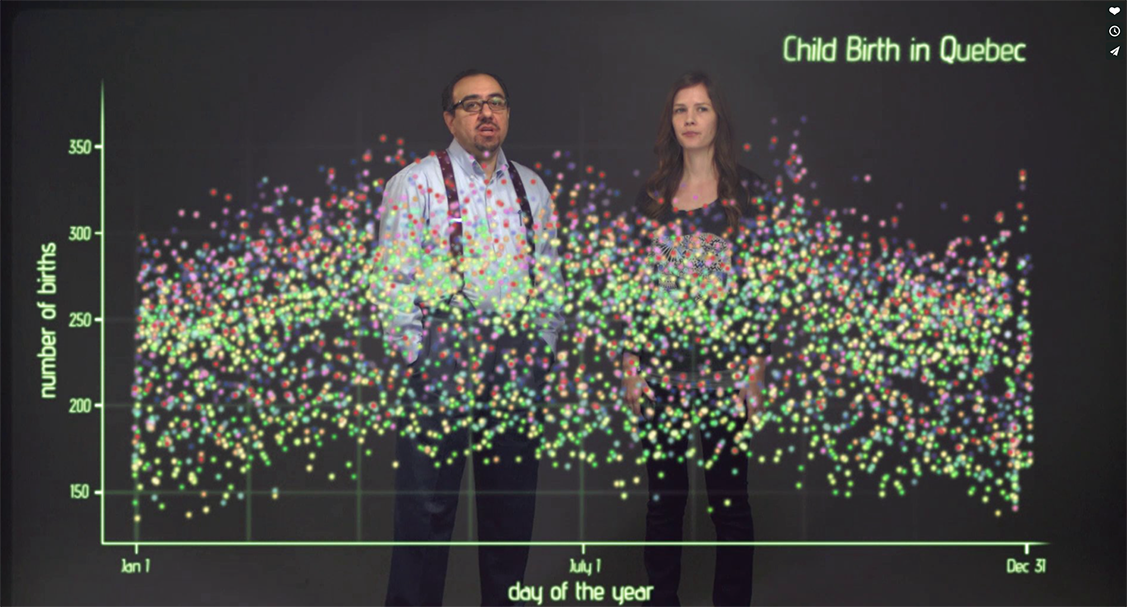
A key in this redesign proposal is the production of the statistics video series in collaboration with Glass Eye Productions Inc., a local video production company, currently in progress. There will be roughly nine episodes of 5-10 minutes length. The scripts for the series are written by the Co-PIs. Each episode takes about 8-10 hour of active shoot. Consequently, the impact of the redesigned course shall be determined upon the completion of the videos, and their utilization in the introductory statistics classes.
Briefly, our video series entitled "Statistics: An Introduction", will include topics in exploratory data analysis as well materials from inferential statistics. As for exploratory data analysis, we will demonstrate approaches for numerical and graphical summarization for univariate and bivariate data. The inferential statistics segments will cover the main ideas in topics such as hypothesis testing and confidence intervals.
Accessibility, Affordability, and Diversity
1. Does the technologies used in the redesign meet section 508 accessibility requirements so students with disabilities can have an equally effective learning experience?
We are developing innovative video series, currently titled "Statistics: An Introduction" in which the main conceptual themes of the introductory statistics course are presented to the students.
2. Are the technologies used readily available and affordable for your students?
The original technologies developed for this course will be fully available to our students -- free of charge: The video series can be downloaded and viewed in multiple platforms, including PC and Mac based computers, laptops, and other hand-held gadgets such as Andriod-based tablets.
3. Do the pedagogical strategies support students' learning with their diverse cultural, ethnic, and gender backgrounds?
The examples, case studies, and guidelines utilized in the video series are drawn from real-life scenarios. As such they will have a universal. More importantly, in various phases of data presentation, data analysis and visualization, as well as interpretation of statistical outcome, we shall remain sensitive and responsive to the students cultural, ethnic, and gender backgrounds.
About Us
Sam Behseta is a Professor of Statistics and Mathematics at the Mathematics Department, CSUF. He received his Ph.D. from Carnegie Mellon University in 2003. His main areas of interest are Bayesian Statistics, Statistics in Neuroscience, Statistics of Decision-Making, and Statistical Modeling of Education Data. Behseta's work has appeared in premier statistical, neuroscience, and machine learning journals such as, Biometrika, Neural Computation, and Neural Networks. He has taught a wide array of undergraduate and graduate courses at CSUF, including Statistical Learning, Bayesian Statistics, Categorical Data Analysis, Probability Theory, and Introductory Statistics. Behseta is the former editor of CHANCE, the magazine of the American Statistical Association (ASA), and is currently the associate editor of the Journal of the American Statistical Association (JASA), and the American Statistician, flagship journals of the ASA. His short CV is available here: http://mathfaculty.fullerton.edu/sbehseta/CV2014.pdf. Also see: http://mathfaculty.fullerton.edu/sbehseta/.
Mori Jamshidian is a Professor of Statistics and Mathematics at the Mathematics Department, CSUF. His work on a diverse body of statistical topics including incomplete (missing) data analysis, simultaneous inference, statistical computing and robust nonparametric estimation has appeared in premier journals such as Journal of The American Statistical Association (JASA), Biometrics, Statistics in Medicine, Journal of the Royal Statistical Society-B (JRSS-B) and Computational Statistics and Data Analysis (CSDA). Jamshidian has taught a wide array of undergraduate and graduate courses at CSUF including Advanced Mathematical Statistics, Computational Statistics, and the introductory course in statistics. In collaboration with his colleague Megan Khatoonabadi, Jamshidian has developed a series of R-based notes which have been published as a compendium by Cenagage Publications. This book is used in all sections of the introductory course at CSUF. For further information see: http://mathfaculty.fullerton.edu/mori/.
Curriculum Vitae
My C.V. with the details of my background and interests.
My MERLOT Member Profile
This URL shows my interests, learning objects, and other materials in my MERLOT profile.