Home
 Improving Student Performance in Web-based Biology 101 Courses
Krista Henderson
Department of Biological Sciences
CSU Fullerton
Course Name & Description: Biology 101: Elements of Biology. Description from the course catalog: Underlying principles governing life forms, processes and interactions. Elements of biology and reasoning skills for understanding scientific issues on personal, societal and global levels. For the non-science major.
Project Abstract: The redesigned version of Biology 101 online was offered in Fall 2014. The main focus is to increase student persistence and thereby increase the student pass rate. The redesigned course attempts to a) increase student engagement with the course material, b) give students more guidance on learning the required material, and c) identify struggling students and offering assistance. I have compared the pass rate of students who took the class online from prior semesters to the percentage of students who passed the course this semester.
Pedagogical Approaches:
- Reading/Viewing guides
- Implementing a topic based approach
- implentation of early interventions with students at-risk of not passing
GE Credit: 3 units which fulfills Scientific Inquiry and quantitative reasoning (B.2 Life Science)
Keywords/Tags: Introductory biology, online
Instructional Delivery: Online
About the Course and the Students Stage 1 |
Biology 101: Elements of Biology is a non-majors biology course that students take to fulfill a general education requirement. This project focuses on the sections of the course that are offered fully online. The online instructors have observed that there are more upperclassmen (juniors and seniors) in the online sections compared to the students in the face-to-face sections of the course. Students often comment in introductory discussion forums that they have delayed completing this general education requirement because they do not like science, and/or that science is a difficult subject for them.
Background on the Redesign
Why Redesign Your Course?
- Student persistence has been an issue in the online sections of the course. Students who do not pass the course have often stopped completing the course requirements partway through the semester. A major objective of the redesign was to to provide the students with more guidance while they are learning the material by providing them with detailed reading and viewing guides. Additionally, we wanted to find ways to reach out to students when they begin to struggle to encourage a higher rate of successful completion.
- Since many of our students are resistant to science, we wanted to find ways to engage the student more and relate biology to their everyday lives. To address this, the course was redesigned into modules that focus on current biological issues such as genetically modified foods and stem cell research.
How Will the "Redesign" Lead to Better Learning?
- Reading and viewing guides will help the student identify the key points that they should understand after they have completed the assigned reading and viewed the required lectures, videos and animations.
- Attempts will be made to identify struggling students - both those who are performing poorly and those who are not spending enough time working on the course material.
- The structure of the course is broken into two-week modules based on a current biological issue. To help them understand the relevance of these topics to their everyday lives, the module discussions often require them to read an article or view a short clip about biology in the news and express their opinion supported by facts about a controversy.
Course Learning Outcomes/Objectives
Student Learning Outcomes: The goals for Biology 101 are for student learning of the following major scientific ideas:
a. Living things are made of smaller structures whose functions enable the organism to survive.
Biology 101 Students should be able to:
- Define the characteristics of life
- Differentiate between the main classes of biologically important molecules.
- Summarize cell theory
- Explain the processes associated with cell growth & division
- Compare & contrast characteristics of prokaryotic & eukaryotic cells
- Relate cell structure to cell function
- Explain how an organism maintains homeostasis
- Organize functions within levels and explain relationships between levels of biological organization (cell, tissue. organ, organ system, organism)
b. Living things depend on each other and the physical environment as they interact to obtain, change, and exchange matter and energy.
Biology 101 Students should be able to:
- Describe how energy from the sun drives most activities on the earth's surface
- Sketch the flow of energy & matter through higher levels of biological organization
- Explain the ways in which organisms may interact
- Identify factors that affect population growth and decline
- Identify factors that affect ecological organization at the community & ecosystem level
- Assess the role of humans in natural systems
- Describe & give examples of the value of biodiversity & the natural world
c. The great diversity of living things is the result of billions of years of evolution of organisms through the mechanisms of heredity, random change, and natural selection.
Biology 101 Students should be able to:
- Illustrate the Central Dogma
- Explain & apply the basic principles of inheritance
- Summarize the evidence for evolution
- Describe how different processes (e.g. mutation, gene drift, selection) can lead to genetic differentiation and speciation
- Define and explain natural selection
- Interpret evolutionary relationships among organisms
- Explain how evolutionary principles & ideas influence daily lives (eg GMOs, AIDS, antibiotic resistance)
Biology 101 students will also possess the following skills:
Biology 101 Students should be able to:
- Retrieve information from a variety of sources (eg popular press, scientific papers)
- Apply the scientific method
- Critically evaluate data accurately (graphs, tables, text)
- Critically evaluate claims rather than accept authoritative statements
- Recognize the historical context of science
- Differentiate between science and non-science
- Analyze societal issues based on biologically sound principles
- Justify opinions on social issues related to biology (stem cells, GMO)
The above SLOs are department provided for this course. The redesign focues on the skills portions (last section) so students engage more in the couse which will help them master the other student learning outcomes. Since the focus of our redesign is increasing the percenage of students who pass the course, they must acheive mastery of all the above SLOs.
About the Students
Biology 101 is taken by the vast majority of student to fulfill their life science general education requirement. This means our students have a wide range of majors and prior experience with science. Students are required to complete an online readiness assessment the first week of the course to encourage them to self-assess if the online learning environment is compatible with their learning style. Most of the students are full-time (self-report on mid-semester survey, 97% are taking four or more classes). About one-third of students took Biology 101 as their first online course (33%, self-report).
Advice I Gave my Students to be Successful
The syllabus includes information about helpful resources available on campus including free tutoring. In addition, expectations about student participation and responsibilities are outlined in detail in the syllabus and the course introduction presentation. The following is the statement from the syllabus:
Participation and Responsibilities
Students are expected to:
- Spend 5-7 hours each week on this course. You may spend slightly more or less depending on your level of knowledge and work habits, but be prepared to spend a significant amount of time on this class.
- Check their fullerton.edu email daily for course updates.
- Read assigned material in the text, and view ALL lecture and support material and take quality notes using the reading and viewing guides.
- Listen actively to lectures – think about the material
- Ask questions to both the instructor, and your classmates (via message boards)
- Complete all assignments– PrepU quizzes, exams, discussions, assignments, and papers – independently.
- Keep track of deadlines
- Check your grades weekly
- Students are required to save digital receipts. If there is ever a question about whether an assignment was submitted, the digital receipt (from Turnitin.com) is the ONLY evidence of submission that will be accepted.
- Students are expected to know and follow rules of “netiquette”. See resource information at http://www.albion.com/netiquette/corerules.html
Challenges my Students Encountered
The results from the mid-semester survey identified what students are finding challenging. Many students commented that finding the time to devote to coursework was their biggest challenge. Others found that completing and understanding reading assignments was very challenging.
About Me
Krista M Henderson, M.S.
California State University, Fullerton
Department of Biological Sciences
khenderson@fullerton.edu
I am a former K-12 teacher who has been teaching general biology at CSU - Fullerton for the last 9 years. I am particularly interested in the integration of technology into both on campus and online classes. My goal for my non-major students is to demonstrate the relevance of biology to their everyday lives, and to assist them in developing science literacy skills that will help them learn more in the future.
K Henderson CV
curriculum vitae for K Henderson
Accessibility, Affordability, and Diversity
Accessibility
- Recorded mini-lectures include a transcript of the audio.
- Any video/animation is captioned.
- Materials are presented in a variety of different ways (reading assignments, animations, audio, etc.)
- Utilization of a variety of assessments to measure the students’ understanding of the material.
Affordability
- Students may purchase or rent the required text in a variety of formats (bound, loose-leaf, eBook)
Diversity
- The discussion forums provide the students the opportunity to express their opinions and experiences relating to the course content.
- Links to additional materials and tutorials are provided within each module for students who are struggling to master the material due to a weak background in science.
Teaching and Learning Resources
MERLOT II
MERLOT is a collection of free and open online teaching, learning and faculty development services contributed and used by an international education community. The MERLOT collection of open resources spans across a wide variety of disciplines and education levels. What sets MERLOT apart is a combination of peer reviews, member comments, learning exercises and other valuable information and metadata associated with the materials.
MERLOT II's Pedagogy Portal
The MERLOT Pedagogy Portal is designed to help you learn about the variety of instructional strategies and issues that could help you become a better teacher. The resources you’ll find in the Pedagogy Portal should apply to teaching a variety of disciplines.
CSU Course Redesign Website
Review the description of the CSU system-wide initiative supporting faculty redesigning their courses to improve student success.
Course Redesign ePortfolio Exemplar
An example of an ePorfolio created by faculty at CSU East Bay to exhibit their course redesign project and their findings.
Course Redesign Faculty Experiences
Lessons Learned & Tips
Teaching Tips
- Organize consistently - Make sure that each section of the course is set up in the same way, so that students can find and access all of the material without searching. Preventing frustration goes a long way to helping students be successful.
- Provide structure - The students in this course were provided learning objectives in advance of completing the material. These objectives were cumulatively the study guide for exams. This makes the expectations of what students are supposed to learn clear as they start the learning process.
- Limit the amount of lecture material - Students in my class has very limited amounts of lecture material. I have been teaching online for a long time, and have found over the years that students will not view large amounts of lecture. Keeping lectures short increases the students use of the material.
- Reach out more - I was genuinely surprised at the positive reactions I received to my contact with failing students. I think sometimes online students feel isolated from the instructor. The personal contact opened the lines of communication, and I believe helped the students feel more comfortable contacting me.
- Reach out earlier - Because reaction to personal contact was so positive, I wished I had made the contact earlier in the semester. KIn the future, I will begin making contact after the 3rd week of class (when the students have completely the first module).
- Make positive contact - I intend to send more personal emails in the future, and would like to add more positive ones ("I appreciated your insight on the discussion board this week when you shared...", "You did an excellent job with... Kepp up the good work", "I noticed how much better you performed on this second exam - good job!")
Course Redesign Obstacles
In the summer of 2014, our campus IT department reported that we now had access to analytics through Moodle. I was excited about using these as part of the redesign. I wanted a way to identify students who were not spending enough time on the course. The intention was to direct different resources to students not putting in the time than to those who were spending time but still performing poorly. I would still be very interested in doing this. Unfortunately, no one on the campus seemed to know how to use the analytics. I made multiple attempts at finding an online resource that explained the different parameters and how Moodle calculates them, but did not find satisfactory information. Not knowing the assumptions the analytics were based on, or how to control the paratemeters, I was unable to incorporate analytics into this redesign. However, I am still attempting to find this information as I ultimately believe it would be invaluable to an online instructor.
One of the biggest issues I have with the online course is providing enough material without overwhelming students with too much material. The addition of the "Confused? Click Here" section to each module allowed me to have extra material (primarily videos and animations) readily available to any student who needs it. Many students reported using this section, and I believe it worked well because students controlled which resources they chose to use. I would like to find a way to add more active practice material, rather than passive videos. As part of another course redesign, I created a series of online tutorials covering multiple difficult topics within biology. I initially did not provide them to my online students for fear of overwhelming them. Based on the success of the other additional resources, I believe I will customize and extra practice set of tutorials for use by the online students.
Strategies I Used to Increase Engagement
- Each module within the course was centered around a current topic in biology of interest to the general public (GMOs, stem cells, sexually transmitted infections).
- Short, specific lectures were used rather than longer ones in order to hold students' attention.
- An opinion poll at the beginning of the semester asked students about the topics they would study. Do they think GMOs are safe? Would they undergo genetic testing? Do they support stem cell research? I provided the students with the results of the class poll each time we began discussing one of these topics. Several students commented that it was interesting to see the results. And many commented in the discussion boards that they had changed their mind after learning more about the topics.
Course Redesign Results Stage 2 |
The Redesigned Course
The following images show different aspects of the redesigned course as it displays on the course page in the LMS (Moodle).
Student Learning Outcomes and Learning Objectives (Study Guide)
These are present at the top of each module page, so that students know expectations in advance.
Student Learning Outcome (from syllabus)
a. Living things are made of smaller structures whose functions enable the organism to survive. Biology 101 Students should be able to: Organize functions within levels and explain relationships between levels of biological organization (cell, tissue. organ, organ system, organism)
(truncated)
To demonstrate you have met this objective you should be able to do the following by the end of this module:
- Compare asexual and sexual reproduction, noting the advantages and disadvantages of both
- Explain the differences between oviparity, ovoviviparity, and viviparity
- Know the function of all reproductive organs, and be able to label on a diagram (uterus, vagina, cervix, fallopian tube/oviduct, ovary, testis, seminiferous tubule, epididymis, vas deferens, seminal vesicle, prostate, bulbourethral gland)
- Describe the structure and development of sperm
- Compare and contrast spermatogenesis and oogenesis
- (truncated)
Module Set Up:
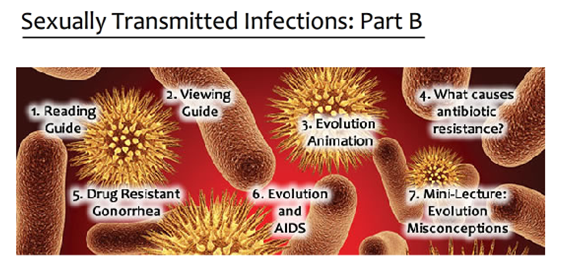
All course modules are set up the same, with the same order and names of links, so students always know where to find their materials.
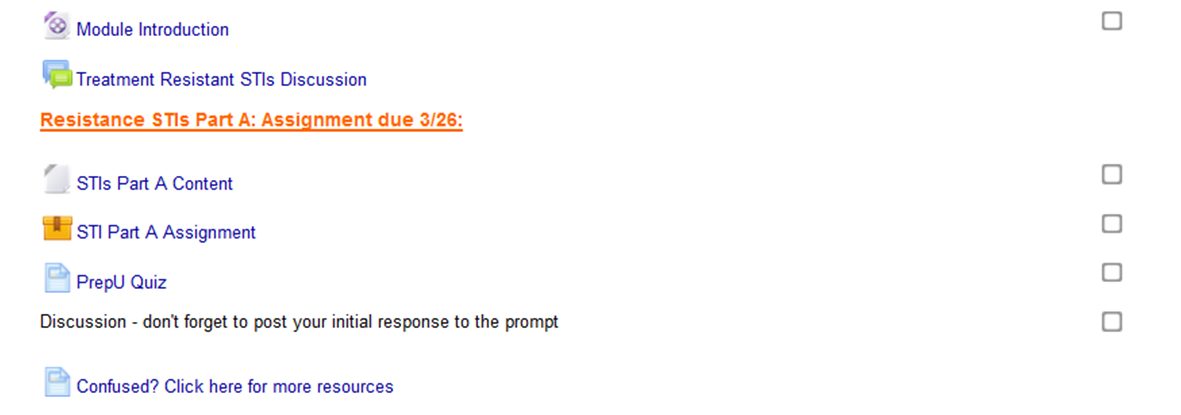
Clickable Interfaces
Each module of the course contains a clickable interface with the links to required information. This provides a visually appealing way for students to access all of the information they need, including files (reading and viewing guides) as well as links (lectures and animation). Please note: this is a picture of the interface - the links on this picture are not functional.
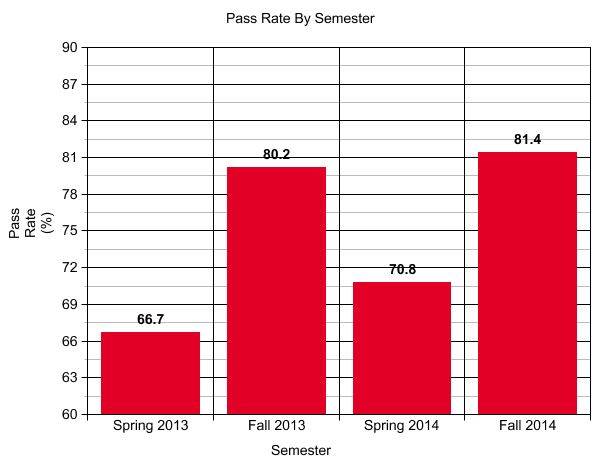
The graph above displays the pass rate (grade of C of better) for students in K. Henderson's online Biology 101 courses. Notice that the pass rate has varied significantly over the previous 2 years.
Results/Findings
What Did You Change Through the Redesign?
- Provided the students with reading and viewing guides to help them identify the key points that they should understand after they have reviewing the course materials (reading, lecture, etc). A sample reading guide is linked below.
- Changed the structure of the course from individual topics to 2-week modules based on a current or controversial topic in Biology. These were designed to be more interesting to students, and to help them identify the importance of the subject matter to their daily lives.
- Provided an extra section of resources for each module (titled "Confused? Click Here for Help"). These are primarily videos that review diffiuclt course concepts. Students who are having trouble understanding a topic can click on the extra resource link.
- Identified and contacted students who were performing poorly mid-semester with suggestions on how to improve their grade, and information on getting extra help.
My revised syllabus includes highlighted areas that were redesigned. [See link below].
Course Redesign Impact on Teaching and Learning
- The pass rate for Fall 2014 in this course was 81.4%. This is much higher than the average pass rate for the previous 3 semesters (72.6%), however, the range of pass rates was for the previous semesters was wide - from 66.7% to 80.2%. Therefore, I an unable to determine whether the pass rate for the redesigned course was signifcantly better than previous semesters.
- Just over half of students reported using the reading guides (55% per the mid-semester survey); slightly more (66.7%) reported using the viewing guides. Those that used them rated them very helpful (39%) or somewhat helpful (61%). Some students who were not completing the guide reported that they did not think they were helpful (13%) but most non-completers reported that they ran out of time to complete them (57%).
- 34% of students reported using the links to additional information ("Confused? Click Here for Help") and most found them to be very helpful (57%) or somewhat helpful (43%).
- At the middle of the semester, I contacted 26 students whose grade was a D+ or below at that time. In that contact, I gave the students some tips on how to improve their progress in the course that was customized to the student's major issue (poor performance or missing assignments). I also provided tutoring information. Out of those 26 students who were not passing mid-semester, 13 earned final grades of C or better.
- Of the 26 students who were sent an email about lack of progress, 9 replied. Most thanked me for taking an interest in their performance, and several asked questions on how to get help with issues that were impacting their learning. Of those 9 students, 6 passed the course with a C or better, 1 withdrew for medical reasons, and 2 earned grades of D or F.
How were the findings assessed and how do they meet the course learning outcomes to assure the continued quality/academic standards of the course?
- In order to assess the effectiveness of the course redesign, I compared pass rates from the redesigned course to pass rates for the previous couse (an average pass rate for the previous 3 semesters). A student "passed" if he/she earned a non-repeatable grade (a C or better). Non passing grades were D+ and below, as well as students earning a W (authorized withdrawal) or WU (unauthorized withdrawal).
Student Feedback
Overall Student Comment Sent By Email
- "thank you for all your help during this semester. You're very organized and I appreciate professors that are like that. "
Positive Student Feedback From Mid-Semester Survey - Reading Guides
- "they motivate me to read the whole chapter thoroughly"
- "I think they are full of helpful information, for myself its sorting the important info and extra fluff out that is difficult."
Positive Student Feedback From Mid-Semester Survey - "Confused? Click Here for Help" Resources
- "These are the best resources in my opinion!"
- "The videos help because I am a visual learner so it shows a different perspective of what we should be learning"
- "They are very helpful when i need more information about the material"
Biol 101 Course Syllabus
Biol 101 syllabus with changes highlighted
Sample progress email sent to students
Example of an email sent to a student who was performing poorly in the course. The email included suggestions for improvement.
Sample Reading Guide
Example of a reading guide provided to students. The reading guides correspond to sections in the course text.
Instructor Reflection
I have been teaching this particular course online for over 7 years and have completely redesigned the course several times. Each of the previous redesigns were based solely on my experience as an instructor with my particular course. While each redesign has left me with a course that was better than before, I was limited to my own knowledge. While I try to keep up to date on new technologies, I accept that there are materials out there of which I am not even aware. This redesign experience was much difference from my earlier ones in that I had the support of a Professional Learning Community, and the ability to see what other instructors were doing with their courses. While all aspects of the redesign experience were helpful and contributed to the success of the final course, I especially appreciated the community and the pedagogical and technological learning involved.