CSU Long Beach QA ePortfolio
Proposal Summary: California State University, Long Beach (CSULB) is a diverse, student-centered, globally engaged public university committed to providing highly valued undergraduate and graduate educational opportunities through superior teaching, research, creative activity and service for the people of California and the world. As an institutional member of the QM program, which is nationally recognized for its peer-based approach to quality assurance and continuous improvement of online and hybrid course design, we, at CSULB, have had various peer review opportunities for quality assurance. We have established a tiered pipeline that will move our faculty through various stages of the Quality Matters standards, through three different programs. These programs aim to build upon each other to help faculty build a strong foundation of design for their online content no matter which modality they will be teaching. These programs will also implement peer review opportunities for QA. Programs will be supported by live training options provided by Academic Technology Services (ATS) and offered in tandem with trainings from the Faculty Center (FC) and Chancellor’s Office (CO).
Campus Goals
- Help faculty create quality courses using CSULB’s three-tier program pipeline based on QM rubric to prepare courses to be sent to the CO for formal QM certification.
- Refine peer review process into CSULB’s three-tiered online course professional development approach to utilize and expand the current community or QM Certified peer and Master reviewers. Faculty will gradually move through these tiered professional programs.
- Increase the amount of Quality Assurance workshop certifications achieved by CSULB campus stakeholders including but not limited to the various QM workshops focused on course design and delivery improvements as well as accessibility.
- Increase the number of QM Certified faculty Peer Reviewers and/or Master Reviewers, so ultimately we can increase the number of QM certified courses. We are achieving this goal by providing opportunities for faculty to become, peer reviewers and master reviewers. Therefore, we have established a team of in house QM certified faculty peer reviewers who eventually will become master reviewers. As a result there would be an increase in the number of our formal course reviews.
Increase the community of peer and master reviewers and provide funding for certification. - The instructional design team will continue to work with faculty and conduct informal reviews using the QM rubric.
QA Lead
- Nancy Quam-Wickham
Professor, College of Liberal Arts, History Department

Supporting Campus Partners
Our campus partners include Academic Technology Service’s instructional designers, deans and associate deans of the eight colleges as well as faculty representatives from each of the eight colleges’. Moreover, ATS is partnering with the campus Faculty Center as well as the Accessible Instructional Materials Center (AIM).
In addition, Instructional Materials center, the Bob Murphy Accessibility Center, and ATS will continue to work together and deliver sustainable training workshops for both faculty and staff on different topics such as accessibility, inclusion, student success, online assessment and academic integrity.
Campus Commitment Toward Sustainability of QA Efforts
- Quality Assurance will continue to be integrated in to ATS’ course conversion process, as well as the professional development programs.
ATS will continue to promote and implement the Chancellor’s Office quality assurance course offerings, as well as begin to offer in-house QM trainings to CSULB faculty.
Instructional designers will continue to conduct QM internal reviews and work closely with faculty.
CSULB will continue to work with faculty in preparing more courses for formal QM reviews; as a result, increase the number of QM certified courses.
CSULB is also striving to increase the number of in house AAPQMR,
We now have three IYOC and two APPQMR in-house facilitators , so we can provide in house QA workshops for the CSULB faculty.
Previous QA Accomplishments
- CSULB encourages their staff with professional development opportunities. All instructional designers are certified as Peer Reviewers and continue to enroll in QA courses offered through QM for professional growth. New staff that were hired also moved toward being a Peer Reviewers and enrolled in QM courses. As a result of previous successful course conversion workshop trainings, ATS has established a positive relationship with the College of Business (COB) and streamlined an informal review process for the Online Master’s of Business and Administration (OMBA) program. It is our expectation that the COB will serve as a model for other colleges to follow and that the value of quality course design is achieved by taking a quality assurance workshop with the staff of ATS, and participating in college strategic planning and departmental incentive programs such as ATS's course conversion program. CSULB applied HEERF allocated money towards stipend based programs that resulted in 270 faculty from each and every college across campus completing ATS's in-house quality assurance programs.
Training Completions
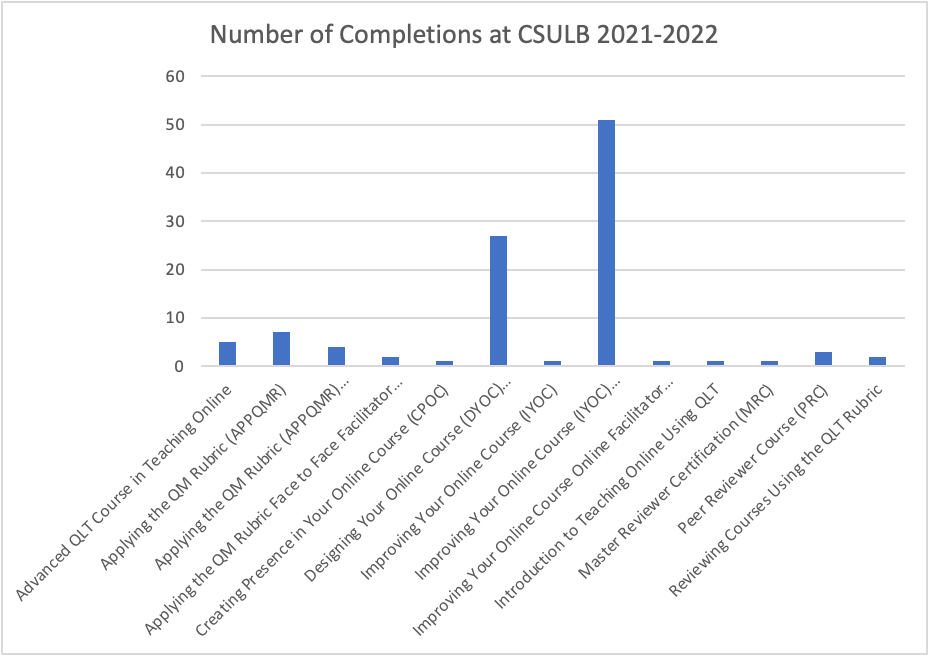
The table below summarizes the overall QA training completions for 2021-2022 including campus-based and CSU offered QLT/QM courses
| Training | Number of Completions |
| Applying the QM Rubric | 11 |
| QM Peer Reviewer Course | 3 |
| Improving Your Online Course | 52 |
| Designing Your Online Course | 27 |
| DYOC Facilitator Course | 0 |
| IYOC Facilitator Course | 2 |
| APPQMR Facilitator Course | 2 |
| Intro to Teaching Online QOLT | 1 |
| Advanced QLT Course in Teaching Online | 5 |
| Total | 103 |
Course Peer Review and Course Certifications
ATS has established a three-tiered stipend based professional development program. Our three-tiered PD program pipeline will require faculty to demonstrate application of the QM standards presented into the teaching. Throughout these professional development offerings, faculty will also be able to engage in peer review process with faculty peer/master reviewers. The peer review process provides faculty the opportunity to become more familiar with QM standards. These programs will not only prepare CSULB faculty for online/remote instruction, but also allow the faculty the opportunity to become more involved in QA via the QM Rubric, and ultimately certify their courses with QM certification.
As a result, we saw increases in the number of completions over the 2020-2021 academic year in DYOC, and APPQMR facilitator completions. The College of Engineering, in collaboration with Academic Technology Services has implemented a process of course review that resembles QM's structure and other colleges are interested in following this model with the end goal of certifying their courses with QM certifications. Courses from each college will be selected for the formal review. Moreover, individual faculty from other colleges are also interested in certifying their online courses with QM certification.
Development of Campus QA Resources
Accessibility/UDL Efforts
- In collaboration with the Accessible Instructional Materials center and the Bob Murphy Accessibility Center, ATS has established and delivered sustainable training workshops for both faculty and staff on accessibility and universal design.
On monthly bases, ATS instructional designers are delivering Blackboard Ally training workshops. Through these workshops ATS has established accessibility awareness among CSULB faculty and staff.
ATS also conducted the Blackboard Ally pilot program, where a group of well-trained students assistants helped faculty in making their course content accessible.
ATS instructional design team will continue to provide accessible course design training and implement quality assurance standards in their course conversion program.
ATS in collaboration with the bookstore, the Bob Murphy Accessible Center and the Accessible Instructional Materials Center, will work with all eight colleges and their departments to be pro-active and to provide presentations, resources and explain our campus accessibility efforts and to create accessibility awareness in our campus.
Next Steps for QA Efforts
- Continue to provide faculty with our three-tiered PD programs throughout the year.
- Recruit new faculty to be part of our community of practice
- Expand our quality assurance community of practice and pay for faculty’s professional development such as the PRC, APPQMR, facilitator courses, etc.
- Provide an incentive professional development program focused on accessibility and remediation training.
- Provide training for the instructional design team so that they can be certified to facilitate the DYOC/IYOC QM course.
- Continue to work closely with our identified QM lead and provide faculty with training workshops and open sessions on how to meet QM standards.
- Work closely with identified colleges in developing course programs and implementing Quality Matters. This will entail specific training for each college that we work closely with.
- Work with the College of Business and the College of Engineering in preparing some of their programs for QM certification and quality assurance.