AY 2021/2022 at San Diego State University
AY 2021/2022 at San Diego State University
San Diego State University spent the 2021/2022 academic year attempting to maintain and grow its Quality Assurance efforts in the face of the ongoing and ever-transforming COVID-19 global pandemic. Focused on the three Campus Goals for Quality Assurance listed below, we celebrate our progress and note the need for continued efforts going forward. These times demand nimble responses from institutions of higher learning and SDSU is well-equipped to leverage lessons learned since March 2020 to improve the quality of teaching and learning on campus. So, in the face of an uncertain future, we are committed to, as Dory in Finding Nemo might say, "just keep swimming..."

Campus Goal for Quality Assurance
Our goals at SDSU for QA during the 2021/2022 academic year were as follows:
- Leverage Canvas Outcomes functionality to standardize SDSU program and department-wide student learning outcome processes
- Maintain, refine, and share SDSU’s Flex-CDI Toolkit with CSU colleagues and others via a Creative Commons license in the Canvas Commons repository
- Grow and formalize SDSU’s use of QLT as the campus standard for QA efforts in online teaching and learning in collaboration with ITS Faculty Fellows, SDSU Global Campus, and other SDSU campus partners
Quality Assurance Lead(s)
- Mark Laumakis, Ph.D., Lecturer, Department of Psychology and Faculty in Residence, Instructional Technology Services (ITS)
Supporting Campus Partners
James Frazee, Deputy Chief Information Officer
QA Resource Team Faculty
Katie Hughes, ITS Faculty Fellow, Arts and Letters
Beth Pollard, ITS Faculty Fellow, Arts and Letters
Stuart Voytilla, ITS Faculty Fellow, Professional Studies and Fine Arts
Center for Teaching and Learning (CTL)
SDSU Global Campus
Campus Commitment Toward Sustainability of QA Efforts
We plan to complement and sustain the momentum gained via OCS funding and support via a variety of on-campus partnerships and programming. These activities will include co-hosting Center for Teaching and Learning events, ITS-led workshops, and other face-to-face and virtual programming. Additional synergies exist in collaborations between ITS and the SDSU Library, Global Campus, and other units including the Center for Inclusive Excellence. The unifying theme in these partnerships and collaborations is ensuring the quality of the student experience in all courses at SDSU, whether they are in-person, hybrid, or fully online.
The QA Resource Team includes:
Mark Laumakis, Faculty in Residence ITS and QA Faculty Lead
- Beth Pollard, History
- Stuart Voytilla, TFM
- Katie Hughes, RWS
- Andrea Saltzman, ID, Instructor
- Linda Woods, ID, ITS
- Phil Denman, ID, ITS
- Jon Rizzo, ID, ITS
Summary of Previous QA Accomplishments
Exploring the Canvas LMS:
faculty began opting in to using the LMS
an initial course template was provided which includes
accessible syllabus template
course accessibility report
course planning grid
quality assurance course design checklist
Evaluation of Canvas LMS Campus pilot:
Faculty and students preferred Canvas
Faculty assigned Canvas a 3.4 GPA or B and Blackboard a 2.0 or C-
Students assigned Canvas a 3.5 GPA or B+, and Blackboard a 2.9 or C+
Progress on Campus Goals for Quality Assurance
- Leverage Canvas Outcomes functionality to standardize SDSU program and department-wide student learning outcome processes
- Progress: Members of the OCS Campus Team hosted a very well-attended Zoom meeting regarding the Canvas Outcomes tool during the Fall 2021 semester. Attendees included Associate Deans from every College, as well as other stakeholders for whom program and department-wide student learning outcome tracking is a major point of focus. The rollout of this tool continues this Spring. Several Colleges are interested in this Canvas Outcomes tool as a way to centralize their efforts regarding accreditation and view it as a superior way to achieve those and related goals. We anticipate continued growth in the use of this tool at SDSU in the next few years, beyond those three credential programs identified initially. Also noteworthy is alignment with our Office of Assessment, Curriculum and Accreditation.
- Maintain, refine, and share SDSU’s Flex-CDI Toolkit with CSU colleagues and others via a Creative Commons license in the Canvas Commons repository
- Progress: We completed the process of publishing the course in the Canvas Commons repository with a Creative Commons license. The course is available here: https://lor.instructure.com/resources/1b3574e6302a4b52b592e1b9f2117b0b?shared. The SDSU OCS Campus Lead shared this valuable resource with CSU colleagues who are part of the monthly CSU Online Course Services Professional Learning Community. There was considerable interest from those who attend that PLC meeting each month, as they are the front-line staff who help run faculty development programs throughout the CSU and they are always looking for materials to share with faculty. They appreciate the need to not have to reinvent the wheel regarding online course development materials to use with CSU faculty members. The Flex-CDI Toolkit in the Canvas Commons repository has been downloaded 19 times since being posted on October 22, 2021.
- Grow and formalize SDSU’s use of QLT as the campus standard for QA efforts in online teaching and learning in collaboration with ITS Faculty Fellows, SDSU Global Campus, and other SDSU campus partners
- Progress: We began working with a cohort of 18 instructors in the Spring 2022 offering of the long-running Course Design Institute (CDI). The updated design of the CDI requires that CDI participants will use the QLT at four separate points in the training: (1) to do a brief self-review of their current course, prior to the start of the CDI, (2) to guide the CDI staff and peer evaluators through their course during two share-outs with other participants as the CDI training progresses, (3) to do a review of their course at the conclusion of the CDI, and (4) to do a review of their course after it is offered for the first time during the 2022 Summer Session. A total of 18 instructors completed the QLT Self-Review prior to the start of the training (one instructor subsequently resigned from her position at SDSU). Results were shared with those CDI participants and we used the results of those Self-Reviews to inform the customization of plans for the Spring 2022 CDI, highlighting areas of perceived need and prioritizing those topics in the timing and sequencing of our collaboration with those CDI participants. This feedback will also inform the new SPOT program.
Training Completions
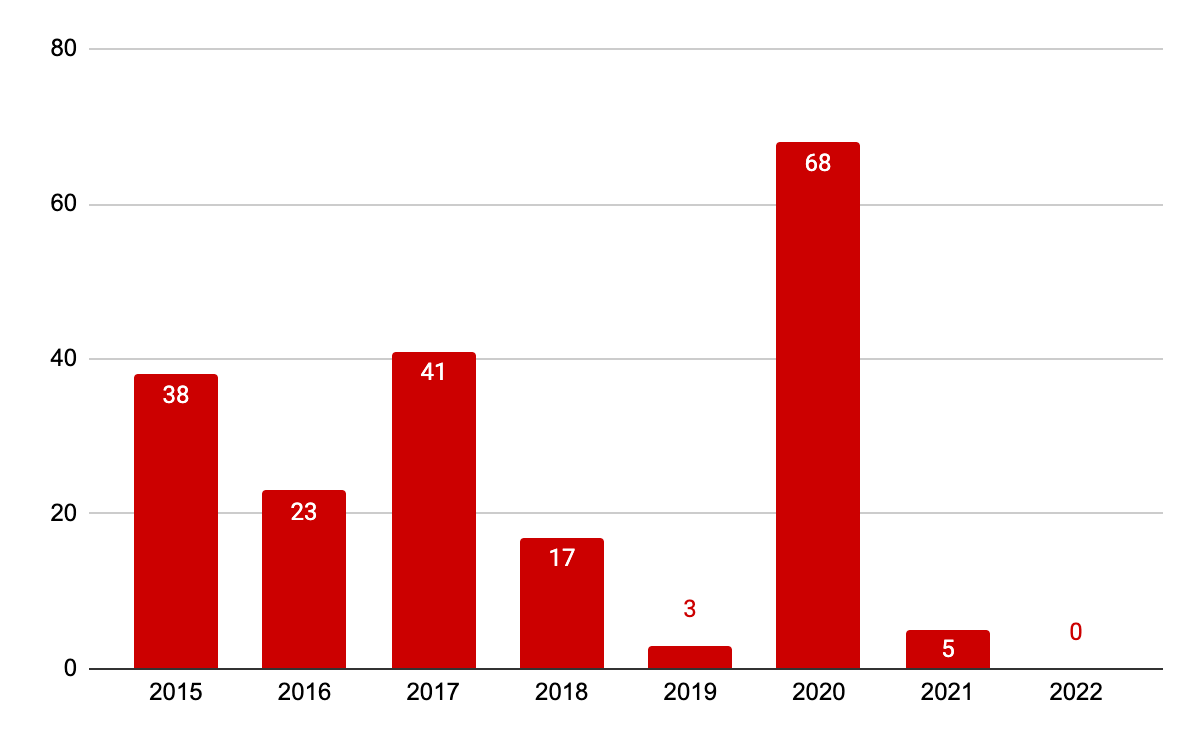
SDSU has completed 195 QA trainings from 2015 through 2022.
Course Peer Review and Course Certifications
We continued to make progress with course peer reviews during the 2021/2022 academic year. Specifically, we were able to complete 5 informal course reviews of fully online courses taught by faculty who are alumni from our long-running Course Design Institute, which, since 2008, has helped more than 200 SDSU instructors develop rich, engaging fully online courses.
Reviewers included the following:
- Phil Denman, ID, ITS
- Katie Hughes, RWS
- Mark Laumakis, Psychology and ITS
- Jon Rizzo, ID, ITS
- Andrea Saltzman, ID, College of Education
The 5 courses reviewed were:
- Noah Arceneaux, JMS 494, Media Law and Ethics
- Maya Ginsberg, MUSIC 351, Music and Culture: Hip Hop
- Nancy Jones, ACCTG 333, Accounting Information Systems
- Scott Lipscomb, MUSIC 152, Rock History to 1980
- Sonya Schumann, MUSIC 151, Intro to Music: History of Rock
Student Quality Assurance Impact Research
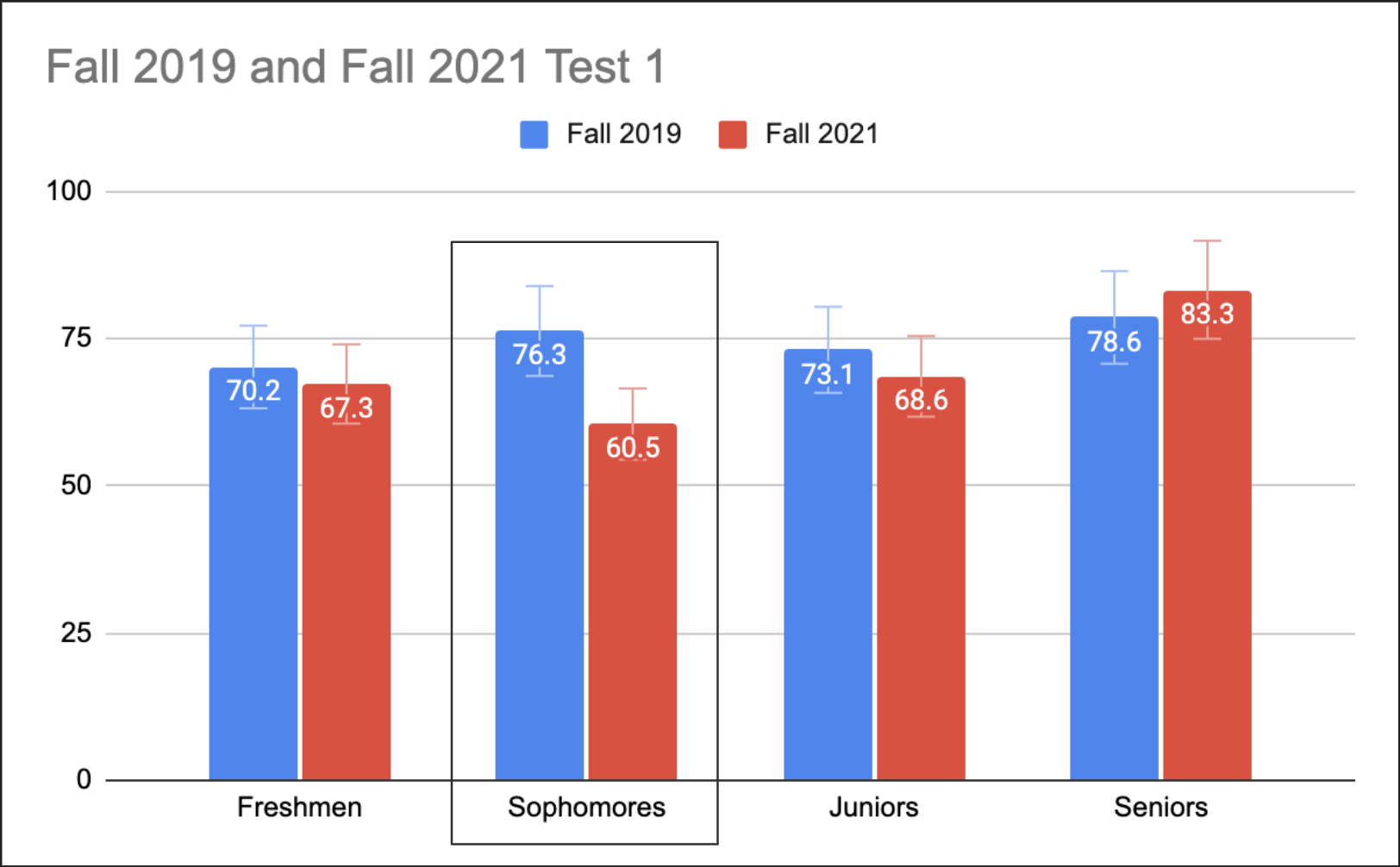
Our SQuAIR research this year focused on student performance as students returned to the in-person classroom in the Fall 2021 semester. Early evidence from one large Introductory General Education course, PSY 101 (Introductory Psychology), taught by Mark Laumakis, QA Faculty Lead, indicated that Sophomores in particular were struggling academically. Data from PSY 101 on all 4 tests followed this same pattern shown on Test #1, with Sophomores underperforming vs. their pre-pandemic performance:
We subsequently gathered course grade data from five high-demand STEM courses in the College of Sciences for both Fall 2021 and Spring 2022 to see if these findings from PSY 101 generalized to those other courses. Those courses included the following:
- CHEM 100 - Intro to General Chemistry
- CHEM 200 - General Chemistry
- MATH 150 - Calculus I
- MATH 151 - Calculus II
- STAT 119 - Elementary Statistics.
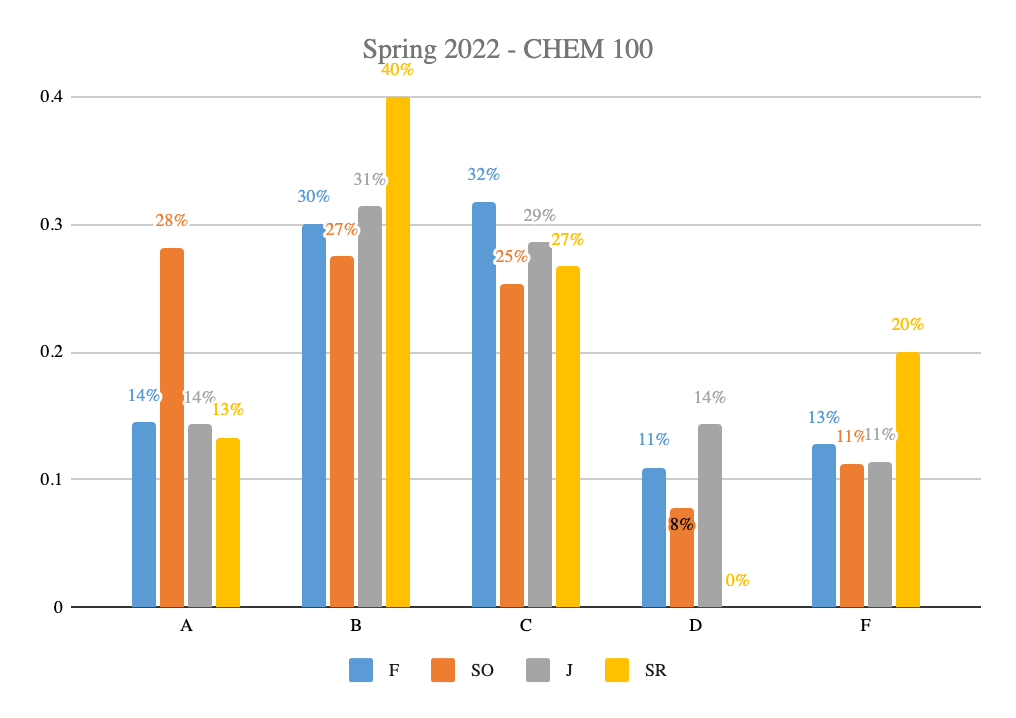
Results did NOT indicate significant problems in course performance for those other courses by Sophomores, as exemplified by these data from CHEM 100 in Spring 2022:
Development of Campus QA Resources
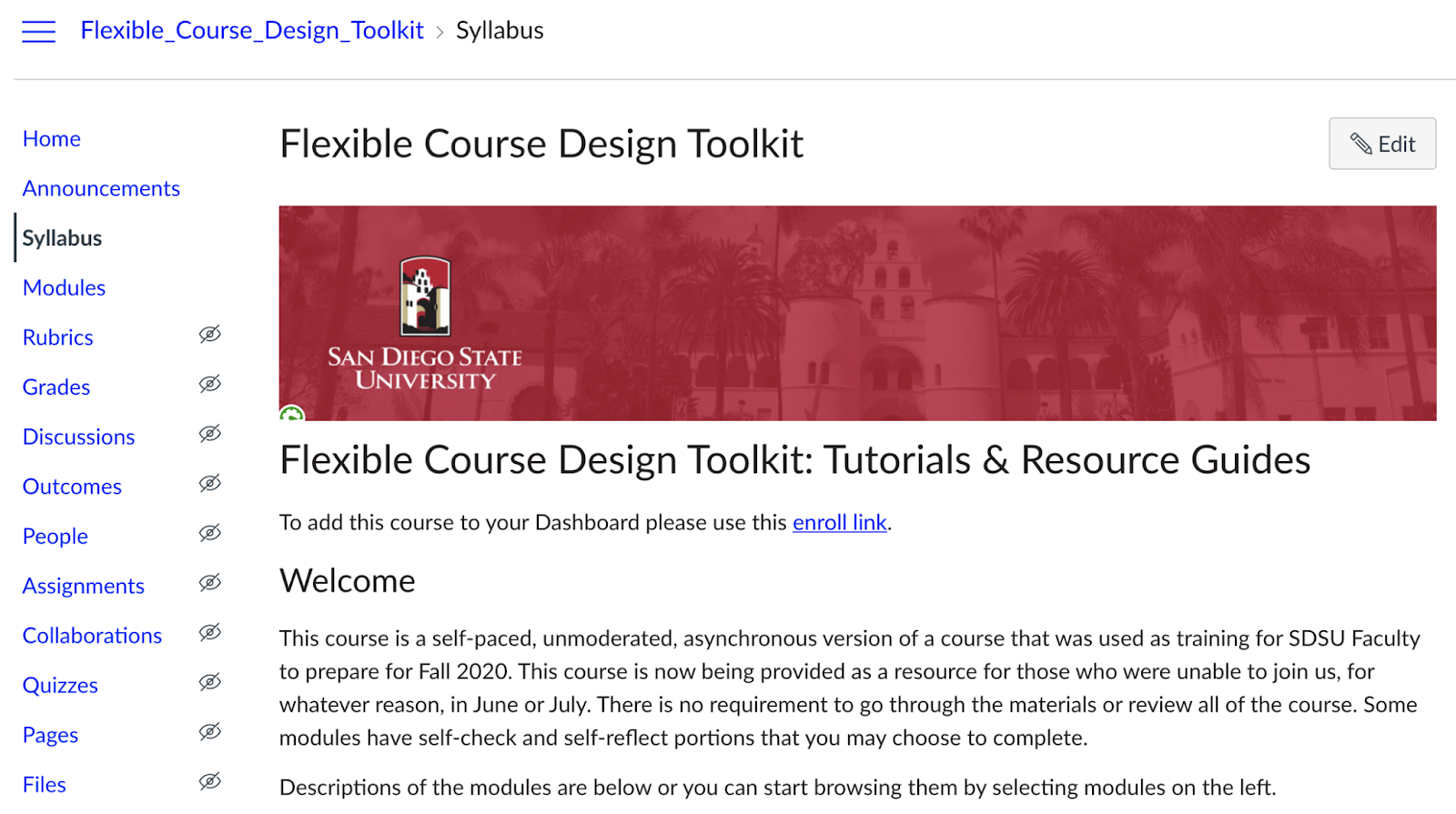
- SDSU Flexible Course Design Toolkit (developed via the Flex CDI training program):
- https://sdsu.instructure.com/courses/58304
Accessibility/UDL Efforts
We ran a new program during the 2021/2022 academic year entitled the Accessibility/Universal Design for Learning Faculty Ambassadors program. A total of 8 instructors from various departments at SDSU participated in the program. Program goals included the following:
- Help develop the new ambassador program
- PopeTech/Ally evaluation and possible software rollout (PopeTech is new accessibility software in Canvas) (Spring 2022)
- Advise faculty and staff on how to accommodate students and utilize UDL teaching techniques.
Instructors also made visitations to both departmental and College-level meetings to share strategies and techniques related to accessibility and UDL.
Next Steps for QA Efforts
Goals for the coming academic year are as follows:
- Continue to grow and formalize SDSU’s use of QLT as the campus standard for QA efforts in online teaching and learning in collaboration with ITS Faculty Fellows, SDSU Global Campus, and other SDSU campus partners
- Establish, grow, and evaluate the efficacy of a new faculty development program focused on the design, development, and evaluation of hybrid and fully online courses across the seven Colleges that comprise SDSU. This new program is called the Self-Paced Online Teaching (SPOT) Training Program. The SPOT program represents an extension of SDSU’s long-running Course Design Institute (CDI), with a more inclusive approach to the types of courses that are deemed to be appropriate for the faculty development program.