2021-2022 — Northridge — ePortfolio for CSU Online Course Services
2021-2022 — Northridge — ePortfolio for CSU Online Course Services
Project Summary
For 2021-2022, CSUN successfully conducted eLearning Institutes to serve the needs of faculty teaching online as well as those who started teaching in the HyFlex format. We served 117 faculty members in our two eLearning Institute cohorts, helping them conduct a QLT self-review and participate in an internal peer review on their courses.
Campus Goal for Quality Assurance
This year, we continued investing on faculty training opportunities and increasing faculty exposure to the QLT rubric. All programming was aimed to be relevant and applicable not only for this continued pandemic and returning to the physical classroom moment, but to also assist faculty in a moment of transition to all online teaching modalities. We proposed and accomplished the following QA goals on our campus:
- to scale QLT training and implementation by faculty across all departments and disciplines;
- to expand the number of faculty peer reviewers and QLT experts on our campus.
Quality Assurance Lead- Janett Silvers, Instructional Designer.
Faculty Development QLT Team
 |
 |
 |
 |
Supporting Campus Partners
The QA Faculty Lead is joined by the Office of Faculty Development team of two instructional designers and other members, all of which are involved in training and are critical in support of the peer-to-peer professional development and the successful adoption of quality assurance methods to a growing number of online/hybrid courses and eLearning projects:
- Hillary Kaplowitz, Senior Instructional Designer
- Susana Marcelo, Instructional Designer
- Whitney Scott, Director of Faculty Development, who is involved in all stages of the quality assurance implementation with the QA lead.
In addition, the Faculty Development works in close collaboration with the Faculty Technology Center within Academic Technology.
Campus Commitment Toward Sustainability of QA Efforts
This year’s QA grant was used to fund the some of the faculty who participated in the eLearning Institutes and the peer reviewers. Campus matching funds and additional funding were used to pay for additional participants and peer reviewers and sustaining other programs in Faculty Development that also use the QLT rubric besides the eLearning Institute, such as:
- The Get Up to Speed with Online Teaching program;
- eLearning resources & Teaching Toolkits;
- Faculty Learning Communities (e.g., equity-minded teaching;
- Transparent assignments and Learning-centered syllabus;
- eLearning Ambassadors consultations;
- the HyFlex pilot program.
Summary of Previous QA Accomplishments
2020-2021: As we pivoted virtual instruction due to the COVID-19 emergency, we got as many faculty members as possible to go through our eLearning Institute with the allocated funds. That required a complete redesign of the eLearning Institute format incorportating a QLT self-review and peer review components. We created a QLT workbook and offered train the trainer sessions to prepare the selected eLearning alumni to be QLT peer reviewers.
Later in 2021, CSUN also started piloting QLT course certification with a small group of faculty.
2014- 2019: Over the years, CSUN has made significant efforts to disseminate the QLT rubric among faculty and campus leaders. Some of the previous accomplishments include: integrating QLT in the face-to-face eLearning programs, such as the Institutes and the Online Teaching and Learning series; creating and maintaining a QLT webpage; holding a 2-day retreat for department chairs; presenting at the Association for Educational Communication and Technology (AECT) Conference, and hosting peer review trainings and other types of QLT workshops on campus.
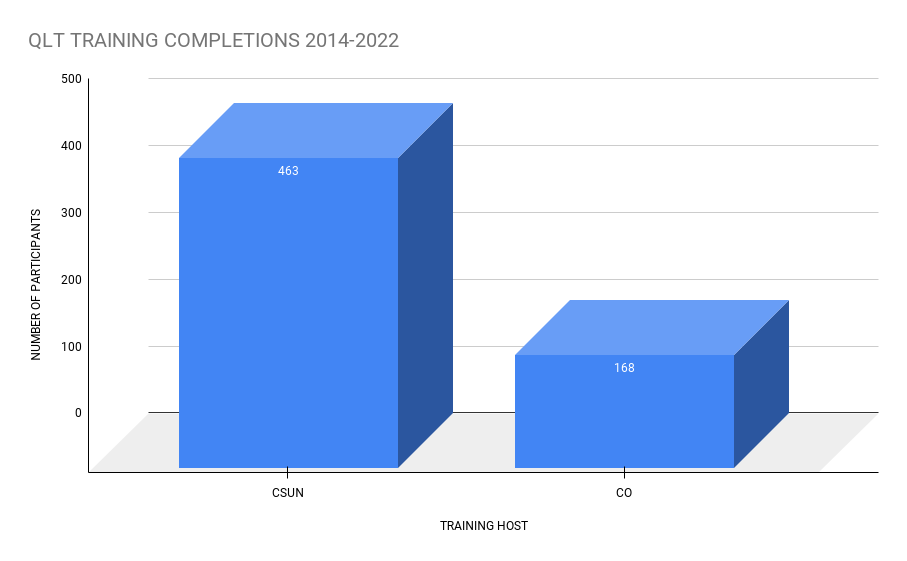 Course Peer Review and Course Certifications
Faculty participating in the eLearning Institutes are required to do a full self-review of one of their courses using the entire QLT 57-objective rubric facilitated in a workbook format created by our team. In addition, a trained peer reviewer is assigned to each participant to provide mentoring and feedback to their course using the QLT rubric.
One other effort our office has made was to bring QLT course certification for the first time at CSUN. We are currently piloting course certification with 5 courses and collecting data that will help us decide how to best support the colleges interested in QLT course certification.
Participating Faculty Feedback
Below are some of the feedback collected in the eLearning Institute evaluations:
- "As a result of this program, I was able to improve some aspects of my course that I believe will lead to better student learning experience and outcomes."
- "It improved the quality of my teaching. It has helped me construct courses in line with the SLOs. My students seem more satisfied with the course"
- "The combo of self-pacing and then a live peer mentor session was perfect; we got the best of both worlds."
- "Having a Faculty Mentor review my QLT workbook and course design was a gift because an outside and experienced teacher helps break through my own biases and assumptions about my course design. We teachers like to think we are doing what is best for our students. The QLT workbook forces us to validate what we think and face ourselves. When we face ourselves, we become better teachers. I am a better teacher after this program."
- "This program ought to be standard practice for educators at the college level."
Development of Campus QA Resources
- Faculty Development's QLT page is the QLT hub used for dissemination of the rubric and hosting the dates of the CO QLT trainings.
- Faculty Development's programming page keeps being updated with the most current programs that faculty can sign up at CSUN.
- eLearning Institute page explains how the program uses the QLT rubric for self-review and peer review of a course.
- Teaching Toolkit is a self-paced resource that features QLT as rubric to inform best practices for teaching and learning.
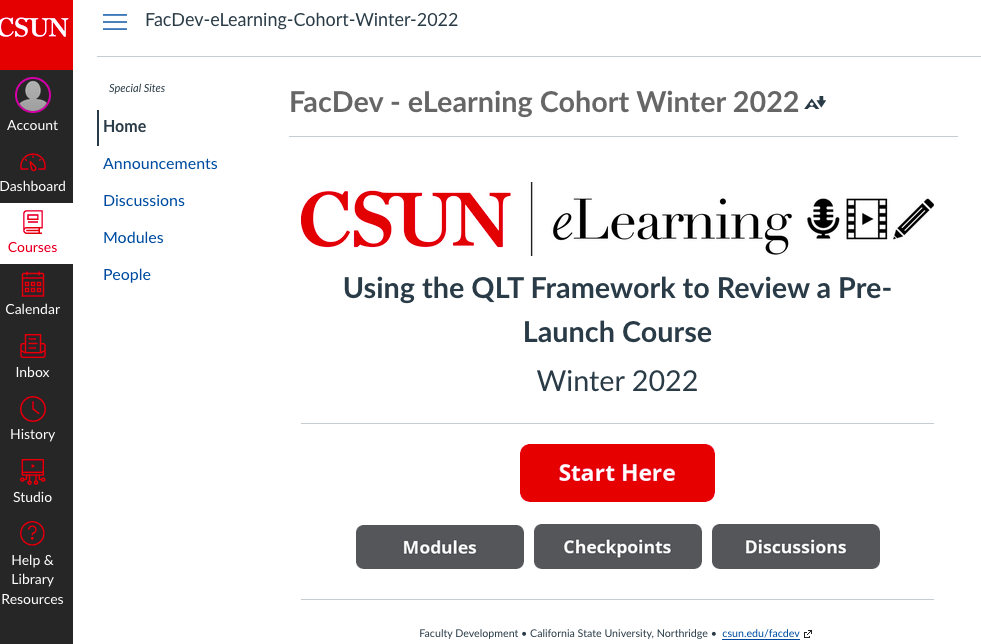 eLearning Institute Cohort Site
Successes
We served 117 faculty members in our two eLearning Institute cohorts, leading them through a QLT self-review and an internal peer review of one course. We not only met our goals but exceeded the number of faculty we had originally proposed initially.
Faculty continue to report increased confidence and knowledge of QLT after completing our trainings. In fact, faculty who completed our eLearning Institutes also gained confidence in their teaching and in the importance of considering equity in a more meaningful way in their course design.
Next Steps for QA Efforts
- Step 1: Continue scaling QLT training and implementation by offering various professional development programming as well as creating and updating resources for faculty such as:
- eLearning Programs (e.g. Get Up to Speed with Online Teaching, summer and winter eLearning Institute);
- Step 2: Maintain a webpage dedicated to QLT with updates about the CO's programs in the Faculty Development website;
- Step 3: Create a revised version of the QLT workbook, the learning material used in the eLearning Institute.
- Step 4: Keep recruiting and training eLearning Institute alumni for one-on-one mentoring and peer review of the courses of the faculty selected to participate in the summer and winter eLearning Institute cohorts.