Chapter 1 - Section 2: Energy and Energy need Calculation
Chapter 1 - Section 2: Energy and Energy need Calculation
Energy and Energy Calculation
Learning Objectives |
|
Energy
Energy is essential to life. Normal function of the human body requires a constant input and output of energy to maintain life. Various chemical components of food provide the input of energy to the body. The chemical breakdown of those chemicals provides the energy needed to carry out thousands of body functions that allow the body to perform daily functions and tasks such as breathing, walking up a flight of steps, and studying for a test.
Energy is classified as either potential or kinetic. Potential energy is stored energy, or energy waiting to happen. Kinetic energy is energy in motion. To illustrate this, think of an Olympic swimmer standing at the pool’s edge awaiting the sound of the whistle to begin the race. While he waits for the signal, he has potential energy. When the whistle sounds and he dives into the pool and begins to swim, his energy is kinetic (in motion).
In food and in components of the human body, potential energy resides in the chemical bonds of specific molecules such as carbohydrates, fats, proteins, and alcohol. This potential energy is converted into kinetic energy in the body that drives many body functions ranging from muscle and nerve function to driving the synthesis of body protein for growth. After potential energy is released to provide kinetic energy, it ultimately becomes thermal energy or heat. You can notice this when you exercise, and your body heats up.
The Calorie Is a Unit of Energy
The amount of energy in nutrients or the amount of energy expended by the body can be quantified with a variety of units used to measure energy. In the US, the kilocalorie (kcal) is most commonly used and is often just referred to as a calorie. Strictly speaking, a kcal is 1000 calories. In nutrition, the term calories almost always refers to kcals. Sometimes the kcal is indicated by capitalizing calories as “Calories.” A kilocalorie is the amount of energy in the form of heat that is required to heat one kilogram of water one degree Celsius.
Most other countries use the kilojoule (kJ) as their standard unit of energy. The joule is a measure of energy based on work accomplished – the energy needed to produce a specific amount of force. Since calories and Joules are both measures of energy, one can be converted to the other – 1 kcal = 4.18 kJ.
Estimating Caloric Content
The energy contained in energy-yielding nutrients differs because the energy-yielding nutrients are composed of different types of chemical bonds. The carbohydrate or protein in a food yields approximately 4 kilocalories per gram, whereas the triglycerides that compose the fat in a food yield 9 kilocalories per gram (Table 3). A kilocalorie of energy performs one thousand times more work than a calorie. On the Nutrition Facts panel found on packaged food, the calories listed for a particular food are actually kilocalories.
Table 3 kcal in macronutrients
| Macronutrient energy source | Calories | Non-macronutrient Energy Source | Calories | |
| Carbohydrate | 4 kcal/gm | Alcohol | 7 kcal/gm | |
| Fat | 9 kcal/gm | |||
| Protein | 4 kcal/gm | |||
Estimating the number of calories in commercially prepared food is fairly easy to do since the total number of calories in a serving of a particular food is listed on the Nutrition Facts panel. If you wanted to know the number of calories just add up the number of calories in each food. For example, if you ate one serving of yogurt that contained 150 calories, on which you sprinkled half of a cup of low-fat granola cereal that contained 209 calories, and drank a glass of orange juice that contained 100 calories, the total number of calories you consumed at breakfast is 150 + 209 + 100 = 459 calories. If you do not have a Nutrition Facts panel for a certain food, such as a half cup of blueberries, and want to find out the amount of calories it contains, an easy resource to use is the Food Calorie Calculator, powered by the USDA National Nutrient Database. You can choose from thousands of foods and brands, and see nutrition facts such as calories, fat, protein, carbohydrates, fiber and sugar.
The calculator has the ability to construct nutrition facts for home recipes by finding the item in the recipe then clicking on the add link. When all the ingredients have been added, at the bottom of the screen is the nutritional and calorie data. This program also provides nutrition information for fast food and restaurant's as well.
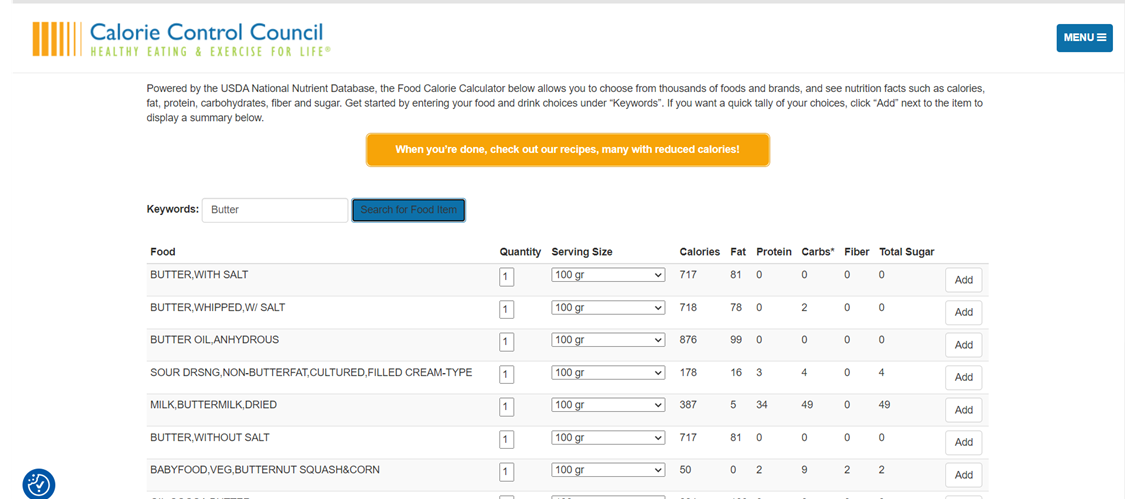
https://caloriecontrol.org/healthy-weight-tool-kit/food-calorie-calculator/
Basal Metabolic Rate
The basal metabolic rate (BMR) is defined as the minimum amount of calories expended by a individual in a restful awake state that keeps the body alive, warm and with all body systems functioning properly. The BMR does not include any type of physical activity, digestion, or absorption of food. This type of metabolic understanding is associated with about 60%-70% of the total body energy needs of the body. If an individual is not completely fasting or completely resting then it their metabolic rate would be termed resting metabolic rate (RMR) and would reflect approximately a 6% increase 66%-76% of the body’s total energy needs compared to the BMR (Smith et al. 2021). Providing this type of calculation to a patient can give them an understanding of the caloric input needed to sustain them at their current weight and provide a foundation of change associated with nutrition lifestyle behavior choices.
BMR calculation
Men: BMR = 88.362 + (13.397 x weight in kg) + (4.799 x height in cm) – (5.677 x age in years)
Women: BMR = 447.593 + (9.247 x weight in kg) + (3.098 x height in cm) – (4.330 x age in years)
Example: 64 y/o female HT 5’4” (64 in x 2.54 cm = 162.56 cm ), WT 145 lbs (145 lbs ¸ 2.2 kg = 65.9 kg)
447.593 + (9.247 x 65.9 kg) + (3.098 x 162.56) – (4.330 x 64)
447.593 + 609.377 + 503. 611 – 277.11
BMR = 1,283.47 kg/24 hrs
Factors to keep in mind that increase the BMR & RMR:
Increased lean body mass (This factor is the most important one with respect to BMR)
- Larger body surface area (Elevated reflecting obesity or greater)
- Male gender
- Body Temperature (Fever or significantly colder environments)
- Thyroid function status
- Stress levels in which the adrenal gland is stimulated to release epinephrine and norepinephrine above homeostatic amounts
- Pregnancy
- Caffeine use; Tobacco use
Factors that negatively affect BMR and cause a reduction in its rate occur with low caloric intake as can be seen with “crash” or “fad” diets. Low caloric intake, lower than the BMR recommendation for age and gender, causes a reduction of the BMR calorie need by 10% to 20% or about 150-300 calories for day. It is for this reason that low calorie dieting less than the BMR requirements fails to produce sustainable weight loss and in some instances weight gain instead of weight loss occurs.
The (United States Department of Agriculture, 2023 [USDA], has a quick and easy online calculator that you can use calculate caloric need for both sedentary and active nutrition recommendations. The Dietary Reference Intakes (DRIs) calculator, established by the Health and Medicine Division of the National Academies of Sciences, Engineering and Medicine, will generate a comprehensive report including BMI and daily caloric recommendations based on age, Ht/Wt, and activity level. The calculator provides a detailed document listing information of recommended macronutrient intake, vitamin and mineral intake that can be printed.
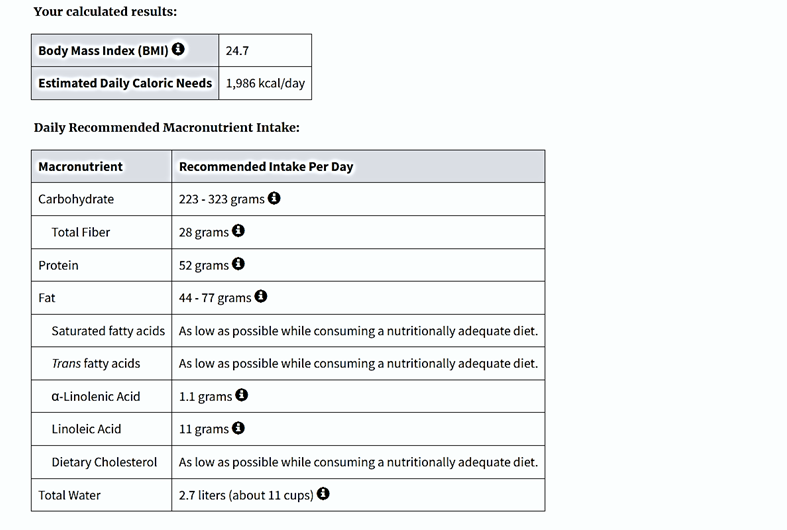
https://www.nal.usda.gov/human-nutrition-and-food-safety/dri-calculator/results