Abstract
Abstract
The Middle Ages in Europe were a complex era, and American high schools do not usually teach this period in depth. Undergraduate students taking courses on French medieval literature in college sometimes encounter difficulty when reading about this period in European history. Our aim in writing this manual was to share our knowledge of medieval history and literature. Our main focus is on literature in translation, but we also discuss key historical and artistic movements to help students understand when and how these important European texts came to be. This book is designed to help students learn about medieval French literature, culture, and history.
The Middle Ages lasted approximately from the Fifth century to the Fifteenth century. It began with the end of the Roman Empire in 476 A.D. and ended approximately with Columbus's discovery of the New World. It lasted a thousand years.
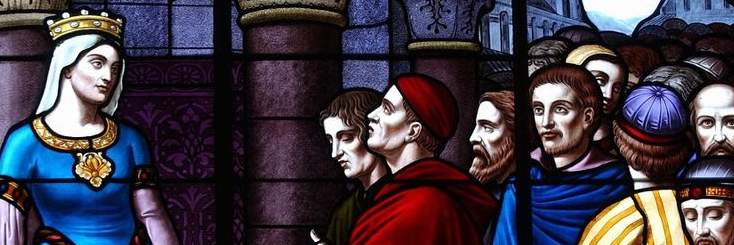
Notre-Dame of Paris

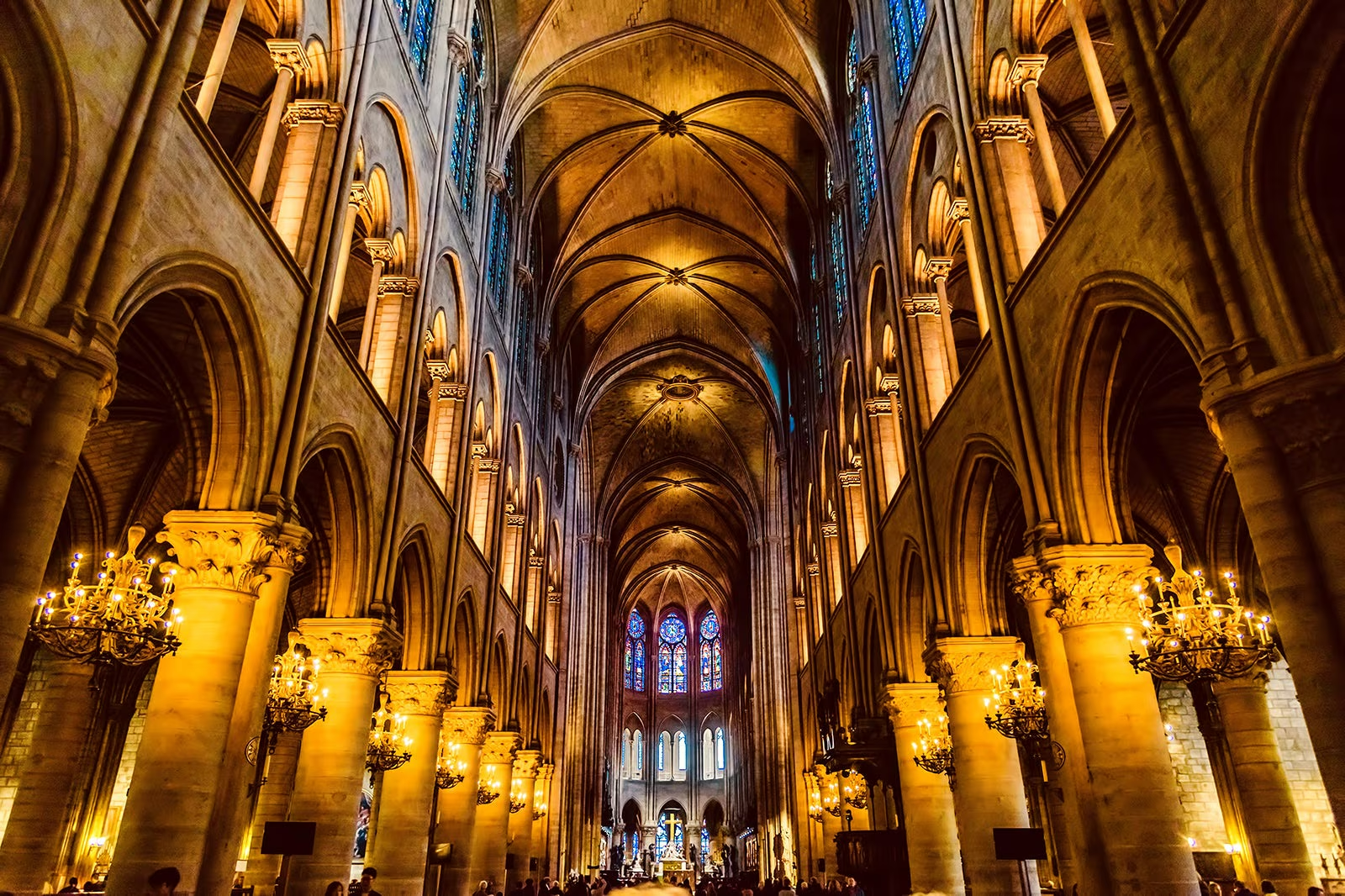
Table of Content
Introduction
Part I: Some Notes on Medieval Art, Culture and History
I. Romanesque Art
II. Gothic Art
III. The Three Orders
IV. Eleanor of Aquitaine: Role of Eleanor of Aquitaine in the Development of Arthurian Legends in Medieval French Literature
Life
The Impact of Alienor on Chrétien de Troyes and the Myth of Arthur:
V. What are Relics?
Compostela
Charlemagne's Relics
Saint Louis and the Sainte Chapelle
VI. What are The Crusades?
Saladin and the Third Crusade
Part II: Critical Approaches
VII. The secret in the Chatelaine de Vergy (tale)
VIII.Chrétien de Troyes
Perceval ou le Conte du Graal and Le Bel Inconnu
Erec and Enid: The Transformation of Erec and Enid into King and Queen
IX. Les Lais/The Lyric Lays by Marie de France
Equitan
Bisclavret
Yonec
Lanval
Anonymous Lays:
Ignauré
Mantel
Pyrame et Thisbé
X.Tristan and Isolde
Works Cited
The impetus for this book came after several years of teaching both medieval French literature and literature-in-translation courses at the University of Pittsburgh at Johnstown. While exploring the historical context of this book, we began with Charlemagne and ended with Eleanor of Aquitaine. Charlemagne had an important role in the democratization of education, which he institutionalized in his Admonitio Generalis (789). The history of the Church and art history are undeniably linked to the Middle Ages. Art was always religious, and this is why we have chosen to discuss the Romanesque and Gothic art movements. To understand religion in the Middle Ages is to understand the importance of relics, pilgrimages, and the Holy Crusades. We have studied countless relics in our research and have focused on a few, for our goal is to help the reader grasp their value for the medieval pilgrim. When discussing the Crusades, we explain how religion and power were inextricably linked in the medieval era. Eleanor of Aquitaine was both queen of France and queen of England and a patron of the arts.
Courtly romance was born in France during the Twelfth century at the court of Eleanor of Aquitaine. This powerful queen was a patron of the arts and encouraged troubadours to write poetry. Our analysis of canonical works such as La Châtelaine de Vergy, Le Bel Inconnu, Perceval ou le Conte du Graal, Erec and Enid, Tristan et Iseut, and the Lais by Marie de France will help readers understand these complex poems.
This book was made possible by the generosity of the European Center for International Studies at the University of Pittsburgh, which, for multiple summers, enabled us to do research in France, Spain, Germany, Belgium, Italy, and Switzerland. We traveled extensively in the region formerly called the Carolingian Empire in the Ninth century. We also wish to thank the Provost of the University of Pittsburgh and its librarians, who awarded us a grant to support the development of this OER.
I. Romanesque Art
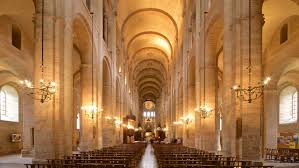
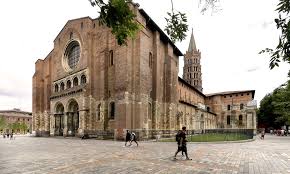
Romanesque churches were round-arched, solid, and heavy compared to the lightness and the pointed arches of Gothic monuments. This was the beginning of the crusades in the Western world. There would be a total of eight crusades from 1095 to 1270. Saint-Louis, king of France, died in Tunisia during the last crusade. There was an increase in building activity in France in the 11th century (History of Art 293). Romanesque art refers to churches that look more Roman. It was, however, the first time the vaults were decorated. France has the richest examples of Romanesque art in all of Europe. Saint-Sernin Basilica in Toulouse (Southwestern France), consecrated in 1096, is an impressive example of Romanesque art (History of Art 294). It is shaped like a large cross and was designed for pilgrims on their way to Compostela or for large crowds.
Carolingian art produced few sculptures, but Romanesque art marked the revival of monumental stone sculpture (History of Art 304). This revival of stone sculpture can be found in Southwestern France and Northern Spain, along the pilgrimage roads (Camino) to Compostela. These stone sculptures in Romanesque art were meant to attract lay worshippers and pilgrims rather than members of a closed monastic community. This development of stone sculpture before 1095 ( the year of the Call for the First Crusade) coincides with religious fervor. (History of Art 305) The “Roman” feature of the statues of Saint-Sernin in Toulouse is solid and looks very heavy compared to the Gothic statues that would emerge in Paris (Saint-Denis) and Chartres around 1130. These stone-carved statues, however, were more accessible to the layman than paintings, and they attracted pilgrims even though they appeared less lifelike than Gothic sculptures.
Saint-Sernin's Basilica in Toulouse (examples of Romanesque Art), France

Compostela, Spain (9th - 18th centuries)
II. Gothic Art
Circa 1130 – Abbot Suger, who worked under the reigns of Louis VI and Louis VII, was the man behind the Gothic architecture of the Basilica of Saint-Denis, which became the necropolis of the French kings. The windows, or stained-glass windows, have been enlarged to the point that they no longer cut into the wall; they now fill the entire wall (History of Art 322). The flying buttresses make this abundance of light possible by carrying the weight of the walls from the outside. They are characteristic of Gothic architecture. These flying buttresses are not visible from the inside.
The first two examples of Gothic religious architecture are Saint-Denis and Chartres, which were built roughly in the same period. Chartres is the only one that still has its original 180 stained-glass windows. They are famous for their blue color. Suger wanted the stained glass to have a miraculous effect. They were supposed to be an integral part of the new Gothic architecture he was creating. Notre-Dame de la Belle-Verrière in Chartres consists of hundreds of small pieces of tinted glass bound together with strips of lead, intended to resemble a mosaic of glass pieces. The years 1200 to 1250 represent the golden age of stained-glass windows. The Sainte-Chapelle in Paris also has beautiful stained-glass windows. This chapel was built by Louis IX, who became Saint Louis. It was built to keep the most important relic of all Christendom, the Crown of Thorns, which Jesus wore during his crucifixion. The king had bought it from Constantinople and had brought it back to Paris. He became very famous in Europe because of this relic.
These cathedrals represent a “concentrated expenditure of effort such as the world has rarely seen before or since.” (History of Art 327) It is also important to note that illumination in book manuscripts was very important during this period. Books were not printed because printing had not yet been invented until the 15th century. Copyist monks, or “moines copistes,” would spend their days in monasteries or abbeys, copying manuscripts and very often changing the texts as they went. An illumination or “enluminure” is a picture drawn by copyist monks on the edge of the page to illustrate the story they are copying. “Until the 13th century, the production of illuminated manuscripts had been centered in the scriptoria of the monasteries. After it shifted even more to urban workshops organized by laymen, the ancestors of the publishing houses of today.” (History of Art 360)


Stained-glass window, Chartres, France. Saint-Denis Basilica, Paris, France
III. The Three Orders
The medieval world was very different from the world we live in, and everything was organized into hierarchical stratifications that have almost disappeared in today’s Europe. According to Duby, the three orders appeared around 1030: oratore, bellatore, and laboratore, or the ones who pray, the ones who fight, and the ones who work (peasants). The three estates were the social orders of the French social hierarchy from the Middle Ages to the French Revolution of 1789.
Bellatore:
According to George Duby, at the beginning of chivalry, knights were young men who did not work in the fields, owned horses, and were close to the castle's master. The castles in the 9th century were not made of stone; they were just basic wooden structures with a simple tower and a wooden wall made to protect the lord from invasion by another lord. These masters had a better life than the peasants working in the fields. Each of these masters became lords, hence the small fiefs throughout the country. Duby and Philippe Contamine agree that knighthood and feudalism are linked.
Feudality emerged in France circa 950. Before 1000 A. D., horses were rare and used for farming or transport. During the Merovingian era (fifth-eighth centuries), warriors were on foot, and horses were scarce. At the beginning, not all knights were noblemen. The ceremony to become a knight was called adoubement or knighting. Most of the new knights between 1150 and 1500 were knighted on the battlefield. They had to prove they were good soldiers and worthy of their lords. According to the chronicles of the time, they would kneel in front of their lord, who would place a sword at the nape of their neck and say the sentence: “Je te fais chevalier au nom de Saint George.” The sword was later blessed. The Church chose to bless it during the ceremony to reduce bloodshed and violence. Knights had to protect widows, orphans, and the weak. Later on, orders would appear, such as the Knights Templar, the Hospitallers, and the Teutonic Knights, who went on crusades to the Holy Land to save Christ’s tomb from the Muslims. The first crusade left France in 1096.
Le tournoi was the knights' favorite sport; it started in the second half of the 11th century. The Church opposed it and condemned it until the 14th century because it was too dangerous and many knights died. They also criticized the parties that followed the jousting. The knights partied too much. During tournaments, knights wore a heaume, which became the English word "helmet".
A proper knight owned a horse, a sword, a spear, and a shield. Knights were supposed to incarnate virtue and justice, spare those who were not fighting, and share their wealth with the poor.
The king was the most important figure of the period we are studying, specifically from the Carolingian dynasty to the end of the Capetian dynasty (8th to 13th century). The king was called the suzerain, and the vassals were all the lords and knights he had under him. Charlemagne was the most important king of the Carolingian dynasty and the central figure in many epic songs written in the 12th and 13th centuries.
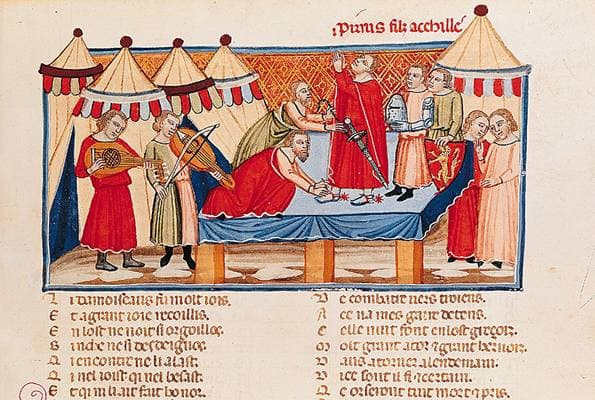
Scene of Adoubement -- Roman de Troie by Benoit de Saint-Maure (1160)
In the Middle Ages, the laboratore or workers were peasants who worked the fields. They did not own the land they worked, and they had to pay taxes to their lords. They usually had a miserable life. They worked all day, and sometimes did not have any food to eat. They were the largest socio-economic group in France until the nineteenth century.
The clergy was part of the oratore. They were Catholics. They worked in monasteries; monks, for example, but were also part of the higher clergy. The higher clergy comprised bishops, archbishops, and cardinals. Many of these high-ranking priests were part of the nobility, especially towards the end of the eighteenth century.
![Painted effigies of Henry II of England (1133-1189 CE) and his wife Eleanor of Aquitaine (1124-1204 CE). Fontevraud Abbey, France [800x542] : r/ArtefactPorn](https://merlot.org/merlot/getCBContentImage?img=1462593%2Fe%2F20262131297943222000.png)
Painted effigies of Henry II of England (1133-1189 ) and his wife Eleanor of Aquitaine (1124-1204 ). Fontevraud Abbey, France
IV. Eleanor of Aquitaine: The Role of Eleanor of Aquitaine in the Development of Arthurian Legends in Medieval French Literature
Life:
Eleanor was queen of France and then queen of England. She ruled the kingdom of Aquitaine, which stretched from the Pyrenees to the Wall of Hadrian and to Ireland. She first married Louis VII of France at the age of fifteen in Bordeaux in 1137. She was the Duchess of Aquitaine, which was a rich duchy. She was a powerful woman for her time. She followed her husband on the Second Crusade (1147), and according to rumors of the time, she fell in love with different men, including Raoul de Faille, the prince of Antioch. Guillaume, archbishop of Tyre, accused her of adultery during the crusade. However, according to specialist Martin Aurell, she was not unfaithful to her husband.
There were many so-called “black legends” surrounding the queen. Many monks wrote that she was beautiful but evil. Her first marriage to the king of France, Louis VII, was annulled by the Church after fifteen years because of consanguinity. She also wrote several poems, but none of them survived. The famous legend of King Arthur originated in southern France, in the Aquitaine region, during Eleanor's reign. The troubadours told and sang the stories of King Arthur and the Knights of the Round Table at the court of Eleanor and later across Europe. The character of Guinevere, Arthur’s wife, may have been inspired by the queen.
Even though she was a powerful woman, Louis VII decided to divorce her after fifteen years because they were related. This divorce had an impact on the histories of both France and England. She then married Henry II, king of England, in 1152. She had ten children, and one of her sons, Richard the Lionheart, was also a poet. She lived in Poitiers (South of France) during her reign as queen of England. Her court in Poitiers was rich and sophisticated. Henry II cheated on her with Rosamund of Clifford, who was ten years younger than the queen. She revolted against him in 1172, and many historians believe this adultery led Eleanor to seek revenge. She raised her three sons against their father: Geoffrey, Richard the Lionheart, and Jean Sans Terre (Without Land). The two brothers Richard and Jean were always fighting. The French king at the time, Philippe Augustus, supported Richard the Lionheart and even went on a crusade with him (the Third Crusade). Jean was supported by his father, the English king.
Henry II imprisoned Eleanor for fifteen years. Richard the Lionheart freed her when she was fifty-seven years old. When Richard came back from the Third Crusade, he was taken prisoner in Austria, and his mother paid the enormous ransom that would eventually free him. She ended her life at Fontevraud.
Her grandfather was Guillaume IX of Aquitaine. He was the first poet of southern France and the first troubadour.
The Impact of Alienor on Chrérien de Troyes and the Myth of Arthur:
She was queen of France from 1137 to 1152 and queen of England from 1154 to 1189. She was the most cultured, enlightened, and powerful woman of her epoch. She was the mother of Richard I, the Lionheart, and she was one of the most influential women of the Middle Ages. She helped develop courtly poetry, and she was a patron of the arts. Many renowned poets such as Chrétien de Troyes and Marie de France were influenced by her. She loved the arts and was always surrounded by poets. Her daughter Marie de Champagne was also very enlightened.
These two women were patrons of Chrétien de Troyes, the most famous French poet of the Middle Ages. At the court of the queen, he wrote several courtly romances such as Lancelot ou le Chevalier à la charrette (1181), featuring King Arthur and the Knights of the Round Table. He was influenced by the Celtic folklore of Brittany. Eleanor held a rich court, and many poets wrote for her. These famous poems or courtly romances were written at her court from 1170 on. Chrétien wrote Lancelot for Eleanor’s daughter, Marie de Champagne, who was a patron of the arts like her mother. He wrote Cligès in 1170. He wrote Perceval ou le Conte du Graal in 1180, but was unable to finish it because he died. He was the first poet to use these Celtic myths and use them in his novels. Chrétien was undeniably the first writer to use Arthur as the ideal king for whom every knight wants to fight. He was also the first writer to use the legend of the Holy Grail.
Marie de France was also another writer who was certainly part of Eleanor’s entourage and wrote the famous Lais, or courtly and magical romances, in the 12th century. She is the first known French woman poet.
King Arthur and Emperor Charlemagne are two of the most prominent figures of Medieval literature. King Arthur is a central figure in French courtly romances of the 12th and 13th centuries. He always appears surrounded by the Knights of the Round Table.
Arthur first appears in the work of Nennius, who wrote Historia Brittonum, or History of Britain, in the 9th century. This book tells the history of Arthur, chief of the Celts at the end of the 5th and the beginning of the 6th century. Arthur fought in the resistance against the Saxons. At that time, Brittany comprised three regions: Wales, Cornwall, and French Brittany. He won many battles with his knights and became famous in the region's folklore. The legendary figure of Arthur in medieval literature is closely linked to the region in France known as Brittany, and more precisely in the Brocéliande Forest, which is featured in many medieval texts related to the Knights of the Round Table, Merlin, the Lady of the Lake, and Morgan le Fay. This forest is also the place of the tomb of Merlin, and the Vale of No Return, where the sorceress Morgan traps unfaithful knights. Chrétien de Troyes is one of the first writers to mention this forest in Yvain ou Le Chevalier au Lion (circa 1170), where his hero Yvain encounters a magical fountain. When entering this forest, the hero penetrates a magical world where his life is in danger until he can save a beautiful queen.
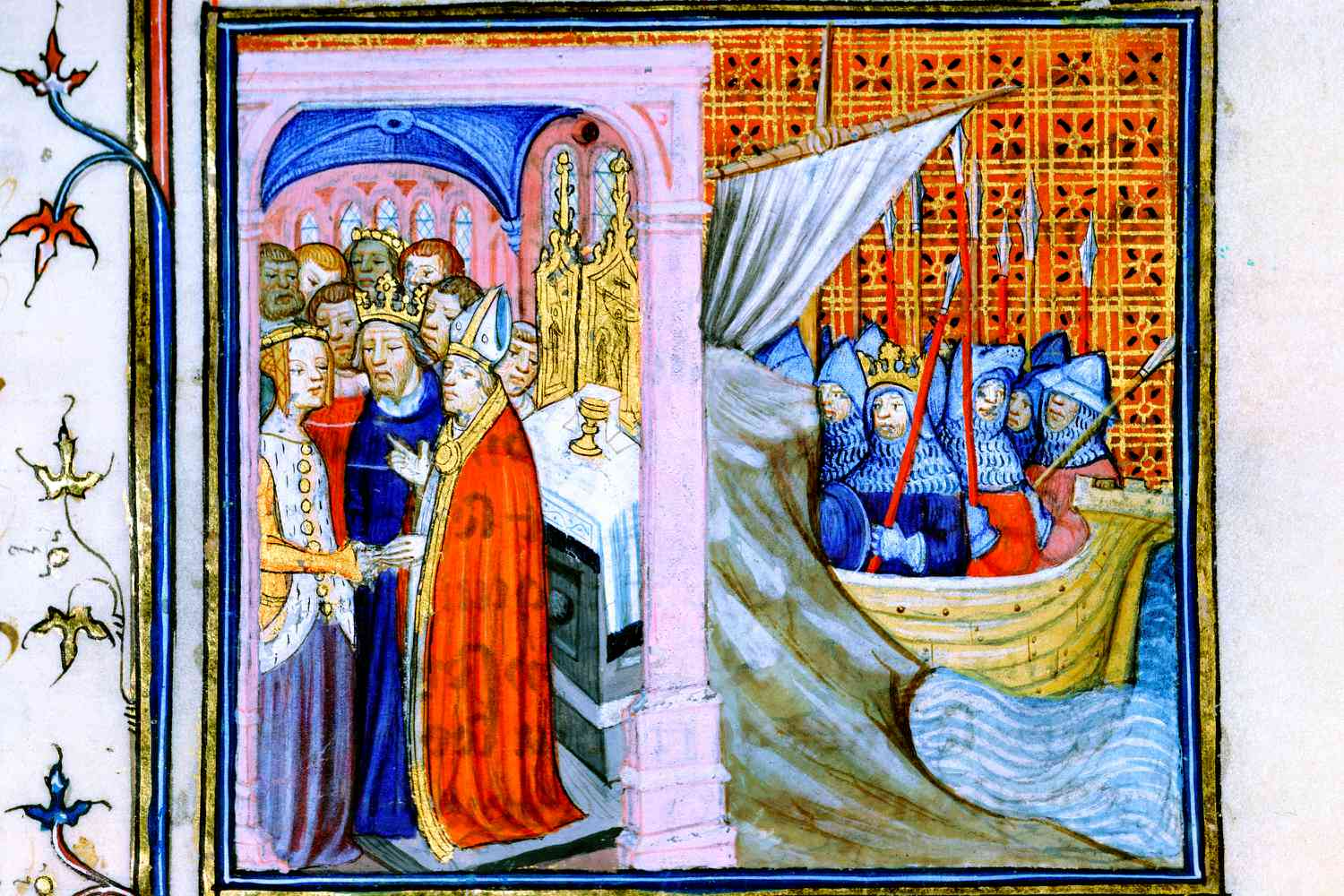 Drawing from Les Chroniques de Saint-Denis, late 14th century: Eleanor of Aquitaine and Louis VII. Eleanor of Aquitaine marrying Louis VII in 1137 (left scene) and Louis VII departing on the Second Crusade (1147)

Brocéliande Forest in Brittany (France)
V. What are Relics?
In the Catholic faith, relics are venerated, especially when they bring miracles to their worshippers. The bones of saints are kept in reliquaries, containers of holy relics. God, Jesus, and Mary are the only ones who should be adored. Also, an important point to note: the relics we have found of Jesus and Mary are not bones; they are fluids. The Holy Blood for Jesus, the Holy Tears, and the Holy Milk for Mary. There are, however, some objects which have touched the body of Jesus, and which are kept as relics in the Catholic world, but not his bones. According to William Saunders, there are two classes of relics. "The first class or real relics include the physical body parts, clothing and instruments connected with a martyr’s imprisonment, torture, and execution, and the second class or representative relics are those which the faithful have touched to the physical body parts or grave of the saint."
It was Helena, the mother of Emperor Constantine I, the founder of Constantinople, who was the first one to find the Holy relics of Christ. She went to the Holy Land and brought back a fragment of the Holy Cross and the Crown of Thorns. She started what would eventually become the commerce of relics. The Middle Ages are famous for the translation of relics. The relics of saints were removed from one place and brought to a church, a convent, or a monastery. They were placed in a reliquiary so that people could worship them. Many kings and queens also gave away part of the saint's skeletons as presents. The skeleton of Saint Louis, for instance, was divided and given away as gifts.
Reliquaries, which can be richly adorned, are typically made of gold and set with semi-precious or even precious stones. Some famous relics include the skull and hands of Charlemagne in Aachen, Germany; the thorn of Christ in Paris; the Shrine of Jesus in Torino, Italy; and the bones of Saint James in Compostela, Spain. The sites of these relics are well known in the Christian world, and many Catholics go on what we call pilgrimages to pray before them. These relics can also cause miracles. The most famous pilgrimage destinations are Jerusalem, Rome, and Compostela.
Compostela
Compostela means field of stars in Spanish. It is a small town in northwestern Spain, in the province of Galicia. It is very close to the Atlantic Ocean. According to the legend, a priest called Theodomir found the body of Saint James in a field at night, surrounded by stars.
In the medieval text known as the Codex Calixtinus, Charlemagne had a visitation from the saint in a dream. The saint asked the emperor to deliver his tomb, which was under siege by the Saracens. It is important to remember that Spain was under Muslim rule for 800 years. Muslims conquered the country in 711, so when Charlemagne was crowned emperor in 800, and the Song of Roland was written around 1090, Spain was still under Spanish influence and would remain so until the fifteenth century. The fact that the whole body of Saint James was found is quite unusual for a relic. The saint’s remains were discovered around 820.
According to the New Testament, James was one of Jesus’s closest disciples, and he was executed by Herod in Jerusalem. After his death, his body was put on a small boat that went directly to Galicia, in Spain. The relics of Saint James are kept in a silver reliquary built in the 19th century. The pilgrims who undertake the pilgrimage every year must descend a flight of stairs beneath the baroque-style altar to pay homage and pray before the saint's relics. Every year, thousands of pilgrims visit the sanctuary of Compostela. They walk with their cloaks, their large-brimmed hat, their staff, and most importantly, a scallop shell. These shells symbolize the pilgrimage to Compostela because scallops are found along the shores of Galicia. According to John Ure: “Spanish knights were excused from participating in the crusades because they had their holy war closer at hand.” (79) He also mentioned: “For much of the Middle Ages, when normal pilgrimages to the Holy Land were virtually impossible, to have been to Compostela was the next best thing to having fought in a crusade.” (79)
There are different paths the pilgrims can take to reach Compostela. The most important one is called the Camino Frances. It is a Spanish expression meaning "the French Way." This path starts in Saint-Jean-Pied-de-Port, a small village in the Basque region of France, near the Spanish border. It is situated in the Pyrenees mountains and is very close to another small village, famous in the Songs of Geste: Roncesvalles. Roncesvalles is the place where Charlemagne’s rear guard was ambushed in the famous Song of Roland.
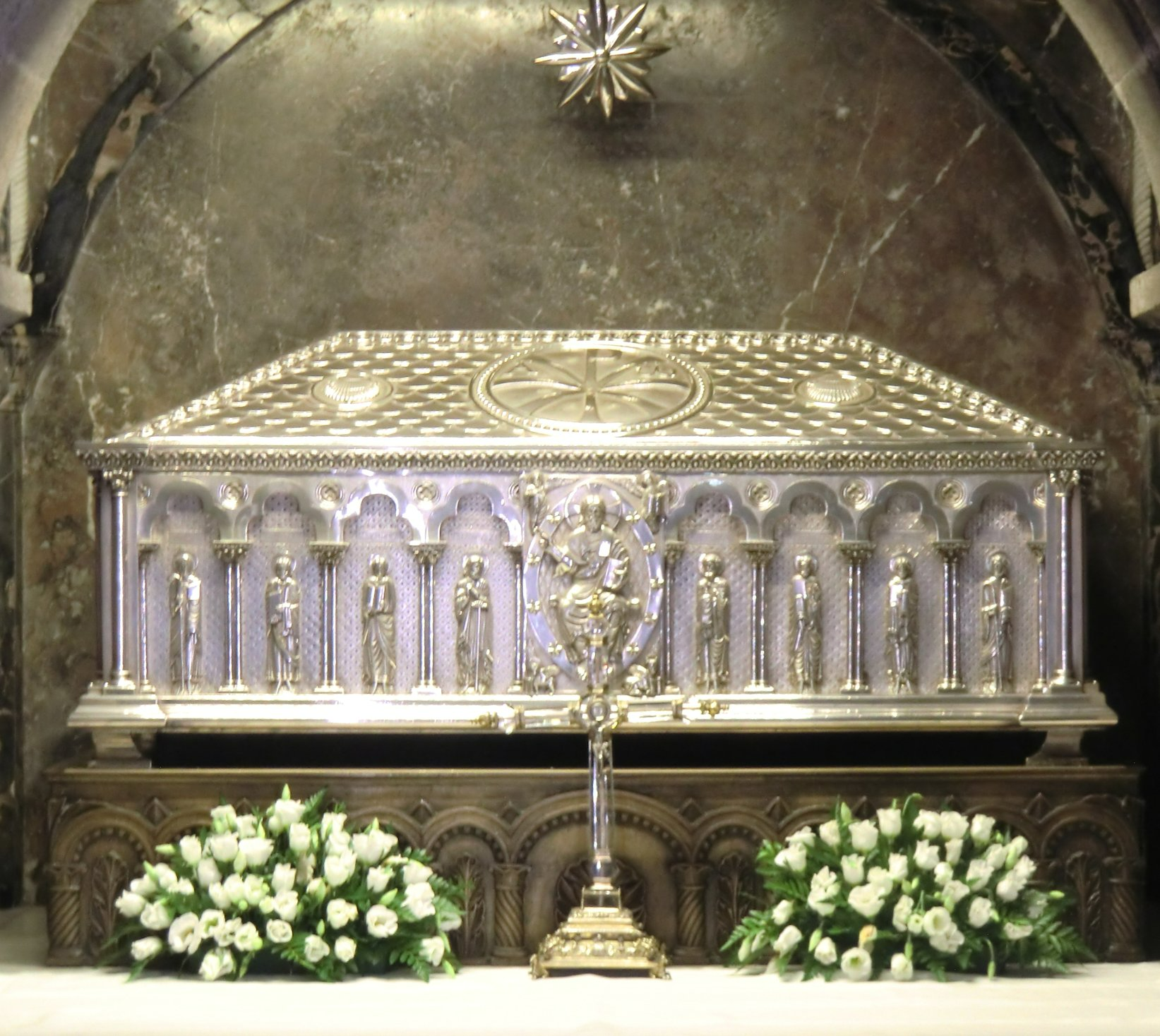
Reliquary of Saint James (Compostela, Spain)
Charlemagne's Relics
Since Charlemagne was canonized in 1165, his remains are also considered relics. There are two places where his relics can be found: inside the cathedral of Aachen, also called Dom, which means cathedral in German, and in the museum next to the cathedral, which contains treasures relevant to the emperor. First, before discussing the relics themselves, it is important to note that the emperor's body was first placed in a third-century Roman sarcophagus upon his death in 814. This marble sarcophagus was then emptied in 1165 when Emperor Barbarossa decided to have Charlemagne canonized. His relics are now in a beautiful reliquary in the center of the cathedral. The reliquary, made of wood and covered with gold and silver, was completed in 1215. The study of the relics revealed that the body of the man we think is the emperor was that of a tall man who died of old age in the eighth century. It was customary in the Middle Ages and after to give some of the bones to prestigious visitors and kings. This is why Charlemagne’s skeleton is not complete. The bones of the saints can also be found in two other places: the arm reliquary and the skull reliquary. The skull reliquary contains the top of the emperor’s skull. The shoulders of the emperor are covered by a gold coat of arms bearing the French fleur-de-lis and the Holy Roman Empire eagle. It dates from the fourteenth century.
There are other relics in the cathedrals, such as Mary’s cloak, Christ’s swaddling clothes, St. John the Baptist’s beheading cloth, and Christ’s loincloth. The most interesting one might be what is called Charlemagne’s Reliquary, which contains a piece of a nail from the True Cross, a piece of the Crown of Thorns, a piece of wood from the True Cross, and a fragment of sponge.
The island of Reichenau near Aachen is also famous for its relics. According to Timo John, there were very few representations of God during the Carolingian dynasty, so relics were important to the pious visitors to the monastery. The relic of the Holy Blood is kept in a gold-and-silver monstrance. It was given to the monastery between 923 and 925. According to John, the monastery also contains the relics of Saint Marc. The remains of the saint are kept in a reliquary with four lions for its feet. (44-47)
Saint Louis and the Sainte Chapelle
King Louis IX, also known as Saint Louis, purchased the Crown of Thorns from the emperor of Constantinople. Saint Louis’s goal in acquiring this relic was to become the most important king of Western Christendom. He spent an astronomical sum of money for the time and finally acquired the Crown in 1238. After a stop in Venice, the precious relic finally arrived in Paris on August 18, 1239. Two years later, Louis IX also purchased a piece of the Holy Cross, the Holy Blood, and a piece of the stone belonging to the Sepulcher. The year after, he bought pieces from Longin’s Holy Spear. The king had to build a monument for these relics, which made him the most powerful king in Europe. The Sainte Chapelle was built in a few months to preserve the Holy relics. It was built in the center of Paris, on the Île de la Cité, and has since become a museum. It can be visited every day. The construction of the Sainte-Chapelle was completed in 1248. This is an important date because this is the year the king decided to leave for his first crusade (the seventh) to go to Egypt.

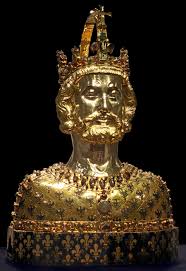
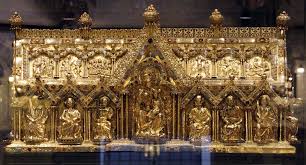
Arm of Charlemagne Bust and reliquary of Charlemagne (14th century) Dom, Aachen, Germany
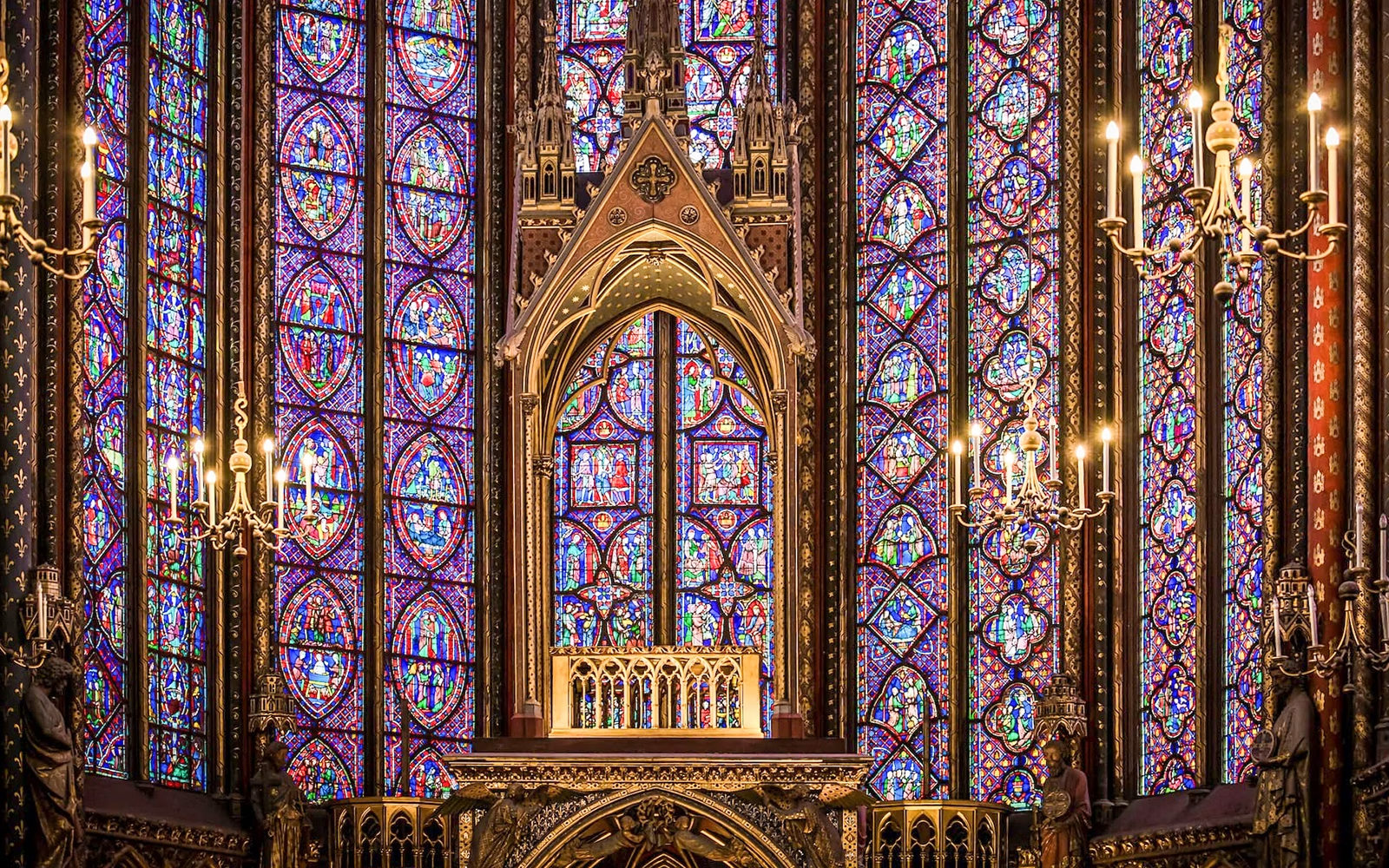
Sainte-Chapelle (Paris)
VI. What are The Crusades?
A crusade is a pilgrimage, but a pilgrimage is not a crusade. The Crusaders were men; there were very few women, who were invested by God. The Pope was the only one who could call the Crusades. The Crusaders took the cross, and very often they never came back. The voyage was perilous and took months, even years. The pilgrims also faced many dangers. The roads to Compostela, for example, were full of thieves, murderers, and brigands who would kill them, rape them, or steal everything from them.
For this book, we will focus on the first three crusades. There were eight crusades to the Holy Land, but there were also crusades against the Albigenses in southern France and the Children's Crusade. We will mention only the crusades in which the French kings and aristocracy participated.
In 1096, Pope Urban II called for the First Crusade. The goal of this crusade was to deliver the tomb of Christ, the Holy Sepulcher, from the Muslims or the Unfaithful. The Crusaders, the men who took the cross, did not leave until 1099. They arrived in Jerusalem and took control of the Tomb of Christ. It resulted in the creation of the Kingdom of Jerusalem. This kingdom goes from Israel today to Jordan.
The Second Crusade started in 1145 and ended in 1148. Conrad III, Louis VII of France, and his wife Eleanor of Aquitaine left for the Holy Land. This crusade failed because the German and the French armies could not take Damascus in Syria. Forty years later, Saladin retook Jerusalem, prompting France, England, and Germany to join the Third Crusade, also known as the Crusade of the Kings.
Saladin and the Third Crusade
According to Thierry Delcourt, Saladin was very powerful and an important figure in the story of Islam. His kingdom was extremely large. The Muslim world was fragmented and divided until Saladin took power and invaded Jerusalem in 1187. He was king of Egypt and also Syria. Baudouin IV, the Leper, was king of Jerusalem, and for a while, there was a truce with Saladin, who was conquering Syria and Iraq. This truce was threatened by Renaud de Chatillon, Prince of Antioch and of Tripoli. He was very turbulent and even sent an expedition to the Red Sea to conquer Mecca. In 1187, Renaud de Chatillon ended the truce with Saladin by attacking a caravan. He was accompanied by Guy de Lusignan, the new king of Jerusalem, and by Knight Templars. The French did not want a war with Saladin at first, but the truce ended. He started a war between the Christians and the Muslims. It was a jihad, or Holy War, in Arabic. Saladin succeeded and ambushed the French army on the road to Tiberias. Saladin killed them in a place called the Horn of Hattin. It was a tactical mistake by the French army. Renaud de Chatillon and Guy de Lusignan were both captured by Saladin's army. The sultan decapitated Renaud de Chatillon; however, beforehand, Saladin had asked him if he wanted to convert to Islam, which he of course refused. Guy de Lusignan was treated correctly. The relic of the True Cross was also taken by the Muslims during the important battle of Hattin, and it was very upsetting for the Christian knights. Saladin arrived in Jerusalem on September 17th, 1187. Historians think that around 20,000 French people took refuge inside the city. Many French people lived in these Latin states. Saladin conquered the city with very little bloodshed.
This quote from Saladin remains famous: "I warn you against shedding blood, indulging in it and making a habit of it, for blood never sleeps." This victory of Saladin was the cause of the Third Crusade. According to Thierry Delcourt, at that time, Henry II Plantagenet, king of England, and Philippe Augustus, king of France, were constantly arguing, especially over Normandy. They would rather not leave their respective countries to go on a difficult and dangerous crusade to the Holy Land. When Henry II died, his son Richard I, the Lionheart, became king, and both kings decided to take the cross. The two kings both arrived in Acre, which they conquered from Saladin. Frederick I drowned himself, so the two other kings were left alone to defend Christendom. The French king returned to Paris, leaving Richard I alone against Saladin. These two men respected each other.
The Third Crusade (1188-1192) is probably the most famous; it involved the Holy German Emperor Frederic I Barbarossa, the French king Philippe Augustus, and the English king and cousin, Richard I the Lionheart. The French king was also Richard's suzerain and lord. The French king returned to France early, leaving Richard I alone to fight Saladin. He did succeed in regaining Acre. The English king created a settlement in Cyprus that would stay there for a long time. Richard failed to recapture Jerusalem and finally accepted the truce offered to him by Saladin on September 2nd, 1192.
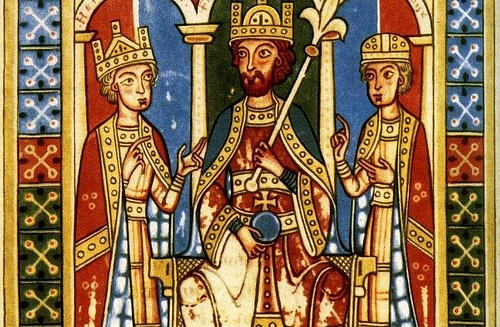
Frederick I Barbarossa and his sons
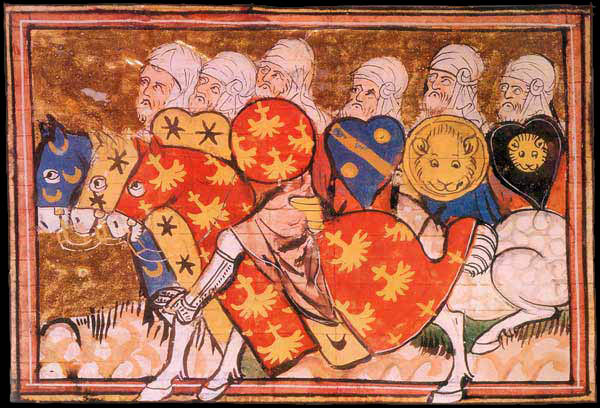
Saladin's troops, French manuscript, 1337
During the first half of the twelfth century, the most popular literature was epic poetry. Eventually, people wanted a different type of literature -- one that reflected the changing values and sophistication of the aristocracy. These novels sought to establish a code of chivalry that refined and cultivated the warrior class as presented in epic poetry. It is almost always the story of a knight who offers his love to a lady (usually married). The settings of the courtly novel alternate between scenes at a court (royal or aristocratic) and scenes in which knights pursue adventures and fulfill quests. These quests took them to many parts of the world, and even to other magic worlds or places. One such place depicted as magical is the forest of Brocéliande in Brittany, France. Here is where the Lady in the Lake produced the sword Excalibur and gave it to the Magician Merlin. He put the sword into the stone so that Arthur could extract it – thus fulfilling a prophecy. In many of these, the knight returns to court (usually King Arthur's) once the adventure or quest has ended. The courtly romance material usually mirrors the everyday lives of kings, princesses, knights – any person not of the peasantry.
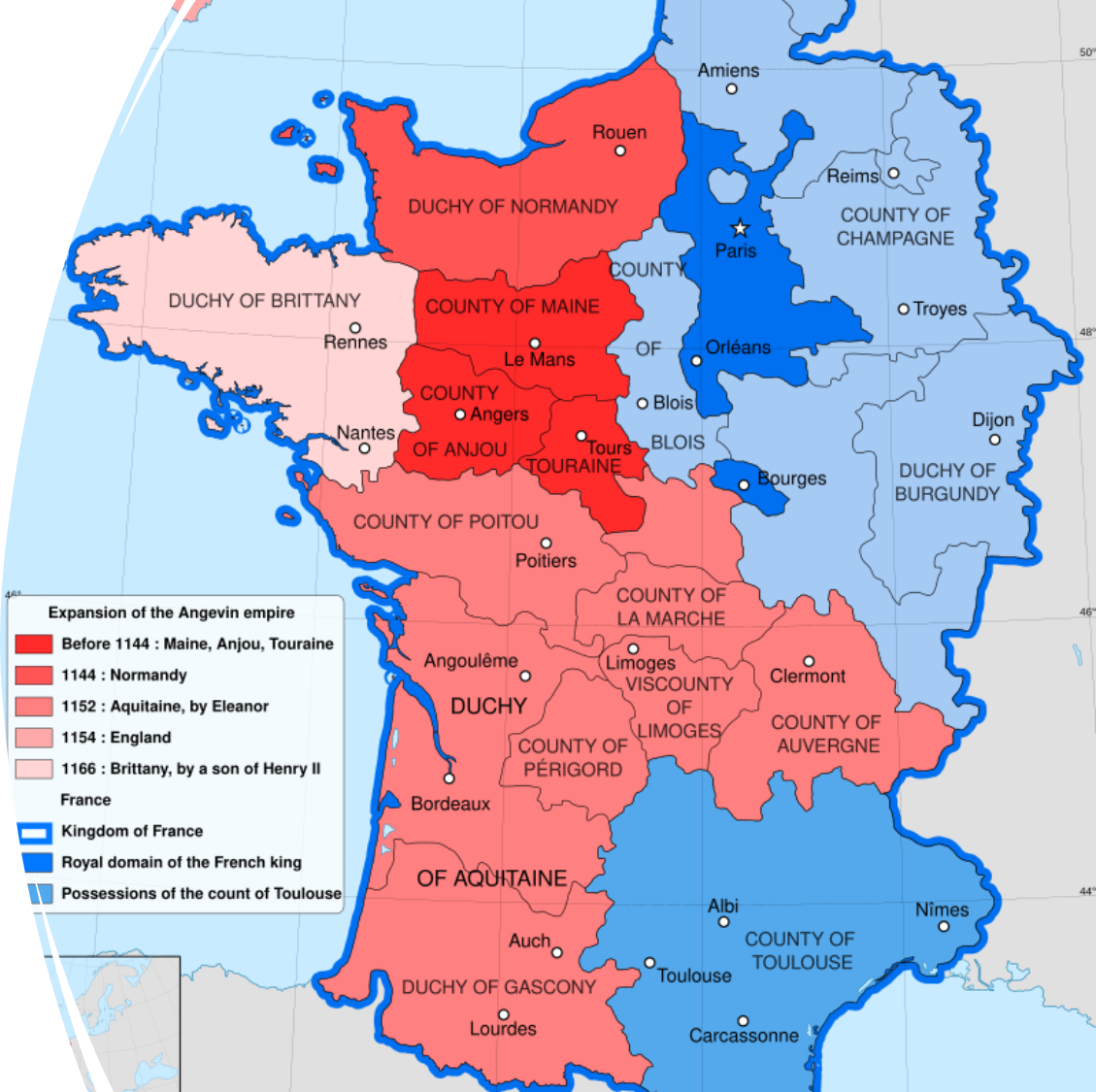
Map of France in the 12th century
VII. The secret in the Chatelaine de Vergy (tale)
The Chatelaine de Vergy is a poem that was written in the thirteenth century by an unknown author. It contains 958 octosyllables. This courtly romance, tells the story of an impossible love between a knight and a lady at the court of the Duke of Burgundy. According to Jean Frappier, the story probably took place around 1250 during the reign of Saint Louis.
At the court of the Duke of Burgundy, the lady of Vergy gave her love to a knight. The lady and the knight agreed to a covenant or contract. Their love must be a total secret from everybody; if the knight reveals the name of his mistress, she will cease to see him. Therefore, each time the knight wants to meet with his lady, she sends a little dog into the orchard or in old French vergier to let him know that she is ready to welcome him into her bedchamber. But the Duchess of Burgundy falls in love with the knight and expresses her love to him. Rejected by him, she becomes very angry and tells her husband that he is trying to seduce her. The duke becomes upset at the knight because he loves and trusts him. Threatened to be expelled from the court and therefore separated from his lady, the knight confesses his love for the Lady of Vergy to the duke. The same night, the duke spies on the lovers and realizes that the knight is telling the truth. The duke then tells his wife that she has misjudged the knight and that he already has a lover. The duchess becomes very jealous and succeeds in getting her husband to tell her the lady's name. The heartless duchess waits until the day of Pentecost to talk to the lady. She alludes to her dog being very well trained. The lady becomes very upset and dies of sorrow, thinking that her lover betrayed her and doesn’t love her anymore. The knight finds his lady dead and kills himself with his sword. When the duke learns what happened, he beheads his wife during the party and decides to become a Knight Templar. Contrary to the knight, the lady lives outside the court, and she only goes there at the end of the poem. As we have explained earlier, she meets with her lover in her vergier or orchard and sends her little dog to him when she is ready to welcome him
This theme of the perfidious wife, in love with a younger man, is already present in the Old Testament with the wife of Potiphar. Genesis explains that Joseph was made head of Potiphar's household, an Egyptian, the chief captain of the army. Potiphar's wife wanted Joseph to have sex with her. When Joseph rightfully refused, Potiphar's wife falsified evidence and accused Joseph of trying to rape her. Joseph was judged guilty because the husband gave too much credit to his wife's words. Joseph, the innocent victim, was cast into prison because of lies and false evidence for approximately two years. In the story, the evil duchess lies to make her husband talk. She pretends to cry and be upset one night when they are both in bed. Her actions recall the actions of another type of character in medieval literature, the lozangier. Like the barons fêlons at the court of King Marc in Tristan and Isolde, who want to accuse Iseult of being unfaithful to the king. The duchess wants the knight to be punished because he rejected her.
The knight doesn’t have any other option but to betray his Lady, because if he hides his secret, he will have to leave the country and will not be able to see his lover again. He is a prisoner of the secret that the lady made him promise to keep. He cannot tell the truth to the duchess without compromising his love. He therefore reveals his secret to his feudal lord because he loves his lady, and he wants to see her again. When the duke betrays the knight’s secret, he also does it for love, because he doesn’t want to see his wife upset. The duke and the knight both fail to see how evil the Duchess is.
The duke, spying on the two lovers in the vergier, believes him, but in a moment of weakness, he confesses to his ill-tempered wife the liaison of the two lovers. He betrays the promise made to the knight. The duchess is jealous and angry because the knight loves someone who is not as noble as she is and whose rank is lower than hers. She then betrays the secret during Pentecost when she alludes to the little dog that the lady sends to her lover when she is ready to welcome him. The secret is therefore betrayed three times in a row. First by the knight, then by the duke, and finally by the duchess. The secret is therefore returning to its originator, and this return is destructive and brings sorrow and death. This secret represents all the happiness in the lady’s life. She can no longer live knowing that it has been discovered. The lady’s reasoning is erroneous. In her mind, the knight was the only one who knew the secret; therefore, he could be the only one who told the duchess, and if he told her, he wouldn’t love her anymore, and therefore, he would love the duchess. Suffering to see her love betrayed, she dies of sadness. Her bad interpretations of the events and of the duchess’s words lead to her death, the death of the knight, and the duchess.
This casket is one of six that depict the story "La Châtelaine de Vergi", a tale of love and death said to be based on a scandal at the Burgundian court (1320-1340). The Met, NYC
VIII. Chrétien de Troyes
Chrétien de Troyes's life is unknown to us. We know that he wrote at the court of Marie de Champagne, the daughter of Eleanor of Aquitaine, and later at that of Philippe de Flandres, probably between 1160 and 1185. The only thing we can be sure of is his name, which he mentions in his novel Eric and Enid. He was the greatest novelist of his time. He wrote five famous novels, but for the purpose of this book we will focus on Erec and Enid (c. 1170) and Perceval ou le Conte du Graal (c. 1181-1185). In this chapter we will compare the main character of Perceval and that of Le Bel Inconnu, a novel not written by Chrétien de Troyes and whose author is unknown.
Perceval ou le Conte du Graal and Le Bel Inconnu
The two heroes of Perceval ou le Conte du Graal (begun in 1181 but left unfinished upon the death of its author, Chrétien de Troyes) and Le Bel Inconnu (13th century) ignore their own identities. Le Bel Inconnu ignores everything about his name and his origins, and Perceval is called "li filz a la veve dame" (74), "the widow's son." He was raised by his mother in a Welsh forest.
In these two novels, Perceval and Guinglain learn about their identities in two different ways, but the notion of compassion is present in all these encounters. Perceval fails to feel compassion for the Fisher King while staying in his fantastical castle. Guinglain, however, does feel compassion for the dragon he meets in the allegorical world of the fairy Blonde Esmée. Their identities are directly linked to feelings of empathy in these specific magical places, which can appear and disappear. These fantastical lands are only accessible to these two knights, who are being tested for their courage and their heroism. Perceval will fail, but Guinglain will succeed. This success and this failure are related to the figure of the mother. Perceval failed in the Fisher King's phantasmagorical castle because he had sinned. He left his mother to die without trying to rescue her. Guinglain, on the other hand, kissed the dragon, who finally revealed his identity.
What Guinglain did not know was that his mother (the fairy Blanches-Mains) was the dragon and that she wanted him to reach her fantastical castle. She had orchestrated the whole thing from the beginning. Guinglain’s quest for identity is also tied to the notion of incest. The fairy’s castle symbolizes the mother’s body, which is forbidden but also conquered by the incestuous son. It is situated in the Ruined City. The city is in ruins because of the incestuous love the mother feels for her son. Guinglain’s attraction for Blanche-Mains is very strong, but she refuses to sleep with him on two different occasions. She attracts him and then rejects him. Her castle is a magical place where she uses powerful spells to make him believe that he has lost his mind. Once the fairy gives herself to Guinglain, she reveals his identity, but she warns him not to leave her. He becomes a prisoner in her magical land, and it is only when he decides to confront her, to disobey her, that he becomes an adult and a true knight. When he leaves her, he also loses access to the castle, which disappears forever.
Chrétien refers to Perceval as "the widow’s son” before we learn his real name. The author emphasizes the importance of the mother in the young hero's life. Perceval has no identity at the beginning of the novel; he is only the son of a woman. It is exactly at the moment when he decides to leave this paradise that his mother, fearing for his son, tells him who his father is: "You do not know it yet, but your father had been injured in the legs, which made him infirm. His beautiful land, his great wealth, and everything he had acquired then started to decline, and he became very poor." ((435-41, Our translation) Perceval's mother does not divulge his name; “Beau fils” or “Beautiful son” does not ask questions. Chrétien de Troyes's character sins by abandoning his mother, who faints before his eyes as he departs. This sin will change the course of his life.
The name of his father is revealed to le Bel Inconnu when he arrives at the “cité gaste,” or “empty city.” This is when the hero meets a wurm or small dragon that comes out of a closet and wants to kiss him. During this frightening episode, the hero shows compassion three times in a row. He wants to kill this fabulous animal, but understands that it shows submission to him when bowing its head. After kissing the knight, the wurm goes back to the closet. In the Middle Ages, people used to put documents in closets, and not linen; this closet symbolizes something important for the development of the main character. The unknown knight will find what he is looking for in this very specific place: an identity and the names of his parents. In heraldry, wurms are usually represented with a child in their mouth, but it is unclear if the beast is eating it or spitting it out. Guinglain finally learns his name thanks to this fantastical beast. From that moment on, the hero has a real identity. This identity was given to him by someone he did not know.
Perceval is no longer a child once Gornemant de Goort teaches him how to behave like a proper knight. Full of remorse because he left his mother as she was fainting, Perceval starts to look for her. Gornemant de Goort understands that the young knight is too talkative and suggests that he be quieter. He tells him not to ask too many questions. After helping Blanchefleur, the young knight arrives at the fantastical castle of the Grail, inhabited by the Fisher King, who gives him the Sword of Destiny. Unfortunately, the knight keeps quiet and does not ask any questions in front of the strange procession. Perceval does not understand right away how fatal this mutism will be for the rest of his life. He fails because he sinned when he left his mother dying. Perceval lacks the necessary compassion to ask the right questions before the Spear and the Grail; he fails at the castle. Le bel inconnu, on the contrary, can feel compassion for the wurm who obeys him. Instead of killing it, he shows constraints and does not harm it. This compassion allows him to learn his name and his origins.
This compassion is really what differentiates the heroes' quests for identity. It is because of this specific failure, his silence, that ladies will lose their husbands, that the lands will burn, and that the country will be ruined.
Perceval wanders in a wasteland for five years, searching for his mother and the Holy Grail. During the next five years, Perceval forgets God, and only during his last encounter with the hermit in the forest does he realize he has committed another sin. The hermit reveals to him that his mother, the Grail King, and the hermit are all siblings. Perceval’s lineage is therefore related to the Grail.
After these five long years of wandering and penitence, Perceval finally learns the secret of his origins. However, he fails in his quest because he never finds the Holy Grail again. His identity quest is a success, but it is accomplished at the expense of the death of his mother, the ruin of Arthur’s land, and the misfortune of all men and women living on that land. His quest for identity is tainted by his failure.
These encounters enabled the two heroes to finally discover their identities and lineage. The mother figure is at the center of these quests. She is the one who plans her son’s life from the beginning. It is also, according to the hermit, Perceval’s mother, who asked God for forgiveness when he left her.
Finally, although the mother figure is highly ambiguous in Le Bel Inconnu, the father figure is also compelling in Perceval. The descriptions of Perceval’s father and the Fisher King are very similar. Both were injured in the legs, and both are disabled. If they are the same character, it would mean that Perceval’s mother committed incest with her brother. According to the Hermit: ‘As for the Fisher King, he is the son of the one who is being served the Grail.” (Our translation) Again, an incestuous relationship is at the origin of these two characters, and these magical lands that appear and disappear in the blink of an eye are forbidden to those who are born out of sinful relationships.
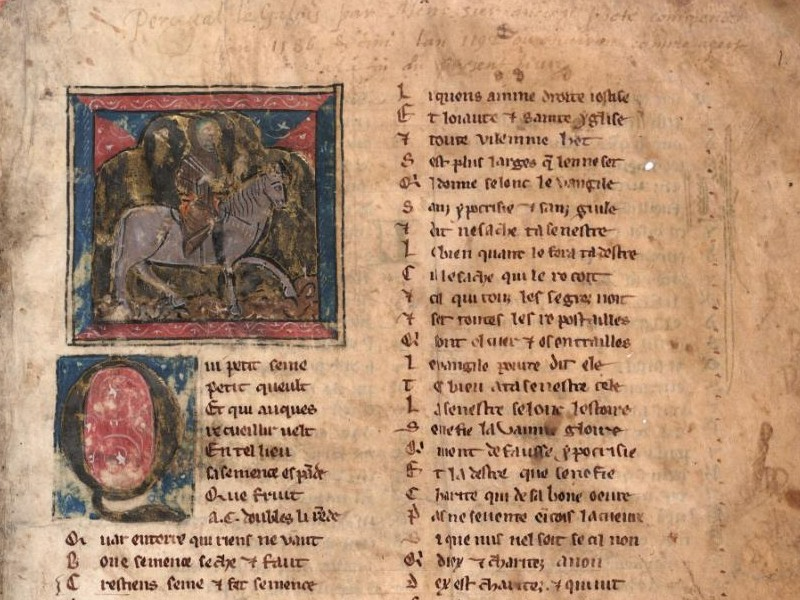
Perceval's departure, Montpellier manuscript (Université de Montpellier)
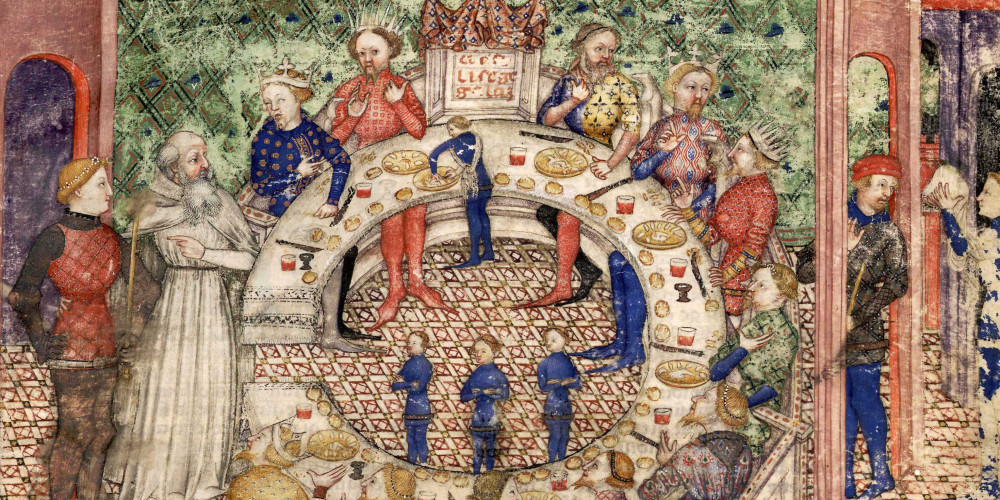
La Table ronde, Manuscript de la Bibliothèque nationale de France
Erec and Enid: The Transformation of Erec and Enid into King and Queen
In Erec and Enid (circa 1170), the knight has to complete a number of quests. It is the story of how Erec, a knight, and Enid, a commoner, undergo a series of adventures that ultimately lead them to become king and queen. It does contain some elements of the supernatural: a mean dwarf, a huge giant, and the Court of Joy. But they also face everyday people in their medieval world. The first and most important quest is to defeat another knight in order to win Enid. Then, they go to King Arthur's court, where they will be received into the nobility. After this initiation, the two head to Erec's castle. It is there that Enid criticizes her husband for becoming lax in his duties as a lord. This deeply offends Erec, and he decides to take on a series of adventures to show his worth. He forbids Enid to speak to help him when he is in danger. She does speak a couple of times, much to the annoyance of Erec, who then prolongs the adventure.
During his quests, he has to fight a giant, defeat several brigands, and escape a plot by an evil innkeeper and his servants to kill him. The innkeeper betrays him because another lord at the inn wants Enid for himself, and to get her, he has to get rid of Erec. The two escape the trap. Then there is a scene in which the couple encounters King Arthur and his court. Both Arthur and Guinevere try very hard to convince Erec to stop his quest, bring his wife back to his castle, and join the rest of the court. Erec refuses, for he still feels that he has more to prove. So, he leaves and eventually comes to his final and most dangerous quest—the saving of an entire village through one-on-one combat in the Court of Joy. He succeeds, and in doing so he frees the woman who has been trapped there for years. Having proved his worth to Enid's satisfaction, the two head up to Erec's castle and are crowned, thus completing their transformation to royalty.
IX Les Lais by Marie de France
The previous chapters focused on the importance of Chrétien de Troie to the Arthurian literature. Then we looked at two tales not written by Chrétien de Troie: Tristan and Isolde and The Châtelaine de Vergy(i). This chapter will present texts from a genre similar to those of the novels of courtly romance: the lai (lay), or lais (lays) plural. During the twelfth century, epic poems were propagandistic stories about Christians defending Christianity from various Muslim empires in the Near East and in North Africa. Towards the middle of the century, other narrative forms, such as courtly romance, emerged and became popular. The knowledge and popularity of the lays also increased during the twelfth century.
What are the lays?
Lais are a literary genre found primarily in medieval French literature. They differ from the courtly novel in three ways: structurally, in their settings, and in their sources. Lays are shorter than almost all novels, usually between 600 and 1200 verses. They are written in rhymed verse that was sometimes put to music. Most of these lays were part of a long tradition of oral storytelling from all over the world — a tradition which lasted over a thousand years. The material for the lays comes predominantly from non-Arthurian sources. Many, but not all, of them come from Celtic mythology, legend, and folklore; others from Greek and Roman mythology; still others from eastern mythology. In this chapter, we will look at different lays, their settings, and their themes.
The primary source in French literature for the lays is Marie de France (referred to as Marie). We have other written versions of lays not attributed to Marie. Some include the name of the person who wrote them (although never substantiated); others that are of Greek and Asian origins, and those that also draw upon Celtic material and are quite similar to the plots of some of Marie's lays. There are themes common to many of the lays: fidelity (infidelity), the jealous and possessive husband, the scorned lady, the forbidden/impossible love, the love (or lack thereof) between a person and a supernatural being, and finally alienation and the otherworld. I will look at a selection of lays, both those written by Marie and those not. Because each lay treats more than one of the aforementioned themes, I have not grouped them by theme. I will, instead, discuss individual lays, first from Marie and then from the other group.
The Lays of Marie de France
Equitan
This lay is about a king in Brittany, France: Equitan. He is a king with a fine reputation and who is greatly loved. His seneschal (a kind of game warden), an excellent and loyal vassal. The king would often go to the seneschal's home to hunt with him. On one visit, Equitan meets the seneschal's wife, whose reported grace, education, and beauty are renowned. Upon seeing her, Equitan falls in love. She, for her part, is attracted to her king. The lovers are victims of Cupid's designs, yet there are several problems with this relationship. Nothing in the text indicates that the seneschal's wife is unhappy in her marriage. However, as is sometimes the case, love can be both a source of great joy and of profound distress and suffering. At first the lovers are quite content. Equitan passionately loves this woman. The day would come when they would have to face reality — that their love is a forbidden one! A King wishing to court a wife of one of his vassals is, in itself, already problematic. The king must, at some point, find himself a woman of a rank worthy of his own. In a society where the eldest male heir inherits everything, it is important for her to produce a son in order to ensure the line of succession.
The other considerable problem is that the lady, being in a position of social inferiority, is vulnerable to ruin. If the relationship becomes known, the king might suffer embarrassment, but the lady's honor and reputation would be destroyed. Even though Equitan was willing to claim her as his queen, it would not have mattered.
Lady: "Love is not honorable unless it is based on equality".
Equitan: "Lady, do not regard me as your king but as your vassal".
This is quite impossible. The royal family and the court would never allow the couple to be together. The king replied that if her husband were dead, he would be able to take her for his wife. Again, this probably would not happen. She interprets it as a promise that he would marry no other. The two devise a plan to kill the seneschal.
This is a cautionary tale, meaning it serves as a warning or a lesson to be learned. The couple set a trap for the seneschal: they plan to burn him in a bathtub filled with scalding water. The seneschal returns sooner than expected, catching the two of them making love. Equitan, to hide his shame, jumps into the bath and burns himself to death. Filled with anger, the seneschal then forces his wife into the scalding water, where she dies. The relationship between the two was never going to succeed. The political factor would not allow the two to marry. The adulterous relationship was condemned by society
Bisclavret
At the heart of this lay is the theme of lycanthropy, the transforming of a man into a werewolf. The wolf held an important place in medieval civilization and culture. First and foremost, it was feared. As the medieval population grew, it became necessary to clear large tracts of land. This put the people in closer contact with the wolves. They aggressively attacked both livestock and humans. Finally, the wolf was the Christian symbol of evil and sexual deviance. In the lay, however, Marie made Bisclavret, the werewolf, a symbol of unjust alienation, making Bisclavret the victim rather than the antagonist.
Three days a week, Bisclavret, whether he wants to or not, transforms into a werewolf. His wife knows not why he disappears. Naturally, she becomes curious, fearing that he has a lover. The important condition that Bisclavret must observe is that he must find his clothes to dress himself, or he will remain a werewolf forever. His wife constantly pressured Bisclavret to explain his odd behavior — eventually wearing him down. He shares his secret with her. Despite her love for him, once she knows the story, she is afraid to lie with him. She seeks a way to separate from him. She reveals the secret of the clothes to her lover ( one whom she had rejected in the past). One night, when Bisclavret is in the form of a werewolf, his wife and her lover hide his clothes, and Bisclavret remains a werewolf.
His wife and her lover marry — and in so doing the wife commits adultery. Now, it is quite understandable that Bisclavret's wife would be repulsed at the thought of lying with him. Yet he is hardly to be blamed. In this sense, she is no different than the wife of Equitan's seneschal in so far as she simply seeks love elsewhere. The transgression lies in the fact that they are both still married. This will be what leads to the demise not of Bisclavret, but of his wife.
A year passes. One day, Bisclavret is being pursued by hunting dogs and is cornered. The hunting party is that of King Arthur and his court. Bisclavret pleads with the king, who, although he does not recognize him, is intrigued and moved by the intelligence, docility, and nobility the beast shows. Over time, the king and his court grow to love him dearly. The day comes when King Arthur holds a festival — which Bisclavret's wife and her husband attend. Bisclavret, on three occasions, tries to, and somewhat succeeds in, biting the knight. The people, astonished, think that he must have good cause. A few days pass, and King Arthur, while out hunting, takes lodgings. Bisclavret's wife goes to see the king. Bisclavret attacks his wife, tearing the nose off her face. The king now understands. He gives to Bisclavret some clothes. Bisclavret then, in private, dresses and emerges from the room in his human form.
In this lay, the wife uses her seductive and persuasive charms when pressing him for an explanation. By expressing fears of his infidelity. She uses emotional blackmail. This lay also presents the theme of the monsters as “the other" — forcing the characters to reconcile all aspects of their personalities or establish new identities by killing their monsters. We all have a "monstrous" side. In this lay, the werewolf is not the monster, rather the victim of his wife's inability, unwillingness, to accept him as he is.
Yonec
Yonec is the story of a young woman who, through a business arrangement between two families, finds herself married to a man 60 years her elder. The first themes that come to mind are the unhappily-married woman to an old, unsatisfactory (even repulsive) rich husband, who has essentially bought her in order to ensure that he will have a male heir to his fortune. He is extremely jealous, possessive, and suspicious. She is virtually a prisoner in the man's home, locked in a chamber at the highest point, under lock and key, and watched by her husband's sister.
Crossing a natural barrier to another world is a metaphor for characters who need to explore love and their desires. The journey represents an attempt to escape the suffocating and confining conditions in which they are living (i.e., the prison her husband has created). The woman's profound unhappiness causes her to wish for a handsome young lover. It is this ardent wish that will summon the fairy-lover to come to her. Yonec is from a supernatural world. He leaves it by taking the form of a beautiful bird. This allows him to fly to her chamber high up in the castle. Once with the princess, he transforms himself back into a handsome prince. The lovers enjoy many passionate and joyful moments. One day, the jealous husband is certain that his wife is somehow being unfaithful. He and his sister find a way to expose the lovers. They set a trap for the bird by putting glass, wires, and spikes on the windowsill. As expected, when the bird tries to enter his lover's chamber, he is mortally wounded. He is forced to return to his supernatural world. His lover manages to escape and follows him back to the hidden entrance of this world. By entering this forbidden world, she assures the death of her lover. She barely manages to escape alive, but not without two important gifts: a ring and his sword. The ring is to make her husband forget, so she will not suffer. The sword is proof of their story to be given to Yonec, their son.
One day, while at a fair in Caerwent, Yonec, his mother, and her husband discover the tomb of Yonec's father. His mother tells Yonec about his father and how much they were loved. She then gives his father's sword to him. Yonec, to avenge his father, kills the husband of his mother. Yonec becomes the lord of that kingdom.
Lanval
The two main themes in Lanval are the secret love between the hero and a woman from a supernatural world (as in Yonec). The relationship can only continue in so far as no one discovers the identity of the knight's mistress. The other theme is that of the spurned and vengeful wife — in this case King Arthur's wife, Gwenevire. She unsuccessfully tries to seduce the younger knight. This theme is not unique to Breton folklore. It is also found in the bible — it is that of Potiphar's wife. Potiphar is a person known only from the Book of Genesis' account of Joseph. Potiphar is said to be the captain of the palace guard. Joseph, sold into slavery by his brothers, is taken to Egypt, where he is sold to Potiphar as a household slave. Potiphar makes Joseph the head of his household, but Potiphar's wife, who is not named in the Bible or in Christian tradition, is furious at Joseph for resisting her attempts to seduce him, and falsely accuses him of attempted rape. Potiphar casts Joseph into prison, from where he later comes to the notice of Pharaoh through his ability to interpret the dreams of other prisoners. (Genesis 39-40)
At the court of King Arthur and his queen Guenièvre, there is a knight, Lanval, who is far from his native land and does not completely fit in. Basically, others are envious of Lanval. Because he is not from that land, he is treated poorly and mocked — precisely because he possesses great talent, beauty, and bravery.
Lanval, who has done more than anybody else to increase King Arthur's wealth and power, is forgotten when the time comes for Arthur's knights to be recompensed for their efforts. Lanval feels completely disrespected, so he leaves the court. One day, while hunting and relaxing alone in the forest, Lanval falls asleep. He lays his head upon his cloak. Thus begins the dream sequence. He is awoken by two beautiful women messengers. They inform him that their mistress wishes that he be brought to her. He follows the two women to where their mistress is. There, it is as if Lanval has been taken to a land of wonder. There is such a collection of fine items: silks, ivory, jewels, food, clothing — an unbelievable amount of riches! All of this, however, pales in comparison to the absolutely magnificent beauty of the woman who owns it all. She and Lanval become lovers. He may visit her as often as he wishes to, but on one condition: absolutely no one is to know of her existence nor of their relationship. If it were to become known, it would mean the end of it all. Here again, we find our marginalized hero finding his place in a world outside of the conventional medieval society. The problems arise when the queen, Guenièvre, sets her mind to having Lanval as her lover.
Lanval is already quite happy with his lover. So, when the queen approaches him to declare her love for him, she is shocked by his rejection of her. She demands to know why he has not accepted her love. Lanval, however, is forbidden to reveal his relationship with the fairy-lover. The queen, furious, tells the king that Lanval has insulted her most egregiously by asking her to become his lover. The king hears of this and is outraged. He demands that there be a trial. The only problem is that those who are going to act as jurors are the very same nobles who are envious of Lanval. Alone, Lanval calls to the lady to come, but to no avail. At the trial, the King is ready to declare Lanval guilty (if only to appease his angered wife), yet still seeks the advice of his barons. One says that the evidence against him is not conclusive. Should he produce his beloved, he shall be cleared. Lanval remains silent, but his lover comes to the court to clear his name. She rides off to Avalon with Lanval.
Avalon is to Breton legend what Valhalla is to the Vikings. It is a place that, in the afterlife, only the worthy are allowed to go. So, if the lady decides to take Lanval to this place, it is because he is worthy of such honor. Even though Lanval never received the respect and honor that he deserved while serving Arthur, he will be rewarded in the next life.
The common themes the lays share: fidelity (infidelity), the jealous and possessive husband, the scorned lady, the forbidden/impossible love, the love (or lack thereof) between a person and a supernatural being, and alienation in the otherworld; they are all mixed with some aspect of love. Marie shows love through a social lens. All of the relationships are adulterous. Marie believes in the institution of marriage. What she criticizes is the social convention of poorly arranged marriages, and in particular, those where the woman is more of a possession or a prisoner than a wife, or those who are married to very old men. The lays discussed in the next section will also address love and fidelity, but the outcomes are not always favorable.
Anonymous Lays: Ignauré, Mantel, Pyramus and Thisbe
The three lays in this section are not attributed to Marie de France — Pyramus and Thisbe comes from a Greek myth set in what is today Iran. The other two come from Celtic folklore. In these lays, criticism of the institution of marriage is not the primary concern; it is only a relative one. Ignauré and Mantel deal with the question of conjugal fidelity. Pyramus and Thisbe is a story about forbidden, ill-fated love.
Ignauré
In the world of courtly medieval love, the lady and her lover were supposed to be completely devoted to one another, or so claimed many a medieval poet. The knight, usually from a lower social class than the lady, by showing his undying and exclusive love through feats of valor, writing of love songs and poetry, tried to be worthy of the lady's love. If the lady granted the gift of her love to him, it was complete, and there would be no other. The lay Ignauré is a parody of this medieval courtly love.
Ignauré is a knight from modest means and background. He is the finest fighter in the land. He is also incredibly attractive — so much so that he is irresistible to almost all of the ladies. He enjoys beauty and sex. His considerable sexual prowess allows him to have, simultaneously, twelve mistresses — each unbeknownst to the others. Each time he is with one, he acts as if he is thinking of no other. Each of these women came from noble, wealthy, and powerful families. Each one gives the knight riches, buys him expensive armor and weapons for the tournaments — leaving many to wonder how he, a relatively poor knight, can afford this. The twelve husbands of these women are completely oblivious to their cuckoldry. This could not last forever, and it did not.
The ladies, who all know each other, are talking together in a park (without their husbands being present). They all admit to having a secret lover, so they devise a game called the Confessor. One woman will be the confessor (priest), and the others will each whisper in her ear the name of her secret lover. No need to say that their reaction is one of shock, jealousy, and fury. Having regained their composure, they decide to kill the knight. To do so, one of them will invite the knight to a rendez-vous in the garden. The knight arrives and is immediately set upon by the twelve who want to stab him to death. The knight, however, manages to placate their anger by telling them that he does love each of them equally, and that they are all special. The women sense that he is being sincere and cease all attempts to kill him. Yet they are left with a problem: they all still love him, but know that things cannot go back to the way they were. So they force him to choose one of them. From that time on, he will be only her lover. The knight chooses the one who was the confessor, but this would not prevent his unhappy ending.
Now that he has only one mistress, he goes to her house much more frequently — increasing his chances of being found out, which he is. The husbands are informed that one man, a lowly knight, has been making a fool out of all of them! They capture Ignauré and give him to their servant's keeping. The women, all still in love with him, begin to ask when he will be released. The husbands have already meted out their punishment. They invite their wives to a supper. The meal they serve consists of Ignauré's private parts and his heart. After the meal, they inform the ladies that they have just eaten their lover. The wives' reaction is both comical and significant. It is not clear what desired outcome the husbands are hoping for, but their wives' reaction is surprising! The twelve of them decide to never eat again. They want the parts of his body each of them had eaten to be the last thing to enter their bodies. They hold true to their word — the twelve die of starvation! This last gesture is poking fun at the ideal of courtly romance and the exclusivity of their relationship — one knight and twelve women.
Mantel
The lay begins with a setting common to many medieval stories: King Arthur's court at Pentecost. It is celebrated on the 50th day (the seventh Sunday) from Easter Sunday. It was a time for the king to gather all of his lords and knights to distribute largesse (rewards for loyal and valiant service). It is also the beginning of the season for tournaments and military campaigns. It is under such festive conditions that the characters in this lay are assembled.
As was his custom, Arthur did not sit down to eat until a new adventure was presented to the court. During this celebration, a young man, an exceedingly handsome messenger, arrives from a very distant land, sent by his lady (fairy). He offers Arthur a boon, a favor, that, if refused, will never be asked again. cannot be refused. He says, "I will not be seeking any outrage against you in which you would suffer any shame or loss." He offers them a mantel (cloak) which no one has ever seen its equal in craftsmanship and beauty.
The mantel will tell whether the lady has wronged her husband or lover in any way. If she has done so, the mantel will not fit properly — being either too long or too short. It is a test of the ladies' fidelity and loyalty. Caredoc requests that, without being told how the mantel works, the ladies of the husbands present, as well as the maidens, be brought into the hall and that each be asked to try on the mantel.
This test is motivated by misogyny (hatred of, aversion to, or prejudice against women) and sets out to demonstrate the weaknesses of women. As is fitting, the queen herself is the first to try on the mantel. The mantel scarcely comes down to her shoes. Embarrassed, the queen faces a dilemma: if she shows anger, her shame will increase. In order to save face, the queen turns it into an amusing game — giving no importance to the results. Once the queen tries it on, the mantel's function becomes known; the others would not dare refuse to do likewise.
All women who are present fail the test. The comic element comes from the men's reactions to the results. After each woman puts on the mantel; and fails the test, the others make fun of the husband. As the other wives fail, it is clear they have all been wronged in some way. The husbands are just as embarrassed as are their wives. All are embarrassed. No one could insult anyone without sharing the insult himself. The lone exception is Caredoc, whose lady is the only one to pass the test. The youth and his lady leave, refusing to dine with them. The end leaves many feeling anger and resentment.
By making Caredoc and his lady the only ones beyond reproach, the lay criticizes the lack of fidelity and loyalty at King Arthur's court — at least on the part of the women! Another lay, Cor, will offer the same test, only this time for the men. The fact that it is King Arthur's court proves that it can, and does, happen anywhere. The message here is that the systems of marriage and courtly love had many flaws. The greatest being the need to seek pleasure outside of the conjugal setting. The fact that the only woman to pass the test is not of this world suggests that the standards that we set are not attainable by mere humans.
Pyramus and Thisbe
The earliest written version of Pyramus and Thisbe is the one found in the Roman poet Ovid's book Metamorphoses (8 CE). It is probable that an earlier Greek version had been written several hundred years previously. The city of Babylon, in modern-day Iran, is the setting — as it is in Metamorphoses.
In the city of Babylon live two very powerful families. Each family has one child: Thisbe, a girl, and Pyramus, a boy. They are, beyond doubt, the two most beautiful children in the kingdom. They are under ten years old and are allowed to spend a lot of time together. Then, Cupid decides to use his arrows on the two. They begin to fall in love. Their bodies are too young to understand love. Their hearts know nothing else. One day, a servant in Thisbe's household observes the two children. The servant, noticing that the two display an unusual closeness, begins to fear that they are in love — and not only as friends. Alarmed, she tells Thisbe's mother, who immediately instructs the servant to prevent Thisbe from leaving the house. From this, a dispute arises between the two families. The two are forbidden to see each other, even to write to each other. Then adolescence claims the two. Their desire and love do not cease.
Their families' properties are separated by a wall. One day, Thisbe finds a small hole in the wall, through which the lovers can finally communicate. Thisbe dreams that God tells her the two must leave the city and meet again under a mulberry tree. The two form a pact to do so. Thisbe is the first to arrive at the mulberry tree. While she waits, she sees a mountain lion who has just killed a flock of sheep and is covered in blood. Terrified, Thisbe runs off but drops her scarf. The lion comes over to where she stood and walks on the scarf, leaving some of his blood.
Pyramus arrives on the scene, wondering where Thisbe could be. He then sees the bloodied scarf on the ground and, horrified, believes that Thisbe has met her end. He laments her death and, out of love, ends his own life. A little while later, Thisbe returns to the mulberry tree. Upon seeing her dead lover, takes her own life — joining the two lovers in death.
Pyramus and Thisbe is obviously a tragedy. There is no moral lesson to be taken away from it. Two young lovers who, forced to separate by their families, must resort to desperate measures to live as free and happy lovers. To this day, families still disapprove of their children's choice of lover on the grounds that "they are not good enough for you." In today's world, there are still many obstacles to love. For that reason, this lay still has relevance today. Today, the most obvious literary reference for this story would be Romeo and Juliet.
These three lays, which are not attributed to Marie, address the question of fidelity. In the case of Ignauré, the death of the women is a critique of the idea of courtly romance where a knight dedicates himself to one woman. Mantel is a story that highlights men's misogynistic mistrust of women. It calls into question whether the institution of marriage in medieval society truly reflects the desires of the men and women at the time. Pyramus and Thisbe is about the absolute devotion the two have for one another. It examines how society judges people's love— sets taboos. It shows how pure love tries to overcome society's obstacles but does not always succeed.
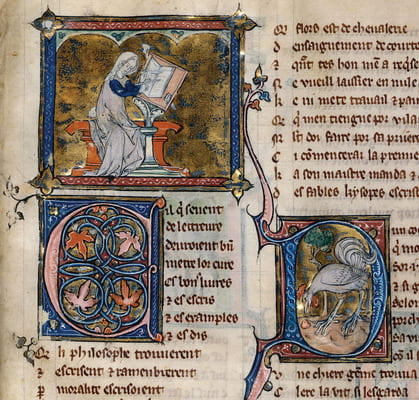
Marie de France (Illuminated Manuscript -- British Library)
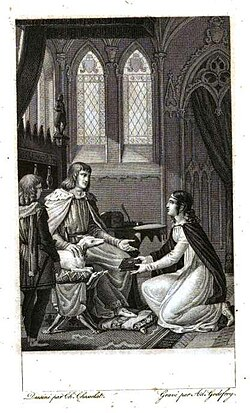
Marie de France presents her book of poems to Henry II of England by Charles Abraham Chasselat (1782-1843)
X. Tristan and Isolde
Tristan and Isolde is a very famous legend. There are several texts or fragments in several European languages, written between the 12th and 14th centuries. The two French texts were written by Thomas (1170-1173) and the other by Béroul. These two texts are incomplete and, together, give the reader a better understanding of the legend. The first text Thomas wrote in octosyllables was for the Plantagenet king. Henry II married Eleanor of Aquitaine in 1154 and gave him the significant Angevin empire. Thanks to her, he was a mighty king who ruled a territory going from the Pyrenees to Scotland. Despite his vast empire, he was still envious of his suzerain, Philippe Augustus, the French king. Philippe Augustus modeled himself on Charlemagne. Charlemagne was, after all, a Frankish king. The Arthurian myth was created because Henry II needed someone to look up to, someone who would epitomize the courage, valor, and greatness of an English king.
As we saw earlier, Arthur was not a real English king; he was probably a Roman chieftain who lived in Great Britain during the 5th or 6th century. Nevertheless, Arthur became the ideal English king, as Charlemagne became the ideal French king and emperor.
Tristan is Mark's nephew and an orphan; he was raised by his uncle. To show his valor, he goes to Ireland to defeat Morholt, a giant who demanded young Irish people as payment. During this fight, he is injured and is healed by Isolde and his mother, who is the queen of Ireland and also a sorceress. During a second trip to Ireland, he wins Isolde for his uncle Mark. On the boat returning to England with Mark's bride, Tristan and Isolde are very thirsty because it is very warm. Brangien, Isolde's maid, unwittingly gives them a bottle to drink from. However, the bottle does not contain water or wine; it is a love potion, originally made by Isolde's mother. Upon Isolde's departure, Isolde's mother gives her a potion to enhance her desire for Mark. Tristan and Isolde both drink this potion and fall simultaneously in love with each other.
In Béroul's story, the potion's effect lasts only three years; in Thomas's version, it never ends. The couple fears Mark's reaction during the wedding night. Brangien is to take Isolde's place during the wedding night. Brangien, who is still a virgin, sleeps with Mark, who is under the influence of alcohol and does not realize that he is not sleeping with his wife. In a way, Tristan and Isolde are very selfish because they ask Brangien to sacrifice herself. On the other hand, it is possible to say that Brangien made a mistake when she gave them the potion to drink on the boat. Once Tristan and Isolde are in Mark's castle, they constantly have to hide their love and meet in secret.
The king is what we would call a weak king. He is surrounded by lozengiers or evil barons, and Tintagel the dwarf. These barons hate Tristan because they are envious of his exploits. They want Mark to find out that Isolde is cheating on him with his nephew and therefore deserves to be punished. Béroul's version begins with the pine scene, in which Mark is hidden in a pine tree and waits to see whether Tristan and Isolde will reveal their love for each other. The evil barons have told Mark to hide in the pines and wait. However, luck is on the side of the lovers because Isolde recognizes Mark's reflection in the water underneath the pine, thus allowing her to change the tone of the conversation to one of detachment and propriety. As a result, Mark sees nothing wrong with the couple's behavior and leaves. She is also able to let Tristan know that they are being observed: "Li rois qui sus (en l'arbr)e estoit Out l'asenblee bien veüe Et la raison tote entendue De la pitié qu'au cors li prist, Qu'il ne plorast ne s'en tenist Por nul avoir; mout a grant duel, Molt het le nain de Tintaguel." (258-64)
Dwarves are usually evil characters in French courtly romance poetry. Even though Mark thinks that the dwarf is wrong and that Tristan and Isolde are just friends, the evil barons and this dwarf will continue to snare the two lovers in a trap. One night, Tristan goes into Isolde's bed, and while they make love, he bleeds because of a wound that has not properly healed. It was another trap from the dwarf. He had previously put flour on the bedroom floor so that he could see if Tristan would walk from his bed to the queen's bed. At that time, people would usually sleep together in the same room. When Tristan hears the king coming back to this room, he suddenly jumps from the queen's bed to his bed, but inadvertently bleeds on the flour. The dwarf shows this to the king, who decides to punish them and have them killed. Once again, luck or God is on the lovers' side. They do not die but escape a terrible punishment. Mark gives Isolde to some lepers who were going to rape her. In the Middle Ages, lepers were famous for their licentiousness. Isolde is saved by Tristan, who takes her away to the forest of Morrois, where they stay for a long time. They suffer because they do not have anything to eat, and they lose weight. After three years, the effect of the potion ends, and they realize that they can no longer stay in the woods. They seek advice from the hermit who lives in the forest, who asks Tristan to return Isolde to Mark. The hermit writes a letter, and Mark accepts. The two lovers will live separately after that.
In Thomas's version, Tristan leaves Isolde when the potion no longer has any power. He goes to Brittany, where he decides to marry Isolde with White Hands. He marries her for different reasons. First, she has the same name as Isolde. But there are more important reasons: he is jealous of King Mark. Mark can sleep with Isolde and have her body; she can receive pleasure from her husband, but he is left all alone. Marrying the second Isolde is cruel, because she does love him, but he cannot love another woman. She suffers dearly because he does not make love to her. He also suffers because he knows his wife deserves better, but he cannot give her what she needs.
The four characters are very unhappy. Mark enjoys his wife's body, but he knows that he will never have her heart. Tristan is dangerously wounded and asks his wife to fetch Isolde, an Irish sorceress who can save him. She sends her brother, Kaherdin, to get Isolde. Isolde is so angry at Tristan that she betrays him, leading to the lovers' deaths at the end of the story. Tristan asked her to tell him what color the sail of the boat that will carry Isolde back to him is. A white sail would mean that Isolde is coming to rescue him, and a black sail would mean that Isolde has denied his request and is not coming to help him. Isolde does go to his rescue, and the sail is white, but the second Isolde lies to him and tells him that the sail is black. Tristan is so upset that he dies a few minutes before Isolde's arrival. She dies next to him because she cannot stand to live without him.
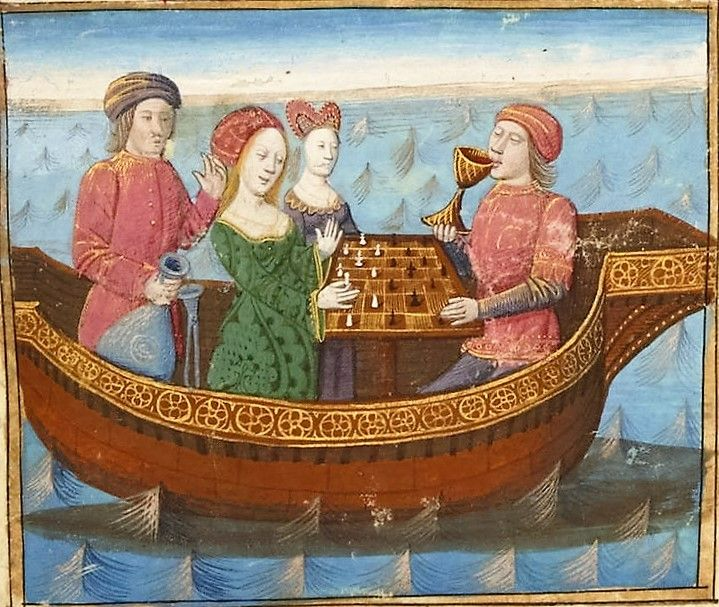
Tristan and Iseult drinking the love potion aboard a ship (miniature, 1470)
Burnley, J.D. « Fine amor: Its meaning and Context. » The Review of English Studies. Oxford: Oxford University Press, 1980.
Chrétien de Troyes. Œuvres complètes. Bibliothèque de la Pléiade, Paris 1998.
Contreni, John J. « The Carolingian Renaissance: Education and Literary Culture. » The New Cambridge Medieval History II c. 700-c. 900. Cambridge: Cambridge University Press, 1995.
Davis. R. H. C. The History of Medieval Europe. Routledge, 2005.
Delcourt, Thierry. https://www.radiofrance.fr/franceinter/podcasts/2000-ans-d-histoire/saladin-et-les-croisades-9481787
Dictionnaire des Lettres Françaises. Paris : Fayard/La Pochothèque, 1964. Dictionnaire du Moyen Âge. Paris: PUF Quadrige, 2002.
Duby, Georges. Le Moyen Âge: Adolescence de la Chrétienté Occidentale 980-1140. Genève: Éditions d'Art Albert Skira, 1995.
Einhard. Vita Karoli Magni : The Life of Charlemagne. Coral Gables: University of Miami Press, 1972.
Fabre, Jean. L’art de l’analyse dans La Princesse de Clèves. Larousse. Paris. 1973.
Frappier, Jean. La châtelaine de Vergi, Marguerite de Navarre et Bandello. Mélanges. 1945. Paris. 1946.
Hunt, Tony. The art of concealment: La Châtelaine de Vergi. French Studies. Volume XLVII. April 1993.
John, Timo. Die Klosterinsel Reichenau im Bodensee: Wiege der abendländischen Kultur. Beuroner Kunstverlag, 2006 (French Edition)
Lakits, Pàl La châtelaine de Vergi et l’évolution de la nouvelle courtoise. Studia Romanica. Kossuth Lajos Tudományegyetem, Debrecen. 1966.
Maddox, Donald. Fictions of Identity in Medieval France. New York: Cambridge University Press, 2000.
Maraud, André. Le lai de Lanval et la Chastelaine de Vergi: La structure narrative. Romania. Tome 93. 1972.
Nancy K.Miller. Plots and plausibilities in Women’s Fiction. An Inimitable Example. The case for The Princesse de Clèves. Edited by Patrick Henry. The Catholic University Of America Press. Washington. D.C. 1992.
Niderst, Alain. La Princesse de Clèves, le roman paradoxal. Larousse. Paris 1973
Saunders, William. https://catholiceducation.org/en/culture/what-are-relics.html
The New Cambridge Medieval History II c. 700-c. 900. Cambridge: Cambridge University Press, 1995.
The New Cambridge Medieval History III c. 900- c. 1024. Cambridge: Cambridge University Press, 1999.
The New Cambridge Medieval History IV c. 1024- c. 1198 Part I. Cambridge: Cambridge University Press, 2004.
The New Cambridge Medieval History IV c. 1024- c. 1198 Part II. Cambridge: Cambridge University Press, 2004.
The New Cambridge Medieval History V c. 1198- c. 1300. Cambridge: Cambridge University Press, 1999.
Ure, John. Pilgrimages: The great adventure of the Middle Ages. 2006; 1st Carroll & Graf ed.