Terza Rima
Terza Rima began in 13th century Italy when famous Italian Poet, Dante Alighieri, was looking for a bold new poetic form to complete his master piece, The Divine Comedy. Not finding one that seemed to work, Dante invented Terza Rima. It is also possible that the form first emerged from the Provencal Troubadour, lyrical poets who performed for the court, that Dante admired. The tripartite stanza likely symbolizes the Holy Trinity.
The Italian Poets, Boccaccio and Petrarch, followed in Dante's example and began to write in Terza Rima not only for the simplicity of it but the unifying effects of the form and the musicality of it.
Geoffrey Chaucer introduced the form to England (and English) with his poem "Compliments to his Lady", but Thomas Wyatt is credited with popularizing the form in his satires and through his translations of Italian Poetry. It then went on to become a favorite form for the romantic poets of the 19th century including such known poets as Lord Byron and Percy Bysshe Shelley.
The form was also used by 20th century poets like Robert Frost, Sylvia Plath and William Carlos Williams to name a few. It is still used today in it's traditional form but it also has two subforms that use its structure to create complete forms. The two subforms are, terza rima sonnet and terzenelle.
A terza rima sonnet uses the three line stanza and rhyme scheme of the traditional terza rima before ending in a couplet. A terzenelle is a nineteen line poetry form that uses five interwoven terza rima tercets and a quatrain, using the first and third lines as the final two, as in a villanelle. Examples of a Terza Rima Sonnet include Shelley's "Ode to the West Wind" and Frost's "Acquainted with the Night". Dusty Grein's "Loud Today" is an example of a terzenelle.
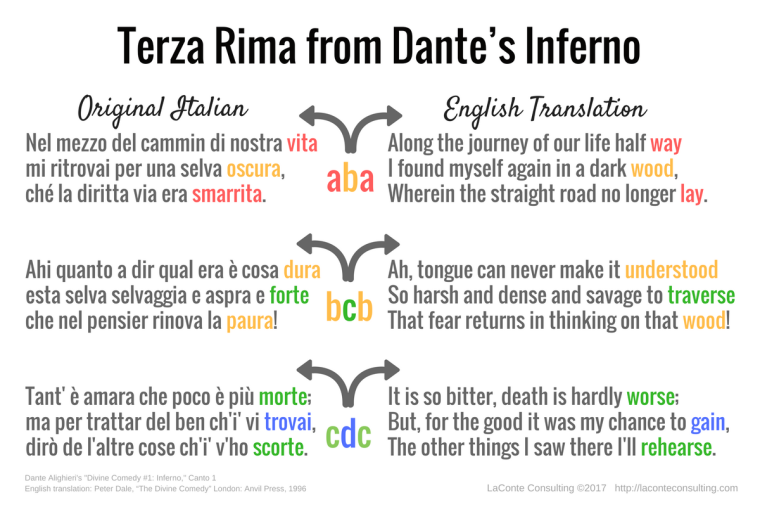
A terza rima can be about anything, but is often used to tell a story, as best demonstrated with Dante's Divine Comedy. It is also super flexible with the only steadfast rules being the stanza are in three lines and it follows an ABA, BCB, rhyme scheme. This means you can use whatever meter you want (as long as it's consistent) so if you write better with a certain meter you can apply it to terza rima.
When translateing Dante's work, there have been a lot of questions on how to translate the rich rhyming possibilities of Italian into English that would make sense with the form of Terza Rima. John Ciardi, chose not to worry about reproducing a faithful translation of the terza rima scheme while Robert Pinsky chose to employ a terza rima that rhymed when possible and used near/slant rhyme to help create a "plausible terza rima in readable English."
O wild West Wind, thou breath of Autumn’s being,
Thou, from whose unseen presence the leaves dead
Are driven, like ghosts from an enchanter fleeing,
Yellow, and black, and pale, and hectic red,
Pestilence-stricken multitudes: O thou,
Who chariotest to their dark wintry bed
The wingèd seeds, where they lie cold and low,
Each like a corpse within its grave, until
Thine azure sister of the Spring shall blow
Her clarion o’er the dreaming earth, and fill
(Driving sweet buds like flocks to feed in air)
With living hues and odours plain and hill:
Wild Spirit, which art moving everywhere;
Destroyer and Preserver; hear, O hear!
The voices in my head are loud today,
I plug my ears, but still I hear them talk
Oh please, oh please just make them go away!
I thought that maybe I could take a walk
That they would quiet down and let me think
I plug my ears, but still I hear them talk
I’m trying not to let my spirit sink,
These voices drowning out my fervent plea
That they would quiet down and let me think
I hear them use my mouth. That wasn’t me!
Oh please help me ignore their foul demands
These voices drowning out my fervent plea
I hang my head, then fiercely wring my hands
As they tell me to do such evil things
Oh please help me ignore their foul demands
Pure misery their constant echoes bring,
As they tell me to do such evil things
The voices in my head are loud today,
Oh please, oh please just make them go away!
HALLOWEEN by Emporia State student Dustin Bittel
That time of year when the leaves die
And fall from the sky to meet ground
Days shorten and the moon rises high
Little monster will begin to round
Corners in search of tasty treats
With tricks in store for those not bound
To the traditions set in beats
To the sound of eerie screams and cries
Of ghostly ghouls and horrifying feats
For once a year the spirit never dies
As we praise the night and moon
And welcome back lost family ties
WHERE SILENCE SOMETIMES TAKES ME by Emporia State student Abi Bohning
Tendrils of despair coil tightly around me
I try to struggle, and weakly lash about
but hopelessness plagues me, I wish to be free
I am defeated, this battle, lost; no doubt
held captive by an indifferent abyss
My silent pleas echo inside, they want out
My joyful song, now silent, I will miss
The only life I lived; I must now remake
Am I enduring a metamorphosis?
Misery is causing my façade to break
I can no longer conceal my growing fear
that my life up to this point was a mistake
My life can be more. I have nothing to fear.