Chapter 8: Storyboarding and Story Scripting
Chapter 8: Storyboarding and Story Scripting
Not all written stories become films and not all films are from published novels. Most, if not all, films have a movie script of some kind. Some examples include:
The Lord of the Rings
In the novel, The Lord of the Rings, we are introduced to two characters, Frodo and Gandalf. Below is a short excerpt from the book (p. 46):
It was just at this time that Gandalf reappeared after his long absence. For three years after the Party he had been away. Then he paid Frodo a brief visit, and after taking a good look at him he went off again. During the next year or two he had turned up fairly often, coming unexpectedly after the dusk, and going off without warning before sunrise. He would not discuss his own business and journeys, and seemed chiefly interested in small news about Frodo's health and doings.
Then suddenly his visits had ceased. It was over nine years since Frodo had seen or heard of him, and he had begun to think that the wizard would never return and had given up all interest in hobbits. But that evening, as Sam was walking home and twilight was fading, there came the once familiar tap on the study window.
Frodo welcomed his old friend with surprise and great delight. They looked hard at one another.
"All well eh?" said Gandalf. "You look the Same as ever, Frodo!"
"So do you," Fordo replied; but secretly he thought that Gandalf looked older and more careworn. He pressed him for news of himself and the wide world, and soon they were deep in talk, and they stayed up far into the night.
This short excerpt gives us an introduction to these characters as they reconnect with each other. Translated to the script, this scene looks like:
ANGLE ON: The shambling OLD PONY snorts and rears as...
SUDDENLY FRODO appears on the bank above the cart.
FRODO: You're late.
CLOSE ON: GANDALF glowers at the young HOBBIT...
GANDALF: A wizard is never late, Frodo Baggins, nor is he early. He arrives precisely when he means to.
They look at each other for a moment...then both start laughing as FRODO's face breaks into a smile and he leaps onto the front seat of the cart.
FRODO: It's wonderful to see you, Gandalf!
(Source: Script from The Internet Movie Script Database IMSDb)
Finally, we see how this scene plays out as a film, with special effects and editing:
(Source: Lord of the Rings: The Fellowship of the Rings, Peter Jackson, 2001, New Line Cinema)
What to notice from text to script to film:
- Character Development and Introduction - we meet Frodo and Gandalf
- Settings - it's been a while since Frodo has seen Gandalf. We learn this from the text "It was over nine years since Frodo had seen or heard from him" and from the script "you're late!"
- Worldbuilding - from the text, we learn that this world is magical because Gandalf is referred to as a wizard and Frodo is a hobbit. From the film, we see the type of characters they are from their costumes and the resources around them (the wizard is using a pony to travel).
Group Analysis Activity:
As a group, read Chapter 1 from Harry Potter and the Sorcerer's Stone and read the movie script from Script Slug. Discuss similarities and differences from text to script.
Then, watch the scene:
(Source: Harry Potter and the Sorcerer's Stone, 2001, Chris Columbus, Warner Bros)
Discuss similarities and differences from text and script to film.
Finally, review the video alone featuring Warner Brs VP Bill Daly and Ethan Dettenmaier as they re-live their days at WB Studios when they had Harry Potter in production. This video not only gives a storyboard for the film Harry Potter and the Sorcerer's Stone but also includes illustrations for the different camera angles. Compare the illustrated script with the original.
(Source: Brigade-Radio-One, 2023).
Creating a storyboard script is crucial for visual storytelling, whether for film, animation, or other visual media. Here are five tips to help you craft an effective storyboard script:
Outline the Story Arc: Begin by outlining the main elements of your story, from beginning, middle, to end. Define the key plot points, character arcs, and any major conflicts or resolutions. This outline will serve as the backbone of your storyboard script, guiding the progression of scenes and shots.
For example, here's how I might write an outline for the novel "The Mediator #3: Reunion" by Meg Cabot (as outlined by the author of this text for class discussion):
Title: Reunion
Introduction (Beginning):
We introduce the main character, Suze, a teenager from NY who has recently moved to California to live with her mom and step-family.
Suze's Goal: Suze is a mediator. She can talk to the dead and help them finalize things before "moving on."
Rising Action (Middle):
Suze comes across the ghosts of four teenagers known as the RLA Angels. It's up to her to help them move on but they seem angry and have targeted a local student at Suze's high school, Michael.
Along the way, she discovers that there might be more to the story of their death than what Michael reported to the police.
This storyboard would continue by identifying the Climax, the Falling Action, and the Resolution which is not included in this text to avoid spoilers for the book.
Focus on Visual Storytelling: Remember that storyboards are primarily visual tools, so focus on communicating key story points through images rather than lengthy dialogue or exposition. Use visuals to convey emotion, action, and important details.
Example: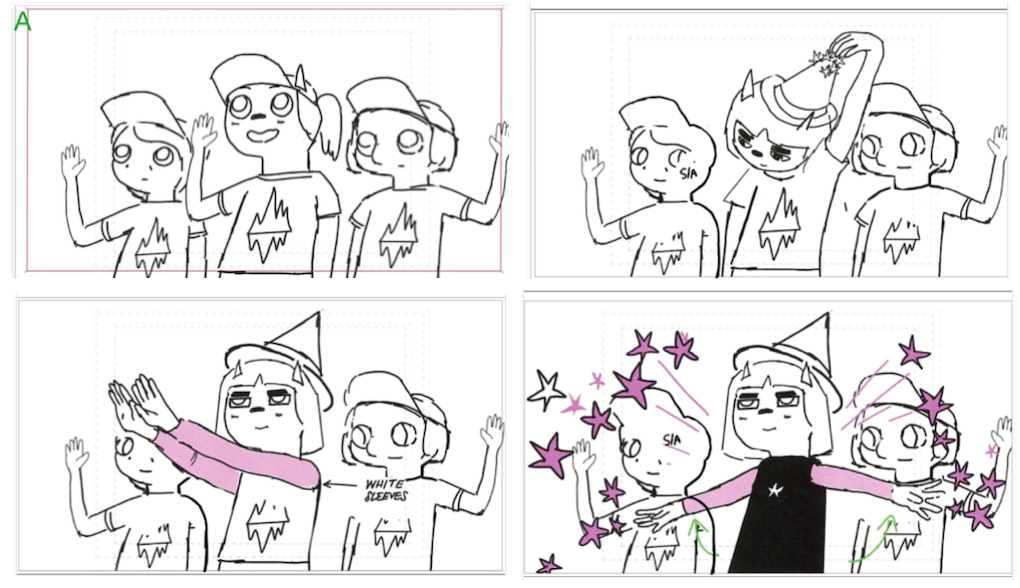
(Source: Summer Camp Island - see the video here).
Descriptive Language: While keeping text minimal, use descriptive language to clearly communicate the actions, emotions, and settings of each scene. Provide enough detail to guide the artist or filmmaker in creating accurate visuals, but avoid overloading with unnecessary information.
Consider Camera Angels and Transitions: Think about how each shot will be framed and from what direction and location. Incorporate camera angles, movements, and transitions into your script to enhance the storytelling. This will also help the team understand where to set up equipment and from what places (including where lighting is needed to create shadows or effects).
Be Open to Collaboration: Storyboarding is a team project. Share your script with others. This could be the director, artists, or other stakeholders to help improve the clarity and effectiveness of the visuals.
By following these tips, you can create a storyboard script that effectively communicates your story visually and serves as a valuable blueprint for the production process.
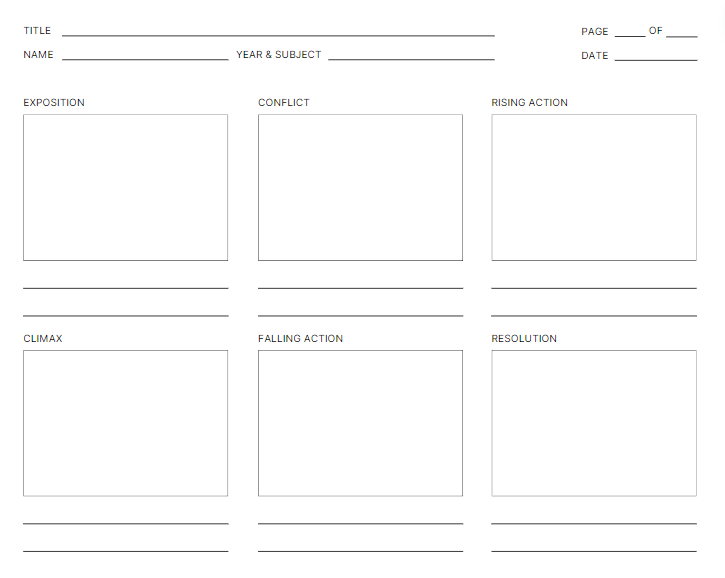 (Source: Canva Template, download here: Blank Simple 6 Panel Storyboard.pdf)
View more examples from Luke Leighfield's article 28 Storyboard Examples to Inspire You available from Boords, 2023).