No Cost Community Corrections Resources
No Cost Community Corrections Resources
Purpose: to help other instructors teaching the same course
Common Course ID: CJUS 4431 – Community Corrections
CSU Instructor Open Textbook Adoption Portrait
Abstract: These OER materials are being utilized in a criminology and criminal justice course for undergraduates by Dr. Andrea Giuffre at California State University, San Bernardino. The students enrolled in this course were Criminology and Criminal Justice majors. All students accessed the course materials for free online. The course material included peer-reviewed journal articles, reports, encyclopedia entries, podcasts, videos, and news articles. The peer-reviewed journal articles were made available through CSUSB’s John M. Pfau Library subscriptions and other materials were publicly available. The main motivations to adopt OER materials were to reduce economic barriers to taking this course and increase quality of instruction with a wider variety of materials.
CJUS 4431 – Community Corrections
Brief Description of course highlights: This course highlights issues and trends in community-based corrections; alternatives to incarceration including diversion, restitution, community treatment facilities, halfway houses, probation and parole, and such developments as house arrest and electronic surveillance. Special emphasis is placed on the functions, strengths, and problems of community-based programs. See course catalog here.
Student population: This class is typically for Criminology and Criminal Justice majors. Incoming students are required to have taken CJUS 3330 (Correctional Theory and Institutions).
Learning or student outcomes: Upon successful completion of this course, students should be able to:
- Define probation, parole, and other non-custodial sanctions associated with community corrections,
- Explain the history, purpose, and effectiveness of community corrections programs,
- Describe trends and the population of people under community supervision,
- Discuss the roles of probation and parole officers,
- Identify issues and potential policy implications and solutions associated with community corrections.
Departmental student learning outcomes that are satisfied by this course include:
- Learning outcome #1: Students will be able to evaluate policy-relevant questions and issues surrounding the various components of the criminal justice system: police, courts, corrections.
- Learning outcome #2: Students will understand the methods used by the criminal justice system to process and sanction criminal offenders.
- Learning outcome #5: Students will understand the purposes and functions of the correctional system, inclusive of prisons, jails, and community programs.
Key challenges faced and how resolved: One key challenge was finding materials that meet accessibility standards. When building the course, I had to spend extra time search for materials that met accessibility and OER criteria.
Syllabus and/or Sample assignment from the course or the adoption Unit Application 2
Textbook or OER/Low cost Title:
Brief Description: The materials for the course included peer-reviewed journal articles (available through the CSUSB library website) and publicly available news articles, videos, and podcasts.
An example of content used: One example comes from the “Deep Dive with Laura Arnold” podcast. The students were required to listen to the episode on “Meek Mill on Probation and Parole in America” found here: https://www.arnoldventures.org/podcasts/probation-and-parole-in-america-with-meek-mill
Student access: Students accessed the materials for this course through the Canvas Learning Management System. In Canvas, I uploaded the required readings and provided links to all other materials.
Supplemental resources: No supplemental materials used for this course.
Provide the cost savings from that of a traditional textbook. If open-access materials were unavailable, I would have used “Community-Based Corrections (12th Edition)” by Leanne Fiftal Alarid. This book is published by Cengage and costs $287.95 as a paperback or $79.99 as an e-book that is only available for a four month term. Given that 20 students were enrolled in this course, I estimate conservatively that $1,599.80 was saved.
License: Specify Creative Commons license, copyright or specify open license
OER/Low Cost Adoption Process
Provide an explanation or what motivated you to use this textbook or OER/Low Cost option. The primary motivator to adopt OER materials was to reduce economic barriers to taking this course. Many of my students have approached me to ask about ways to reduce or eliminate the cost of course materials, so this seemed like a necessary step. Additionally, I wanted to increase the quality of instruction with a wider variety of materials. Textbooks in community corrections are notably limited and without recent updates. At the same time, I wanted students to consume materials from practitioners and individuals affected by the criminal legal system, which are limited in traditional textbooks.
How did you find and select the open textbook for this course? I consulted other faculty mentors to locate materials for this course.
Sharing Best Practices: I would suggest other faculty members consider a wide variety of materials in their instruction, beyond textbooks and peer-reviewed journal articles alone. For example, videos and podcasts with captions and transcripts can be exceptionally valuable to students. I often paired peer-reviewed journal articles with publicly available podcasts and videos to facilitate learning. For example, in our module about community corrections officers, we discussed the following:
- Hsieh, M. L., Hafoka, M., Woo, Y., van Wormer, J., Stohr, M. K., & Hemmens, C. (2015). Probation officer roles: A statutory analysis. Federal Probation, 79, 20.
- Davies, D. (2020). Former parole officer reflects on his time supervising ‘the second chance club’ [Radio broadcast]. NPR. https://www.npr.org/2020/03/02/811187788/former-parole-officer-reflects-on-his-time-supervising-the-second-chance-club
- Death or Prison. (2021). Episode 40: Probation guidelines | Death or prison podcast [Video]. YouTube. https://www.youtube.com/watch?v=ryl44VM3j6A
My other suggestion centers around utilizing the expertise of other faculty members to help produce meaningful course material. Do not be afraid to reach out to others who have similar challenges and collaborate to produce or amalgamate the material that is right for your students.
Describe any key challenges you experienced, how they were resolved and lessons learned. One key challenge was finding materials that meet accessibility standards. For example, many video and audio materials are without captions and some educational resources from the library are scanned so that they cannot be read with a screen reader. When building the course, I had to search for materials that met accessibility and OER criteria. I learned building OER courses is time consuming, but worth the cost savings in the end.
Instructor Name: Dr. Andrea Giuffre
I am an Assistant Professor of Criminology and Criminal Justice at California State University, San Bernardino. 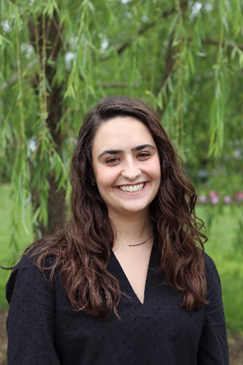 Please provide a link to your university page.
https://www.csusb.edu/profile/andrea.giuffre
Please describe the courses you teach.
I teach CJUS 3320 (Theories of Crime and Delinquency), CJUS 4431 (Community Corrections), and CJUS 6631 (Graduate Seminar in Corrections).
Describe your teaching philosophy and any research interests related to your discipline or teaching. As an instructor, I strive to create an empowering learning environment for all students so they can accomplish their own goals and create a more socially just world. Whether online or face-to-face, my courses include problem-based learning components that require students to apply course material to current events. I am also committed to providing accessible material to all students and believe that course material should be created in a thoughtful manner that is supported by research. I use audio, visual, and textual course materials to accommodate students with different learning styles.
My primary research interests include the social harms of criminal legal system contact, financial operations of the criminal legal system, and corrections. I am currently working on a project that explores how individuals on community supervision approach and perceive social support exchange. My work has appeared in outlets such as Criminology, Criminal Justice & Behavior, and The British Journal of Criminology.