Spanish for Health Professions – SPAN 2050
Spanish for Health Professions – SPAN 2050
Purpose: to help other instructors teaching the same course
Common Course ID or Course ID: SPAN 2050
CSU Instructor Open Textbook Adoption Portrait
Abstract: This open textbook is being utilized in a Spanish course for undergraduate students by Maryann Parada at California State University Bakersfield. The open textbook provides medical terminology input in context and opportunities for reflection on language access in healthcare services. The main motivation to adopt an open textbook was to provide authentic resources. Most students access the open textbook in digital format via our LMS.
Spanish for Health Professions – SPAN 2050
Brief Description of course highlights: This course is designed to meet the communication needs of those in health professions. It reinforces grammatical structures of Spanish and focuses on the vocabulary associated with the medical field.
Student population: Students who enroll in this course are in a variety of majors, but mostly Nursing, Biology (Pre-Med), Psychology, and Spanish. The prerequisite is currently Spanish 1. Since we have both heritage and second language learners interested in the course, they take a short survey and are placed into different sections. The course reported on here is for heritage speaker students who come with a degree of fluency in Spanish. We are in the process of building a Medical Spanish minor, so this course section will likely become “Advanced Spanish for Health Professions”.
Learning or student outcomes:
- Understand the primary public health concerns related to language access barriers.
- Be able to identify and compare grammatical structures in Spanish and English.
- Have a command of basic medical terminology related to human anatomy, physiology, and conditions.
- Be able to realize common clinical tasks and communicative exchanges in Spanish.
Key challenges faced and how resolved: One challenge was ensuring continuity across the materials and assignments, given the absence of a cohesive textbook. I resolved this through a very structured course design, with specific categories of recurring assignment types (e.g. health-related news articles; medical drama; medical vocabulary diary; etc.)
OER/Low cost Title: Multiple Online Resources
Brief Description: We do not use a textbook, but rather a variety of freely available online resources. Students collectively read and comment on news articles around different medical and health topics, study topic-based medical vocabulary, keep a vocabulary diary, watch episodes of a television medical drama, study medical dialogues, and engage in community health education, among other things.
Please provide a link to the resource
- Articles from a variety of sources, such as the CDC and NIH websites, medlineplus.gov, saludterapia.com, Univision.com, medical blogs, etc.
- Mexican medical drama “A corazón abierto” is available on YouTube.
- Spanish Medical Conversation (Quick Study Academic) Pamphlet
- Medical dialogues
Authors: Multiple authors of the resources
Student access: All material is accessed through our course management system (Canvas). Either the files are available for viewing and download there, or links are provided to access them externally. Students purchase the Spanish Medical Conversation pamphlet on Amazon.
Supplemental resources: I point students toward online dictionaries, such as wordreference.com, and show them how to recognize the Med tag on entries as well as how to appropriately use the forum discussions to identify accurate terminology. For translation/interpreting practice, I suggest the inexpensive manual, available on Amazon:
Lunn & Lunsford. 2021. En otras palabras: Perfeccionamiento del español por medio de la traducción. Georgetown University Press. ISBN: 1647120098. https://www.amazon.com/-/es/Patricia-V-Lunn/dp/1647120098
Provide the cost savings from that of a traditional textbook. The previous textbook used costs $66 new and $50 used. Students now only purchase a vocabulary pamphlet ($6.95). Savings: $43-59
License: Openly licensed and Copyright.
OER/Low Cost Adoption Process
Provide an explanation or what motivated you to use this textbook or OER/Low Cost option. I always want to save students money. Also, there are few appropriate textbooks for teaching the subject to heritage speakers. In addition, it was important to me to provide maximally authentic resources of local relevance.
How did you find and select the open textbook for this course? I consulted other faculty who generously shared ideas with me. I evaluated a large number of textbooks to have a good sense of what was available.
Sharing Best Practices: I think it helps to understand how many national and state organizations have Spanish content on their websites. There are also local and regional Spanish-language newspapers in every area of the country. There are zero or low-cost resources all around us, in our own backyard, that, when carefully selected, can be wonderfully effective pedagogical tools.
Describe any key challenges you experienced, how they were resolved and lessons learned. One challenge has been article URLs that can change over time, so it always needs checking and updating. Also, some articles can quickly become outdated, so being open to swapping out and updating is essential.
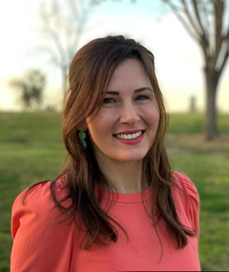
Instructor Name: Maryann Parada
I am a Spanish professor at California State University Bakersfield. I teach Spanish in the U.S.; Spanish Phonetics; Translation & Interpreting; Sociolinguistics; History of Spanish; Spanish for Health Professions; Spanish for Heritage Speakers; Heritage Language Teaching Pedagogies.
Please provide a link to your university page.
https://www.csub.edu/modlang/faculty-and-staff.shtml
Please describe the courses you teach.
I teach courses in Spanish language and linguistics, from the beginning to graduate levels. The courses I teach relate to my areas of expertise and interest, which include sociolinguistics, Spanish as a minority/heritage language, language attitudes and policy, and translation/interpretation.
Describe your teaching philosophy and any research interests related to your discipline or teaching. My courses are highly discussion-based and community-focused, either through simple engagement or service-learning. Students play active roles in the decision-making and execution of class activities. They work collaboratively and rotate leading. They are often invited to reflect on how their experiences and identities connect to course concepts and topics.
I have research interests in translation and interpreting that are relevant to this course. Students work on honing these skills but also learn about how to work effectively with a medical interpreter. Others relevant research interests are: Spanish in the U.S.; bilingualism; names and identity; sociolinguistic variation; dialectology.