
ENG 1050A Stretch Composition I
ENG 1050A Stretch Composition I
Purpose: to help other instructors teaching the same course
Common Course ID: ENG 1050A
CSU Instructor Open Textbook Adoption Portrait
Abstract: This open textbook is being utilized in an English course for undergraduate students by Dr. Joseph Dornich at the CSUSB campus. The open textbook provides an example of two rhetorically based essays, leading to the first main assignment: A Comparative Rhetorical Analysis. The main motivation to adopt an open textbook was to save students money, but also provide a visual resource for in-class discussions. Most student access the open textbook via an internet browser on their laptops.
ENG 1050A Stretch Composition I
Brief Description of course highlights: ENG 1050A Stretch Composition I: Analysis and use of strategies for conducting research and critically reading and writing expository texts. Explores relationships among language, meaning, and context, and emphasizes writing as a recursive process and as a means of critical thinking. Students identify themselves for placement in this course through Directed Self-Placement. Students will remain with the same cohort of classmates in the same time slot across ENG 1050A -ENG 1060A. Graded Credit/No Credit. Formerly offered as Eng 105A.
Student population: ENG 1050A is comprised, almost entirely, of first-semester freshmen. The class is a prerequisite for all CSUSB students. There are, on average, 24 students in each section.
Learning or student outcomes: English 1050A asks students to consider the role language plays in shaping how they see, read, and understand themselves and the culture in which they live. Toward this aim, students will focus on language and rhetoric as it is used to move within and across discourse communities and their respective social issues pressing on each of them.
Key challenges faced and how resolved: First-semester freshman can often be shy, insecure, or disengaged about the material. Particularly for a course that is a requirement. To combat this, I used the Discussion Board tool on Canvas, where I asked students to respond to a series of questions/observations about the day’s reading. Then, as a class, I used their responses to seed our discussion
Textbook or OER/Low cost Title:
Brief Description: These two articles, from The Chronicle of Higher Education, argue for the best pedagogical practices in teaching composition. In doing so, they utilize the three main rhetorical appeals: logos, ethos, and pathos.
Please provide a link to the resource| “We Know What Works in Teaching Composition” https://www.chronicle.com/article/we-know-what-works-in-teaching-composition
“No, We’re Not Teaching Composition ‘All Wrong’ https://www.chronicle.com/article/no-were-not-teaching-composition-all-wrong/
Authors: Doug Hesse and Emily Shearer Stewart (respectively)
Student access: Chronicle of Higher Ed website, via any internet browser.
Supplemental resources: The Discussion option on Canvas was used to generate in-class conversations and analysis about these readings.
Provide the cost savings from that of a traditional textbook. Traditionally, composition textbooks vary from $15 to $35 dollars. I provided all materials for this course, costing the students nothing.
License: The articles are openly licensed.
OER/Low Cost Adoption Process
Provide an explanation or what motivated you to use this textbook or OER/Low Cost option. It saved students money, something that is always useful, but particularly for first-semester freshmen who are new to college and its respective costs. Additionally, as these articles are about how to best teach composition, my students are, essentially, part of the subject matter. This leads to discussions about their learning experiences, the practices that have best served them.
How did you find and select the open textbook for this course? Colleagues at a previous university used these articles in their composition course.
Sharing Best Practices: Don’t be shy about motivations – I explain on the first day my desire to save my students some money. Also, if the materials require a laptop and/or printing, be aware of the limitations/lack of resources for some students and have a backup plan.
Describe any key challenges you experienced, how they were resolved and lessons learned. While a free, electronic version of these articles does save students money, some will invariably read them on their phone, which can hinder comprehension and the ability to annotate.
Instructor Name: Joseph Dornich
I am a lecturer in the English Department at California State University, San Bernardino.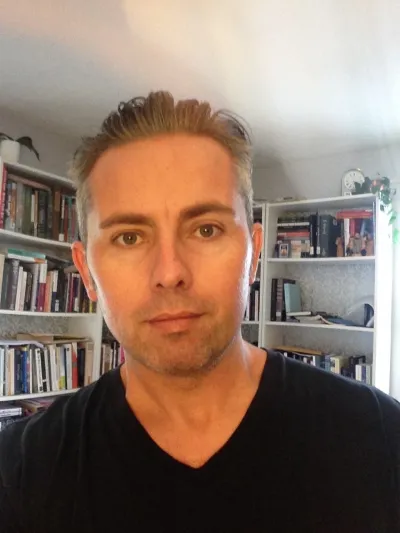
Please provide a link to your university page.
https://www.csusb.edu/profile/joseph.dornich
Please describe the courses you teach.
ENG 1050A, 1060A, 1700, and 3000
Describe your teaching philosophy and any research interests related to your discipline or teaching. As befits discussion-oriented classes, my teaching centers on focal questions of interpretation. My lesson plans consist of questions and writing exercises designed to challenge students’ hermeneutic abilities and to encourage them to share their thoughts with the class. These questions appeal to students’ curiosity and prompt intrinsically motivated close readings, while also challenging them to maintain a degree of sympathy or even empathy. For example, when reading David Dow’s, An Autobiography of an Execution, we debate the nature vs. nurture argument of murderers and other violent criminals, and the overall efficacy of the death penalty as a deterrent to violent crime. These moments of civil discourse give rise to thoughtful discussions based on close readings of the text. Students tackle such concepts as the various types of humor and their subsequent effects in Slaughterhouse-five, as well as novel’s use of moral courage and apathetic indifference in the face of war. Whether in general class discussions or shared writing exercises, exploring a text’s points of tension encourages students to make literary analysis and interpretation a matter of personal investment. In the process of trying to balance a civil discourse with sympathy and empathy, my students become acute close readers while allowing for a variety of perspectives.