Child Growth and Development
Child Growth and Development
Purpose: to help other instructors teaching the same course
CDFS 111
CSU Instructor Open Textbook Adoption Portrait
Abstract: This open textbook is being utilized in a Child and Family Studies course
for undergraduate students by Youngok Jung at California State University Long
Beach. The open textbook provides comprehensive learning content that
incorporates a textbook licensed under the Creative Commons Attribution 4.0
International License (CC BY 4.0), freely available online resources, instructor-
created content, and scholarly articles available through library databases. The
main motivation for adopting an open textbook was to reduce educational costs
and incorporate current interests and issues in child development. Most students
access the open textbook through Canvas, which will be regularly updated.
CDFS 111: Child Growth and Development Brief Description of course highlights: Examination of the progression of children’s physical, cognitive, language, and socio-emotional development from conception through childhood, with emphasis on interactions between biological processes and environmental factors. Students will apply developmental theories to observe children and analyze the characteristics of individual development.
Student population: Most students are Child and Family Studies majors and
minors with options and concentrations in child development. There are no
prerequisites for this course.
Student Learning Outcomes (SLOs):
Upon successful completion of this course, students will be able to:
- SLO 1: Identify the typical progression of young children’s development.
- SLO 2: Identify major developmental milestones from conception to
adolescence in the domains of physical, social-emotional, cognitive, and
language development.SLO 3: Identify social, cultural, economic, political, and historical contexts
that affect children’s development.
- SLO 4: Describe how multiple factors related to biology, environment, and
social interactions influence children’s development.
- SLO 5: Identify and examine major developmental theories and knowledge
of child development.
- SLO 6: Apply objective techniques, tools, and skills when observing,
describing, and evaluating behavior in children.
- SLO 7: Differentiate characteristics of typical and atypical development.
- SLO 8: Describe the unique care, development, and learning needs of
infants and toddlers and how to support their growth, development, and
learning.
- SLO 9: Apply culturally competent strategies to engage diverse children and
families to improve children’s development and learning.
Sample assignment - Child Observation Report:
Observation is probably the oldest, most frequently utilized, a and most insightful method for assessing children's growth, development, and learning. In this assignment, students are tasked to spend at least 30 minutes observing a child or a group of children. This is a detailed narrative account of observed behaviors and events, recorded in a sequential manner as they occur. These observations are then analyzed through the developmental theories reviewed in class and outlined in the OER textbook and open instructional materials. Throughout the course, we will delve into various observation methods, examine assorted developmental theories, and assess child development in multiple developmental domains. The observation report must be written in APA style with a 12-point font and be formatted in .doc or .docx. If you are not familiar with APA style, please refer to the Purdue Writing Lab.
Examples:
- An infant/infants engaged in play alone, with peers, or with parents.
- A child engaged in free play alone, with peers, or with parents.
- A child/children engaged in free play that includes assigned roles and rules with peers.
- A child/children engaged in whole group, small group, or individual instruction with teachers
Understanding the whole child: Prenatal development through adolescence.
Textbook: Paris, J., Ricardo, A., & Raymond, D. (2019).
Understanding the whole child: Prenatal development through adolescence.
OER Commons. *This textbook is accessible under the terms of the Creative
Commons Attribution 4.0 International License (CC BY 4.0), granting users the
freedom to utilize it at no cost.
Authors: Jennifer Paris, Antoinette Ricardo, and Dawn Rymond
Student access: Students can access the textbook and other instructional materials through links provided in the Canvas course.
Supplemental resources: The textbook is supplemented with the following
resources:
- Instructor-created videos
- YouTube videos
- Podcasts
- Scholarly journal articles
- Online resources
Cost savings from that of a traditional textbook: $109.99
License: The textbook is licensed under the Creative Commons Attribution 4.0
International License (CC BY 4.0), which means that users are free to share and
adapt the textbook, even commercially.
Explanation and what motivated you to use this textbook. I wanted to create an instructional packet that incorporates an OER textbook and additional learning resources available online at no cost. This packet would save students money, incorporate exemplary and up-to-date learning resources, and adapt to current trends in child development.
How did you find and select the open textbook for this course? I consulted the
“Child Growth and Development” Canvas shell created by the authors. I also consulted librarians, instructional designers, and other faculty members. I also browsed OER sites and reviewed other courses sharing the same title that are available on Canvas Commons.
Sharing Best Practices: Numerous OER resources are readily available online at no cost. It is crucial to take time to choose an OER textbook and online learning resources that align with you course learning objectives. The university library website features a dedicated section on OERs, and librarians can provide guidance and support in navigating the website and OERs.
Key challenges you experienced: It was challenging to find supplemental readings and online resources that could accompany the OER textbook that was specifically developed for early childhood education. The OER textbook was created for the course “Child Growth and Development,” a title shared by all such courses offered across community colleges in California for the Associate in Science for Transfer in Early Childhood Education, aligning its content with Teacher Performance Expectations (TPEs). However, many students taking this course at CSU Long Beach are interested in fields such as social work, psychology, occupational therapy (OT), physical therapy (PT), and speech therapy (ST). These students need content that extends beyond educational topics into developmental psychology, diversity and inclusion, and research based practices, which must be supplemented by additional instructional materials. I learned that the university library and librarians are deeply committed to OERs and are eager to assist in curating additional instructional materials to reduce students’ educational costs.
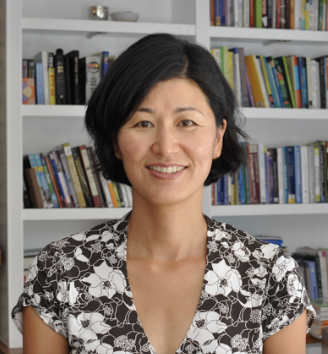
Youngok Jung
I am a Child and Family Studies professor at the California State University Long
Beach. I teach CDFS 111, CDFS 310, and 311.
 University webpage: https://www.csulb.edu/college-of-
health-human-services/family-and-consumer-sciences/page/dr-youngok-jung-0
The courses you teach: Examination of the progression of
children’s physical, cognitive, language, and socio-emotional development from
conception through childhood, with emphasis on interactions between biological processes and environmental factors. Students will apply developmental theories to observe children and analyze the characteristics of individual development.
Teaching philosophy: My teaching philosophy is based on Vygotsky’s sociocultural theory (1978) that learning can be most effective when students actively engage in instructional activities within supportive social contexts. I believe that students thrive when work within their zone of proximal development while receiving scaffolding from peers and advanced learners. To facilitate this, I ask thought-provoking questions, offer scaffolding, provide small- and whole-group activities, and pose real-life dilemmas that challenge students to think critically and make an informed decision. The real-life dilemmas especially help students’ understanding of theories, abstract concepts, and evidence-based practices and compel them to develop culturally sensitive perspectives, make insightful decisions, and transform individual learning into socially and culturally meaningful practices. Central to CDFS 111: Child Growth and Development is the exploration of developmental theories. In the course, students delve into development theories that explain children’s cognitive, physical, moral, socio-emotional, and language development. They apply these theories to understand both the universality and variability of child development across cultures and within a culture. Through child observation, students gain insights into children's development and learning, integrating developmental theories discussed in class. Furthermore, students engage with recent peer-reviewed scholarly articles to delve into how developmental theories inform contemporary research and teaching practices in child and family studies. Throughout these explorations, I emphasize the significance of diversity, equity, and social justice, illuminating how various factors like race, culture, society, economy, and policy shape child development. My research interests lie in the area of child development and early childhood education across three strands: 1) high-quality early childhood education; 2) underprivileged children; and 3) school readiness. Throughout my research, I have focused on describing high-quality early childhood education programs that are effective in producing gains in young children’s learning.