Zero Cost, Open Access Criminology and Criminal Justice Research Methods
Zero Cost, Open Access Criminology and Criminal Justice Research Methods
Purpose: to help other instructors teaching the same course
Common Course ID: CJUS 3311
CSU Instructor Open Textbook Adoption Portrait
Abstract: This open textbook is being utilized in a criminology and criminal justice course for undergraduate students by Dr. Andrea Giuffre at CSUSB. The open textbook provides an overview of criminological and criminal justice research methods. The open textbook is supplemented by no-cost resources available through the university’s library. The main motivation to adopt an open textbook was to reduce equity issues among students and provide more engaging materials. Students can access the open textbook online.
Course Title and Number: CJUS 3311 – Research Methods in Criminal Justice
Brief Description of course highlights: This course introduces students to scientific methodology and research designs used to conduct basic and applied research in the criminal justice field. The course has an emphasis on scientific operationalization, survey methodology, and concepts of evaluation design. We will also discuss qualitative research methodologies and ethical issues within criminological and criminal justice research. Please see the course description in the catalog for more information.
Student population: This class is available to criminal justice majors at CSUSB. Students must have passed Theories of Crime and Delinquency (CJUS 3320) with a C- grade or better and Introduction to the Criminal Justice System (CJUS 1101) and Criminal Law (CJUS 1102) with C grades or better. Typically, students are juniors or seniors when they take this course.
Learning or student outcomes: Upon successful completion of this course, students should be able to:
- Understand the scientific approach to research,
- Read and critically analyze criminological and criminal justice research articles,
- Display an awareness of ethical issues associated with criminological and criminal justice research,
- Understand the different approaches and techniques to design criminological and criminal justice research studies and the strengths and weaknesses of each design,
- Identify the basics of theory-based research design, conceptualization, and measurement of theoretical ideas, sampling, and data collection,
- Interpret research data and results, and
- Effectively communicate research design and findings to an audience.
Departmental student learning outcomes that are satisfied by this course include:
- Learning outcome #1: Students will be able to evaluate policy-relevant questions and issues surrounding the various components of the criminal justice system: police, courts, corrections.
- Learning outcome #6: Students will develop an understanding of the theories of crime and causation, including its measurement.
- Learning outcome #7: Students will develop an understanding of research methods in criminal justice.
Syllabus and/or Sample assignment from the course or the adoption: This Critical Information Literacy assignment shows how the class relied on resources provided by CSUSB’s Pfau Library.
Textbook or OER/Low cost Title: Applied Research Methods in Criminal Justice and Criminology
Brief Description: This textbook is an open access textbook, hosted online through the University of North Texas’ Open Books site. Books hosted on the site are available to read free online and can accommodate assistive devices such as screen readers.
Please provide a link to the resource https://openbooks.library.unt.edu/cjresearchmethods/front-matter/applied-research-methods-in-criminal-justice-and-criminology
Authors: Eric J. Fritsch, Chad R. Trulson, & Ashley G. Blackburn
Student access: Students access the textbook at the University of North Texas’ Open Books website.
Supplemental resources: The textbook includes critical thinking questions and key terms at the end of each chapter.
Provide the cost savings from that of a traditional textbook. The textbook provides students an estimated savings of $92 per person. The traditional textbook used for this course was “MindTap Criminal Justice, 1 term (6 months) Printed Access Card for Maxfield/Babbie's Research Methods for Criminal Justice and Criminology, 8th Edition” ISBN: 9781337092319. This is an estimated cost savings of $3,956 for the 43 enrolled students in Spring 2025.
License: The textbook is CC BY-NC, meaning reusers can distribute, remix, adapt, and build upon the material in any medium or format for noncommercial purposes only, and only so long as attribution is given to the creator.
OER/Low Cost Adoption Process
Provide an explanation or what motivated you to use this textbook or OER/Low Cost option. The major motivation to adopt OER materials for this course was to reduce economic barriers associated with a traditional research methods textbook. Secondarily, the traditional textbook for this course is available as a 6 month subscription. With OER materials, students can access the book at any time they choose. Third, I wanted to increase students’ access to nontraditional materials that are typically not found in research methods textbooks such as videos where real researchers talk about their experiences.
How did you find and select the open textbook for this course? My colleague shared this resource with me.
Sharing Best Practices: I would suggest faculty members reach out to their colleagues for assistance when designing their courses and make sure to reach out to multiple people. When you are able to review multiple iterations of a course, you can find what works best for you and your students. I also recommend exploring different types of media and library resources to facilitate learning. For example, we have watched videos on how false news can spread, the Stanford Prison Experiment, and criminal justice myths in this course. I typically pair video media with peer-reviewed articles from the CSUSB library or the open-access textbook.
Describe any key challenges you experienced, how they were resolved and lessons learned. A key challenge of this course is finding materials that are engaging for students and meet the needs of undergraduate students. Often, it is easy to find examples of research that are more suited to graduate level classes. Another key challenge was finding materials that are accessible for students. I had to spend time working with accessibility services at CSUSB to remediate book chapters, for instance.
Instructor Name: Dr. Andrea Giuffre
I am an Assistant Professor of Criminology and Criminal Justice at California State University, San Bernardino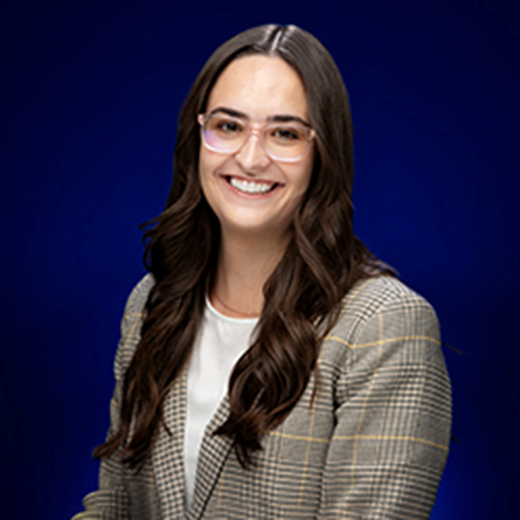 Please provide a link to your university page.
https://www.csusb.edu/profile/andrea.giuffre
Please describe the courses you teach
CJUS 3320 (Theories of Crime and Delinquency)
CJUS 3311 (Research Methods in Criminal Justice)
CJUS 4431 (Community Corrections)
CJUS 6631 (Graduate Seminar in Corrections).
Describe your teaching philosophy and any research interests related to your discipline or teaching. As an instructor, I strive to create an empowering learning environment for all students so they can accomplish their own goals and create a more socially just world. Whether online or face-to-face, my courses include problem-based learning components that require students to apply course material to current events. I am also committed to providing accessible material to all students and believe that course material should be created in a thoughtful manner that is supported by research. I use audio, visual, and textual course materials to accommodate students with different learning styles.
My primary research interests include the social harms of criminal legal system contact, financial operations of the criminal legal system, and corrections. I am currently working on a project that explores how individuals on community supervision approach and perceive social support exchange. My work has appeared in outlets such as Criminology, Criminology & Public Policy, Criminal Justice & Behavior, and The British Journal of Criminology.