
Introduction to Cellular and Molecular Biology BIOL 210
Introduction to Cellular and Molecular Biology BIOL 210
Purpose: to help other instructors teaching the same course
Common Course ID: BIOL 210
CSU Instructor Open Textbook Adoption Portrait
Abstract: This open textbook is being utilized in a biological sciences course for undergraduate or graduate students by Dr. George Brusch IV at California State University San Marcos. The open textbook provides students with accessible, affordable, and customizable learning resources that enhance their educational experience. The main motivation to adopt an open textbook was to reduce the financial burden of educational materials, making high-quality resources more accessible to all learners. Most student access the open textbook in their university Canvas page and through the internet.
Introduction to Cellular & Molecular Biology - BIOL 210
Brief Description of course highlights: The first of a two-semester core sequence that provides the student with basic knowledge in biology, including specific experimental techniques and familiarity with the scientific method. Emphasizes cellular structure and physiology, molecular evolution, classical and molecular genetics, and biochemistry. https://catalog.csusm.edu/search_advanced.php?cur_cat_oid=10&search_database=Search&search_db=Search&cpage=1&ecpage=1&ppage=1&spage=1&tpage=1&location=33&filter%5Bkeyword%5D=BIOL+210#
Student Population: Most students who take this course are freshman biology or biotechnology students. Students are required to have taken or be co-enrolled in CHEM 150.
Learning or student outcomes: Upon completion of BIOL 210, students will be able to:
1. Understand the major atomic, molecular, and cellular processes which underlie living things.
2. Demonstrate mastery of the major principles of cellular structure, cellular physiology, and the flow of genetic information in cells.
3. Develop an integrated view of how molecular biology affects the biosphere, and vice versa (when taken with the companion course BIOL 211 Introduction to Organismal and Population Biology).
4. Demonstrate a theoretical and practical understanding of current techniques utilized in molecular and cellular biology research, including enzyme activity assays, PCR, and gel electrophoresis.
5. Be able to investigate a research problem using the scientific method.
6. Be able to discuss some of the bioethical dilemmas associated with modern molecular biology research and develop scientifically informed opinions/arguments about these issues.
Key challenges faced and how resolved: A major issue has been keeping students focused on portions of the material that are important for this course. The Open-Source Textbook covers a wide variety of topics and I have learned that I need to be incredibly specific on what pages, examples, and practice problems students should utilize when studying for this course.
Textbook or OER/Low cost Title: Open-source e-textbook: Biology 2e
Brief Description: Biology 2e is designed to cover the scope and sequence requirements of a typical two-semester biology course for science majors. The text provides comprehensive coverage of foundational research and core biology concepts through an evolutionary lens. Biology includes rich features that engage students in scientific inquiry, highlight careers in the biological sciences, and offer everyday applications. The book also includes various types of practice and homework questions that help students understand—and apply—key concepts.
Please provide a link to the resource
https://openstax.org/details/books/biology-2e
Authors:
Mary Ann Clark, Texas Wesleyan University
Jung Choi, Georgia Institute of Technology
Matthew Douglas, Grand Rapids Community College
Student access: Students access the materials for this course primarily through their university Canvas website. They can also access the textbook online for free.
Supplemental resources: I provide detailed power points, study guides, practice exams, and critical thinking questions to students through their Canvas website.
Provide the cost savings from that of a traditional textbook: I used to ask students to purchase the 12th edition of Campbell Biology before switching to a no cost course model. That textbook was typically ~$165 new or ~$80 to rent for the semester.
License: The OpenStax textbook is under Creative Commons Attribution License v4.0 . For access to the other classroom resources, interested parties can contact George Brusch directly via email: gbrusch@csusm.edu
OER/Low Cost Adoption Process
Please provide an explanation or what motivated you to use this textbook or OER/Low Cost. My major motivation for using an open-source textbook is because it is free. This alleviates the financial burden on students, making education more accessible and equitable.
How did you find and select the open textbook for this course? I had heard of the Open Biology textbook for many years but finally made the time to review the material. I was really blown away with how informative, interactive, and succinct the textbook is. And it’s free!
Sharing Best Practices: Don’t be intimidated. Publishers can be pretty pushy if you mention that you’re thinking about switching to an open-source material. I had a rep for a major publisher tell me point-blank that I’d be doing a major disservice to my students if I switched to an open-source text compared to their higher priced book. This has not been the case at all, and I am so grateful that I ignored their advice.
Describe any challenges you experienced, and lessons learned. A major issue has been keeping students focused on portions of the material that are important for this course. The open- source textbook covers a wide variety of topics and I have learned that I need to be incredibly specific on what pages, examples, and practice problems students should utilize when studying for this course.
Instructor Name - Dr. George A Brusch IV
I am an Assistant Professor at the California State University San Marcos. 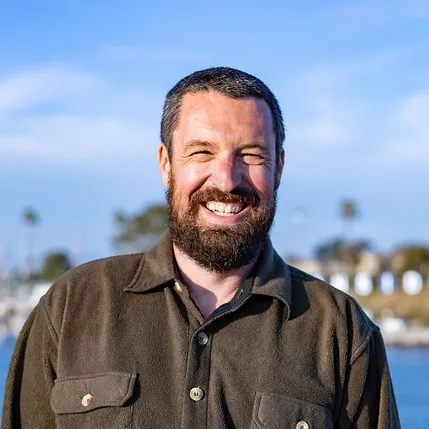
Please provide a link to your university page.
https://www.csusm.edu/profiles/index.html?u=gbrusch
Please describe the courses you teach: I teach introductory biology courses, animal physiology, and a variety of upper division physiology electives.
Describe your teaching philosophy and any research interests related to your discipline or teaching. I love teaching and have dedicated my career to it—I get to educate and learn at the same time. I believe that my ultimate goal as an educator is to inspire a love of learning, foster critical thinking, and keep students engaged throughout the process. I have found, through trial and error, that the best way to avoid glassy-eyed students during a course is a mixture of content delivered via slides, models, drawings, and discussion, intermixed with videos, songs, and corny jokes delivered in a way that edu-tains students (i.e., educates and entertains). I have learned that to effectively reach students I need to remain malleable in my teaching style, and I rely on a variety of techniques in and out of the classroom to engage my students, including potentially embarrassing myself as we work through difficult concepts. Some students need contact in office hours, others thrive in the laboratory, and I have to respect that everyone can have a slightly different learning style.