Comparative Vertebrate Anatomy Laboratory - BIO 401L
Comparative Vertebrate Anatomy Laboratory - BIO 401L
Purpose: to help other instructors teaching the same course
Common Course ID: BIOL 401L
CSU Instructor Open Textbook Adoption Portrait
Abstract: This open textbook is being utilized in a biological sciences course for undergraduate or graduate students by Dr. George Brusch IV at California State University San Marcos. The open textbook provides students with accessible, affordable, and customizable learning resources that enhance their educational experience. The main motivation to adopt an open textbook was to reduce the financial burden of educational materials, making high-quality resources more accessible to all learners. Most student access the open textbook in [their university Canvas page and through the internet.
Comparative Vertebrate Anatomy Lab - BIOL 401L
Brief Description of course highlights: Comparison of similarities and differences among vertebrate groups on the basis of structure and function. Emphasis will be placed on the evolution and vertebrate structures, new roles for derived and ancestral characters, adaptation of new functions, relationship to life style, life history and evolutionary phylogeny. A major goal of this course is to generate a greater understanding of the evolutionary processes and concomitant structural changes that have occurred among vertebrates including humans. Laboratory study includes dissection, and analysis of organ systems, and evolutionary innovations among representative vertebrates.
Student Population: Most students who take this course are junior or senior biology students. Prerequisite(s): BIOL 210, BIOL 211, and BIOL 212, or enrollment in the Biological Sciences graduate program.
Learning or student outcomes: Upon completion of BIOL 401, students will be able to:
- Compare and contrast anatomical characteristics across major groups of tetrapods
- Understand principles of structure & function in an evolutionary context
- Apply anatomical terminology
- Access, interpret, and reference the primary scientific literature
Key challenges faced and how resolved: Creating a custom, free lab manual is both a blessing and a curse. The good news is that it provide a no-cost course, the bad news is that any mistake in the manual only has the professor to blame. There are some directions we wrote in the lab manual that felt incredibly clear. However, students have found some of the jargon confusing so I’ve had to remain malleable and open to feedback so that it can be updated as the semester goes on to maximize student understanding.
Textbook or OER/Low cost Title: 401L Lab
Please provide a brief description of the textbook, OER or Low-Cost option (including anything relevant to your choice) We provide all of the laboratory materials for students through Canvas. These include detailed descriptions of each weeks experiments so that students can read about them ahead of time and come prepared to complete all of the planned procedures.
Please provide a link to access the resource: Please email George Brusch (gbrusch@csusm.edu) if you want access to any of the course materials.
Student access: Students access the materials for this course primarily through their university Canvas website.
Supplemental resources: I provide detailed power points, study guides, practice exams, and critical thinking questions to students through their Canvas website. There is also a class set of The Dissection of Vertebrates available in the lab for students to use.
Provide the cost savings from that of a traditional textbook. Students save anywhere from $50-70 compared to a traditional laboratory manual.
License:. For access to the classroom resources, interested parties can contact George Brusch directly via email: gbrusch@csusm.edu
OER/Low Cost Adoption Process
Please provide an explanation or what motivated you to use this textbook or OER/Low Cost. My major motivation for using an open-source textbook is because it is free. This alleviates the financial burden on students, making education more accessible and equitable.
How did you find and select the open textbook for this course? We created the weekly laboratory manual from scratch based on important physiological systems and how our students could experimentally detail each.
Sharing Best Practices: It is important to be open to student feedback when creating a lab manual. Also accept the fact that your manual will never been in ‘final draft’ form as it will likely change each semester (or even each week!) depending on the needs of the students or the ever-changing experiments you come up with.
Describe any challenges you experienced, and lessons learned. It was important to be patient throughout the process. What made sense to the other instructors and I did not always translate properly to the students. Not all students come with the same background, which is a net positive thing, but that means that the lab manual needs to be malleable to meet everyone’s needs.
Instructor Name - Dr. George A Brusch IV
I am an Assistant Professor at the California State University San Marcos. 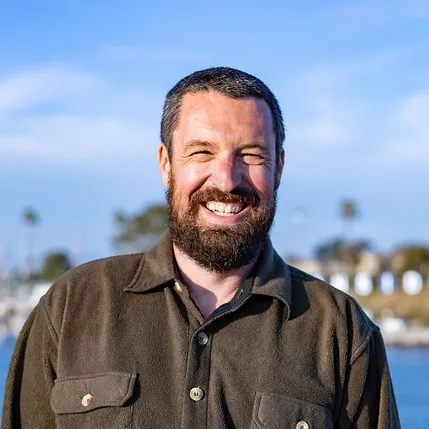
Please provide a link to your university page.
https://www.csusm.edu/profiles/index.html?u=gbrusch
Please describe the courses you teach: I teach introductory biology courses, animal physiology, and a variety of upper division physiology electives.
Describe your teaching philosophy and any research interests related to your discipline or teaching. I love teaching and have dedicated my career to it—I get to educate and learn at the same time. I believe that my ultimate goal as an educator is to inspire a love of learning, foster critical thinking, and keep students engaged throughout the process. I have found, through trial and error, that the best way to avoid glassy-eyed students during a course is a mixture of content delivered via slides, models, drawings, and discussion, intermixed with videos, songs, and corny jokes delivered in a way that edu-tains students (i.e., educates and entertains). I have learned that to effectively reach students I need to remain malleable in my teaching style, and I rely on a variety of techniques in and out of the classroom to engage my students, including potentially embarrassing myself as we work through difficult concepts. Some students need contact in office hours, others thrive in the laboratory, and I have to respect that everyone can have a slightly different learning style.