
Human Development in Perspective
Human Development in Perspective
Purpose: to help other instructors teaching the same course
Common Course ID: HD 490
CSU Instructor Open Textbook Adoption Portrait
Abstract: This open textbook is being utilized in a Human Development course for undergraduate or graduate students by Dr. Kathy Fuller at CSUSM. The open textbook provides concepts associated with the various topics of human services. The main motivation to adopt an open textbook was to decrease the cost of education for the students and to address current challenges in supporting children and youth most effectively. Most students access the open textbook directly from the associated weekly modules in the CANVAS course shell.
Human Development in Perspective – HD 490
Brief Description of course highlights: A seminar intended for students in their final year of undergraduate study. Drawing from theories and knowledge gained from previous courses, this capstone course helps students to experience the application of such knowledge within allied health and human services fields. This course is the “capstone” for students obtaining a BA degree in Human Development. It will emphasize the perspectives in understanding the practical integration and application of Human Development & Family Developmental Theory (FDT) within the broader context of the community/society. Attention will be given to perspectives for working with families, youth and children, by designing and presenting a community-based program, as an intervention targeted to solve or contribute to resolution of a needed human services issue/problem. The focus is on students demonstrating how biological, psychological, familial, social, historical, and cultural dynamics influence the needs of the community, and the use of theory as a framework to address real-world problems relating to lifespan development in an applied settings such as counseling, health care, and education. Students will incorporate the specialized needs and the impact of disability, gender, and other personal and family contextual situations through their scholarly and community-based research, in developing their group’s program designs and interventions.
Student population: This course is designed to assist students in learning about topics associated with a variety of human services. The more information students have about serving different populations, the more effective choices they can make for a satisfying career.
Learning or student outcomes: The Department of Human Development has six “Program Student Learning Outcomes” which are supported by the required courses. Please find these outcomes below. HD 490 focuses on the numbers 2, 4 & 6 outcomes:
1. Use theory and research to explain lifespan development in individual, family, and/or community contexts.
2. Critically evaluate evidence-based practices, programs, or policy solutions to address real-world problems related to human development.
3. Analyze structural inequities related to lifespan development to identify strategies for promoting social justice.
4. Assess needs and evaluate the delivery of human services
5. Use research methods in Human Development to design, analyze, and conduct research, and present research findings.
6. Apply professional ethics, knowledge, awareness, and/or skills for health and human services settings.
Course Student Learning Outcomes (CSLOs)
1. Apply the understanding achieved in earlier courses to examine a problem or situation within allied health and human service fields.
2. Propose an application within the allied health and human service fields, utilizing the theories of human development.
3. Design a program to improve the design and delivery of services that address social issues and meet community needs, utilizing empirically based knowledge.
Key challenges faced and how resolved: The biggest challenge for teaching this course is organizing all the information necessary to present a variety of perspectives associated with the course topics. I have resolved this issue by locating resources to create a solid foundation and background for each topic.
OER/Low Cost Adoption Process
Provide an explanation or what motivated you to use this textbook or OER/Low Cost option. I selected free online resources to save students money, ensure up to date information, customize the learning experience for each student and improve learning experiences for all.
How did you find and select the open textbook for this course? Each resource was selected individually. I browsed OER sites; googled academic research; compared and evaluated various resources; shared resources with peers; and consulted students for their interests.
Sharing Best Practices: Definitely use the OER provided through Merlot. Also, I would run a check on the course weekly to maintain links function and check on the dates of publication to ensure the information is up to date and doesn’t require students to purchase a membership to access the resource.
Describe any key challenges you experienced, how they were resolved and lessons learned. I learned that free resources can be deleted and that a weekly check of resources will ensure that they are accessible to students.
Textbook or OER/Low cost Title: Various free resources from the internet provided.
Brief Description: I selected a variety of readings, videos, TED talks and activities to support the concepts discussed in class that were available for no cost on the internet.
Please provide a link to the resource HD 490_ Fuller OER list.docx
(file will download to wherever you have identified files are stored)
Authors: Authors provided for each resource
Student access: Students access the resources directly from each weekly module in the course shell created in CANVAS.
Provide the cost savings from that of a traditional textbook. A traditional Human Development textbook costs approximately $100.
License: Materials are copyrighted but can be accessed for free online from miscellaneous websites, such as TED and YouTube, listed above
Instructor Name - Dr. Kathy Fuller
I am a Human Development professor at California State University, San Marcos.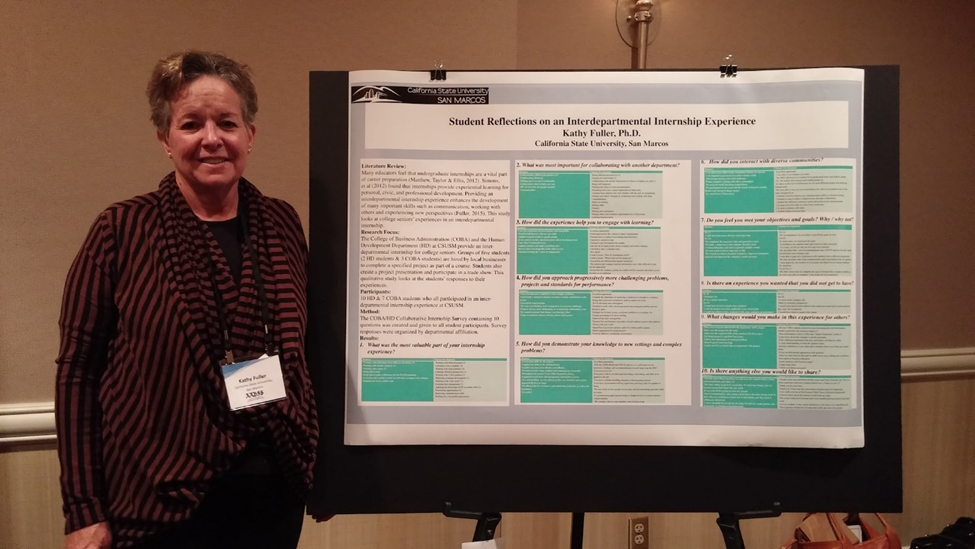
Please describe the courses you teach
HD 102 - Preparatory Skills for Human Development Majors - Units: 3
Develops competencies that support long-term professional success and provides an early start on the process of career planning and development. Places particular emphasis on exploring career opportunities in health, human services and allied fields; building skills for success in the HD major and after graduation; and applying competencies to address long-term professional development needs. Includes values clarification, goal setting, problem solving, critical thinking, and decision making.
HD 302 - Human Development in Childhood - Units: 3
Explores child development from lifespan, interdisciplinary, and multicultural perspectives useful for working with children. A special focus is on practicing the skills to conduct a community needs assessment for healthy child development based on the Precede-Proceed Model.
HD 380 - Child and Youth Development in Family and Community Contexts Considers the social cultural, cognitive, emotional, linguistic, and behavioral development of children and youth from interdisciplinary, multicultural, and applied perspectives. Students will apply major theories in the field of human development to their work in evidence-based services and programs for children and youth in a variety of family and community contexts with special attention to identifying multicultural and sociocultural influences on development.
HD 490 - Human Development in Perspective - Units: 3
Seminar intended for students in the final year of undergrad study. Drawing from theories and knowledge gained from previous courses, this capstone course helps to experience the application of such knowledge within allied health and human services fields.
HD 495 - Field Experience in Human Development - Units: 3
Supervised experience providing service in health and human services setting. Students will spend approximately eight (8) hours per week, for a minimum of 90 hours during the semester, in a child, adolescent and/or adult human services organization. Students will participate in service delivery, conduct observations, read related material and prepare written reports.
HD 497 - Applied Research in Human Development - Units: 4
Reviews the importance of theory, research objectives and various quantitative and qualitative methods. Students will be expected to participate in the development and implementation of an applied research study that they either initiate or is part of an ongoing research study. Students will be involved in data collection, data coding, data analysis and manuscript preparation. Three hours of lecture. Two hours of laboratory.
Describe your teaching philosophy and any research interests related to your discipline or teaching. As I consider my career of teaching a variety of ages, stages and content area, I realize how I have brought my experiential knowledge, educational exploration and practical applications together as many societal changes have required innovative flexibility and understanding. I have always felt that the foundational core of effectively teaching students is knowing who they are, their strengths and what they need to be successful. In order to address this concept adequately, the following questions need to be answered: Where do students come from and what experiences influence their basic beliefs? What are students’ educational and life goals? How can I create curriculum that will support students in utilizing course learning in real world applications?
To create a positive class environment whether online or in person, I feel it is important to establish a relationship of trust with your students. This takes time and can only be accomplished by showing students that you really care about them as individuals, as well as their learning experiences in the class by providing the most effective associated learning experiences possible through creating a learning community founded on respect for self and all other participants. In order to discover specific aspects of every student, a teacher needs to provide opportunities for students to share with both the teacher and the rest of the class. By encouraging participation through providing scaffolding and support, students are more open to sharing and learning. I’ve found that the secret to successful online teaching is to respond to every student quickly and in a positive manner. I find it important to start a response with a positive about a portion of the student’s post that is reflectively crafted and then incorporate possible ideas to make the post even better.
My teaching style focuses on building a learning community which engages individual students in each classroom. Student engagement is an important aspect of learning. If a student is engaged and actively participating in the learning process, they will benefit much more than being a passive participant. To support all students in feeling comfortable participating in class activities, it is important to establish an environment of understanding and acceptance. Above all, I try very hard to create a classroom in which everyone is respected and enjoys reading and sharing ideas focused on provided topics.
I always respond to every student for each required assignment and/or online post. These comments provide a teacher “presence” in the online classroom, as well as provides individual support for each student. Through interacting individually with students, I learn more about them and how best to support their growth and development toward their eventual career. Writing is an issue for many students, so I try to model how specific thoughts on topics can be portrayed in a professional written format.
Another important aspect of engaging students in any class, is for the instructor to incorporate learning styles (sensory preferences) and preferred intelligence areas when creating learning experiences. An online course works well for many students, as we teach students to become visual learners. However, for those students who prefer to learn through other styles or intelligence areas, accommodations need to be met.
Finally, student feedback on their experiences in the classroom is an important aspect for keeping courses on track to meet student needs. I reflect on comments students provide and make the necessary accommodations in my courses as needed