
¡Explica resumidamente el contenido de tu web!
En esta demo sobre la creación de una web con Content Builder te enseñaremos las principales funcionalidades de esta herramienta.
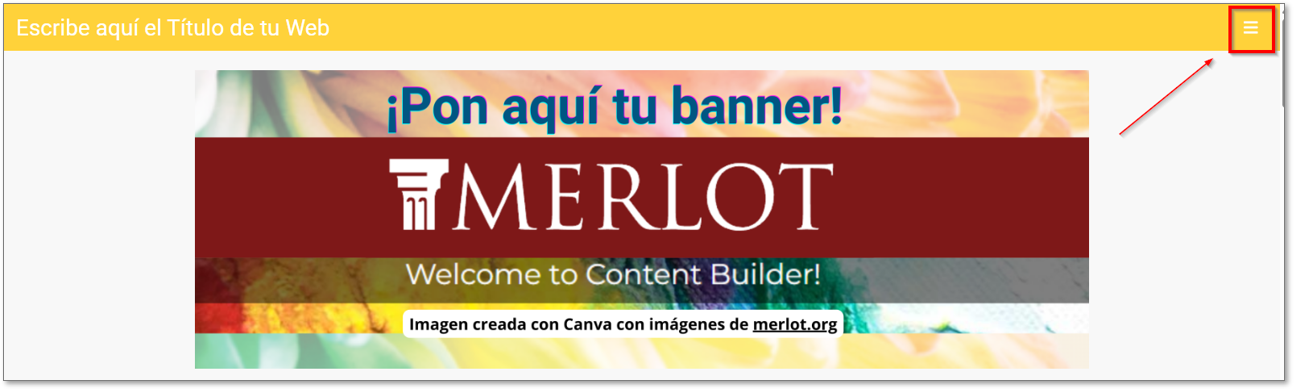
Navega por las diferentes pestañas clicando en el icono de las tres líneas horizontales horizontales para ver cómo se visualizarían los diferentes diseños de página:
Dentro del texto puedes enlazar el contenido que necesites, como por ejemplo la página oficial de ayuda de Content Builder: Welcome To Content Builder.

También puedes enlazar páginas y las secciones de las páginas de la web que estás diseñando.
Recently added materials to MERLOT
-
Percentage Calculator: Percentage of a Base Amount
An interactive tool for calculating a percentage of a base amount. Learners enter an amount and a percentage rate, then check the result using R = A × p ÷ 100. The page includes the example 20% of 150 = 30, guidance on interpreting the base value, and accuracy checks using 0%, 50% and 100%. It can support practice and checking percentage arithmetic. Submitted by a representative of CalcOcean.
-
Subskills sports technique taxonomy
An open dataset (CC BY 4.0) that breaks 22 sports into 554 sub-skills, the individual techniques learners practise, such as the backhand clear in badminton or the back-rank mate in chess. Each sub-skill has a one-line description, a suggested learning order and a beginner, intermediate or advanced level, plus counts of the tutorial videos reviewed for it. Useful for planning physical education units and coaching progressions, and for research on skill learning. Files: CSV and JSON, updated monthly. Citable as DOI 10.5281/zenodo.23125616.
-
Free Driver Permit Practice Questions with Explanations
A free, browser-based set of multiple-choice practice questions for the United States driver's license knowledge test, the written exam a learner takes to get a permit. Each question is scored immediately and followed by a one-sentence explanation of the rule behind the correct answer, so the activity works for self-study or as a short warm-up in a driver-education, adult-education or ESL class. Questions are drawn from a rotating pool and cover traffic sign shapes and colors, pavement markings, traffic signal rules including flashing signals, right of way at intersections and roundabouts, turn signalling, railroad crossings, right turn on red, and pedestrian right of way in a crosswalk. The question set is general United States road-rule material rather than the statute of any one state, so it suits a mixed group; learners should still read their own state's official driver handbook for state-specific limits. No sign-up, no account and no personal data collection are involved, and the page carries no advertising, which makes it usable on shared or public-access library and classroom computers and on a projector for group practice. It is not affiliated with or endorsed by any state Department of Motor Vehicles. Published by dmv-ready.org.
-
Image Formation by Concave Mirror · Light – Reflection and Refraction — VisualTextbook
An interactive 2D optics laboratory exploring image formation by concave spherical mirrors across all standard object positions (beyond C, at C, between C and F, at F, and between F and P). Features real-time ray tracing of principal rays (parallel-through-focus and center-of-curvature rays), interactive candle drag and slider controls for object distance and height, dynamic image characterization (real vs. virtual, inverted vs. erect, magnified vs. diminished), and step-by-step ray construction playback for classroom demonstration and self-study.
-
MechCodex: Free Mechanical Engineering Calculators
Professional-grade engineering calculators, material databases, and standards references for mechanical engineers.
-
Engineering Graphics & CAD
Engineering Graphics & CAD is an introductory textbook for engineering students that presents the principles and practices of engineering graphics and computer-aided design. The book develops the visualization and graphical communication skills needed to understand, create, and interpret engineering drawings while connecting traditional engineering graphics concepts with modern CAD methods. It is intended for undergraduate engineering graphics, engineering drawing, and introductory CAD courses.
-
Global Procurement Professional Course In Dubai | WingsWay
Global Procurement Professional Course in Dubai with IFPSM PAS accreditation. Build practical skills in procurement, sourcing and supplier management. After completing our IFPSM-approved Certified Global Procurement courses , online, offline, or in hybrid mode, you’ll qualify for various job roles worldwide. Freshers and graduates in this industry can also work in sourcing, buying, trading companies, MNC buying companies, and more as a: Procurement Analyst Junior Procurement Specialist Purchasing Coordinator Entry-Level Purchasing Manager Procurement Executive Entry-Level Procurement Manager Supplier Relationship Analyst Supplier Performance Coordinator Sourcing Analyst Assistant Trader Junior MNC Buyer Entry-Level MNC Procurement Specialist Vendor Relations Coordinator Supplier Development Associate Professionals looking for regional opportunities can explore our procurement course in Qatar.
-
The B2B Safety Paradox: How to Build SaaS Pipeline via Pattern-Breaking Messaging
When every SaaS platform promises "streamlined workflows" and "scalable efficiency," prospective buyers simply tune out. Discover how the B2B Safety Paradox inflates Customer Acquisition Costs, and how applying pattern-breaking messaging across semantic, visual, and positioning touchpoints unlocks revenue growth. Creative B2B for SaaS
-
Countries of the World Quiz
This interactive geography activity helps learners practice recognizing countries around the world using map-based questions. It can be used for independent study, classroom practice, or informal geography review. Learners identify countries from their geographic outlines and receive an opportunity to strengthen their familiarity with world geography through repeated practice.
-
CIPS Certification In Dubai | Levels, Fees & Course Details
Transform your procurement career with CIPS certification in Dubai — the globally recognised qualification from the Chartered Institute of Procurement & Supply that's reshaping supply chain leadership across the UAE, India, and GCC region. As a CIPS Approved Training Centre, WingsWay delivers expert-led programs designed for the dynamic Middle East procurement landscape. CIPS Certification Requirements Working professionals across UAE and GCC — from junior buyers to procurement directors. Flexible weekend, evening, and online options let you study while maintaining your career momentum. Sectors include construction, oil & gas, healthcare, hospitality, retail, and manufacturing.
-
TI-84 Calculator Online
Try our free TI-84, TI-30XS, and advanced graphing calculators online. Solve math problems, plot functions, and calculate quickly on any device freely.
-
Aeroway: Open Aeronautical Engineering, Flight Planning & E6B Computational Suite
Aeroway is an open-access, browser-based computational aeronautical platform and Open Educational Resource (OER) designed for aerospace engineering students, collegiate flight academies (FAA Part 141), and professional aviators. The platform provides 18 interactive engineering calculation instruments, standard atmosphere models (ICAO Doc 7488/3), crosswind trigonometry visualizers, weight-and-balance envelope graphs, and complete interactive flight training laboratories with printable student PDF worksheets. Built entirely on client-side deterministic TypeScript engines with zero tracking databases or account barriers.
-
Aeroway LAB-2026-01: Density Altitude & High-Hot-Heavy Performance Laboratory
Aeroway LAB-2026-01 is an interactive, browser-based computational aeronautical laboratory designed for collegiate aviation flight students (FAA Part 141) and aerospace engineering coursework. Evaluates geopotential pressure lapse rates, air density ratios (σ), and density altitude conforming to ICAO Doc 7488/3 (Extended Standard Atmosphere) and NOAA/NASA U.S. Standard Atmosphere (1976). Includes an interactive atmospheric modeling sandbox, tiered problem sets with worked step-by-step mathematical solutions, FAA Airman Certification Standards (ACS) oral exam prep, and printable monochrome student PDF worksheets. 100% client-side deterministic evaluation with zero student data collection.
-
Court Rules
Court Rules is a free reference for U.S. federal court practice: the Federal Rules of Civil Procedure, district local rules, individual judge standing orders and court holidays, organized by court. The deadline calculator counts calendar, business and court days and applies each district's holidays. A public API and an MCP server at courtrules.app/mcp serve the same data to legal-tech tools.
-
Becoming Reflective Educators II
As an extension of graduate pedagogy, this second volume explores how current and former graduate students extended the peer-to-peer support beyond the classroom walls to mirror the peer-to-peer collaboration and mentoring of faculty and scholars in various fields. Foels and Pfannenstiel developed graduate pedagogical approaches to model collaboration and mentoring. This work creates space for graduate students to realize graduate specific goals like publishing their research, acting as reviewers to understand the peer review cycle, and developing a work for a specific publication. Volume II includes reflections from both doctoral and masters students as they apply theories and learning from their graduate program in real world contexts.
-
Mental Health Statistics (National Institute of Mental Health)
A National Institute of Mental Health hub of U.S. prevalence and treatment statistics for mental illnesses, including any mental illness, major depression, anxiety disorders, ADHD, bipolar disorder, eating disorders, PTSD, schizophrenia, and suicide. Each topic page presents charts broken down by sex, age, and race/ethnicity, along with the share of people receiving treatment, drawn from national surveys such as the National Survey on Drug Use and Health. Students can use it to ground discussions of psychological disorders in current population data and to practice reading prevalence figures.
-
Neurosynth
A platform that automatically combines results from more than 14,000 published fMRI studies into brain maps for over 1,300 psychological terms, such as "memory," "fear," or "language." Users can search a term to see which brain regions are most consistently linked to it, or click a brain location to see related terms and studies. It is useful for teaching how meta-analysis works in neuroscience and the limits of linking one brain region to one function. The project is open source and funded by NIH.
-
PsychoPy
Free, open-source software for building and running psychology experiments. The Builder interface lets students create experiments by dragging components onto a timeline. Coder mode allows Python scripting for more complex designs. It offers precise timing for stimulus presentation and response collection, and experiments can be moved online through Pavlovia.org, which charges for hosting. It is widely used in university research methods and cognitive psychology labs.
-
JASP: Free Statistical Software
Free, open-source statistics software developed at the University of Amsterdam that runs both classical (frequentist) and Bayesian analyses. It has a spreadsheet layout, menus instead of code, results that update as options change, and tables and graphs in APA format that can be copied into Word. Teaching support includes a built-in data library of example datasets, video tutorials, and getting-started guides. It runs on Windows, Mac, and Linux and is a no-cost alternative to SPSS for psychology statistics courses.
-
Laws of UX
A free collection of 32 psychological principles that apply to the design of user interfaces, including Fitts's law, Hick's law, Miller's law, and the serial position effect. Each principle has a short definition, an illustration, key takeaways, and links to the original research. It shows students how findings from perception, attention, and memory are applied in technology design. Content is licensed CC BY-NC-ND 4.0.
-
FORRT: Framework for Open and Reproducible Research Training
A community-built resource hub for teaching open and reproducible research practices. It includes an open science glossary, curated teaching resources, lesson plans, example syllabi, summaries of research literature, and guides on pedagogy and equity in open scholarship. Content is licensed under CC BY-NC-SA 4.0. Instructors can use it to add transparency, replication, and research ethics to existing methods and statistics courses.
-
Collaborative Replication and Education Project (CREP)
A project that helps instructors and students carry out direct replications of highly cited psychology studies as course or thesis research. CREP selects studies suitable for student replication, provides materials and training, and reviews each team's procedures before data collection. Student data are combined across sites into larger replication projects that can lead to co-authored publications. It gives students hands-on experience with open science, preregistration, and replication.
-
Open Stats Lab
A set of statistics activities built on open data from articles published in Psychological Science. Each lab pairs a published article with its dataset and an activity that walks students through reproducing the reported analyses. Labs cover correlation, regression, t-tests, one-way and factorial ANOVA, and other analyses, and they can be used with any statistics software. The activities show students how the statistics they are learning are used in real published research.
-
The Cognitive Atlas
A collaborative knowledge base that defines the concepts, experimental tasks, and disorders studied in cognitive science and shows how they relate to one another. It contains entries for more than 900 mental concepts and more than 800 tasks, each linked to the processes the task is thought to measure. Content is shared under a Creative Commons Attribution-ShareAlike license and can be viewed without registration. Students can use it to clarify terminology, plan research designs, and see how a construct is measured across studies.
Como has comprobado, la versatilidad de la herramienta Content Builder es muy amplia y su uso resulta intuitivo. Te animamos a aprovechar esta funcionalidad para el diseño web y la creación de tus recursos educativos.
¡No olvides compartir tus REA!
Si decides compartir tu sitio web, los pasos que tienes que seguir son:
También pudes añadir tu sitio web a MERLOT.