
¡Explica resumidamente el contenido de tu web!
En esta demo sobre la creación de una web con Content Builder te enseñaremos las principales funcionalidades de esta herramienta.
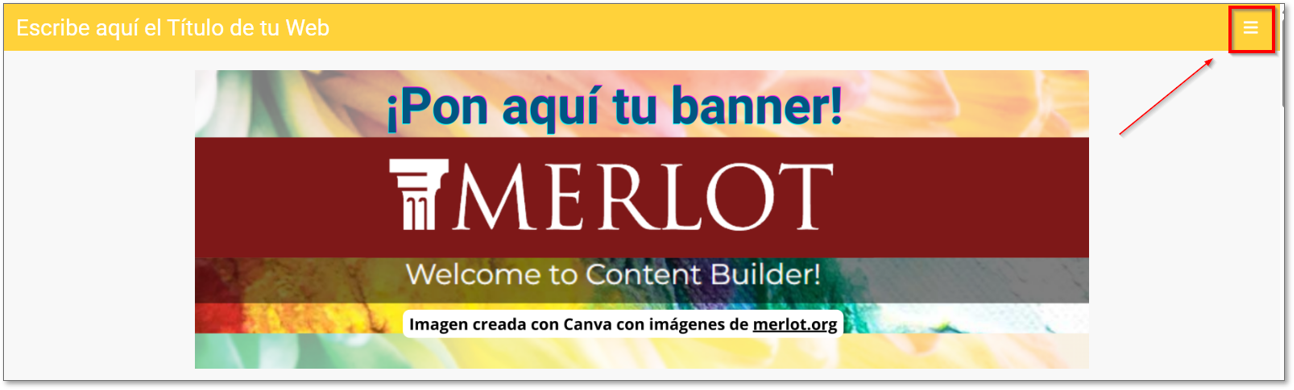
Navega por las diferentes pestañas clicando en el icono de las tres líneas horizontales horizontales para ver cómo se visualizarían los diferentes diseños de página:
Dentro del texto puedes enlazar el contenido que necesites, como por ejemplo la página oficial de ayuda de Content Builder: Welcome To Content Builder.

También puedes enlazar páginas y las secciones de las páginas de la web que estás diseñando.
Como has comprobado, la versatilidad de la herramienta Content Builder es muy amplia y su uso resulta intuitivo. Te animamos a aprovechar esta funcionalidad para el diseño web y la creación de tus recursos educativos.
¡No olvides compartir tus REA!
Si decides compartir tu sitio web, los pasos que tienes que seguir son:
También pudes añadir tu sitio web a MERLOT.
Recently added materials to MERLOT
-
Dynamic Aeroelasticity: Flutter, Divergence & Reversal
This open-access educational module provides an advanced treatment of dynamic aeroelasticity within the Aerospace Structures Curriculum Series. Designed for undergraduate and graduate engineering students, the text covers Collar's triangle of forces, static wing torsional divergence, control surface aileron reversal, classical two-degree-of-freedom wing flutter, V-g stability diagrams, Lagrangian formulations of coupled equations of motion, and advanced aeroelastic tailoring/mitigation strategies (mass balancing, composite anisotropy, and active flutter suppression). Rigorously structured to satisfy International Engineering Alliance (IEA) Washington Accord graduate attribute competencies (WA1–WA3).
-
Bruto-netto salaris calculator — bereken je netto loon (Toolkistje)
Gratis online calculator waarmee werknemers hun bruto maandsalaris omrekenen naar netto. Vul je brutoloon in en zie direct je netto per maand en per jaar, inclusief vakantiegeld (8%), eventuele 13e maand en pensioenpremie. Handig om een loonstrook te controleren of salarissen te vergelijken. Nederlandstalig, geen registratie nodig.
-
T-Test Calculator (one-sample, two-sample and paired)
Free online t-test calculator for one-sample, two-sample (Welch or pooled) and paired tests. Students enter their own data and see the t statistic, degrees of freedom, p-value and confidence interval, with each step of the working shown and a worked example.
-
Escape The Lab: An AP Chemistry Adventure by Dragotoba
Escape The Lab
-
Global Cities Codebook for Global Student Learning Outcomes
The Global Cities Codebook for Global Student Learning Outcomes gives teachers a way to define, teach, and measure global learning in any K-12 program or classroom. It draws on original data from the pioneering Global Scholars international virtual exchange program. The Global Cities framework is grounded in four global student learning outcomes: appreciation for diversity cultural understanding global knowledge global engagement We have identified 55 concrete, observable, and teachable indicators that name the knowledge, skills, attitudes, and behaviors students may demonstrate as they progress toward the four learning outcomes. Global Cities, Inc., a program of Bloomberg Philanthropies, conducted this research with Harvard Graduate School of Education’s Project Zero. The Codebook is co-published by the Organisation for Economic Co-operation and Development (OECD).
-
An online English lesson for adult students based on the You-Tube video “What really happened during the Salem Witch Trials”
This resource is a comprehensive, ready-to-use 90-minute lesson plan designed for adult learners (levels B2–C1) studying English online. The lesson focuses on the topic of "Crime and Punishment" and aims to develop speaking skills through the use of reporting verbs (e.g., accuse, deny, admit, threaten, persuade) in reported speech. The core methodology relies on an authentic video material (a TED-Ed video about the Salem Witch Trials) to model real-life communicative situations and reduce language anxiety.
-
Find Your Next Football Club Today With Club Connect
Club Connect Recruit is a trusted football recruitment platform that connects semi-professional players with verified UK clubs. Every club is 100% verified before it can contact players, so you always deal with real organisations. Player registration is free, and you can build a professional Digital Football CV showing your stats, videos and availability in one profile. 7+ Player Pro features boost your visibility and let you track how clubs view your profile. Our secure and private recruitment platform keeps all messages and trial invites in one place, with no public comments or distractions. Join Club Connect and take the next step in your football journey.
-
Cultural Humility: Retraining and retooling nurses to provide equitable cancer care - PMC
Cancer outcome disparities exist among Black, Indigenous, and people of color despite advancements in screening, detection, and treatment. In addition to racial and ethnic diversity, the U.S. population is experiencing shifts in sociodemographics, including a growing aging population, sex and gender identities, spiritual and religious belief systems, and divides between high- and low-income households.
-
Nurse-Led Aesthetics in Hinckley You Can Trust
Rejuvenate Clinic is a private, nurse-led aesthetics clinic in Hinckley, offering anti-wrinkle injections, lip fillers Hinckley treatments, skin peels, microneedling, and fat dissolving. The clinic is led by a Registered Nurse with 25+ years of clinical experience, 10+ years in aesthetics, and an MSc in Advanced Clinical Practice. Every client gets a personalised treatment plan and a free consultation, with a two-week follow-up review included. Results are kept natural and subtle, and every visit is calm and unhurried. Appointments are by booking only, with late night and weekend slots.
-
pubmed.ncbi.nlm.nih.gov
Background: The ability of nurses to deliver culturally mindful health care may be vital to improving the patient-clinician relationship and subsequent health outcomes for marginalized populations. Continuing education in cultural training should be designed to enhance a nurse's cultural humility. Method: This study explores the concept of nurse cultural humility using the methods outlined by Walker and Avant (2018): define the attributes, offer a model case exemplifying the attributes, discuss the antecedents and consequences, and determine empirical referents. Results: The defining attributes of cultural humility in nursing are a lifelong process of reflexivity, an understanding and appreciation that the cultural backgrounds of both nurse and patient influence health care encounters, and a commitment to redress and mitigate power imbalances in the patient-clinician relationship. Conclusion: By clearly defining nurse cultural humility, leaders will be able to develop cultural training interventions to enhance nurse cultural humility and measure the concept accurately. [J Contin Educ Nurs. 2024;55(12):596-603.].
-
Cultural Humility: A Quick Reference Guide
This guide is for anyone who is interested in learning more about cultural humility and how to practice it.
-
Rethinking Cultural Competence: Shifting to Cultural Humility - PMC
Healthcare and social services providers are deemed culturally competent when they offer culturally appropriate care to the populations they serve. While a review of the literature highlights the limited effectiveness of cultural competence training, its value remains largely unchallenged and it is institutionally mandated as a means of decreasing health disparities and improving quality of care. A plethora of trainings are designed to expose providers to different cultures and expand their understanding of the beliefs, values and behavior thus, achieving competence. Although this intention is commendable, training providers in becoming competent in various cultures presents the risk of stereotyping, stigmatizing, and othering patients and can foster implicit racist attitudes and behaviors. Further, by disregarding intersectionality, cultural competence trainings tend to undermine provider recognition that patients inhabit multiple social statuses that potentially shape their beliefs, values and behavior. To address these risks, we propose training providers in cultural humility, that is, an orientation to care that is based on self-reflexivity, appreciation of patients’ lay expertise, openness to sharing power with patients, and to continue learning from one’s patients. We also briefly discuss our own cultural humility training. Training providers in cultural humility and abandoning the term cultural competence is a long-awaited paradigm shift that must be advanced.
-
Calculadora de Porcentagem (Percentage Calculator)
This free online percentage calculator (in Portuguese) helps students and teachers work through common percentage problems: calculating a percentage of a value, finding what percentage one value is of another, and percentage increase or decrease. Results appear instantly in the browser — no registration and no installation. Suitable as a classroom practice aid or for self-study of basic arithmetic and financial mathematics.
-
Literature Lab: Sorotan Literatur Berbantukan GenAI (GenAI-Assisted Literature Review)
A bilingual (Bahasa Melayu / English) inclusive open learning module that guides postgraduate students and early-career researchers through a responsible, GenAI-assisted literature review. Five units (about 2 hours) follow the review workflow: research scope and ethics; search and verify sources with Google Scholar; build a literature matrix with Gemini Notebook; themes and critical synthesis; and research gaps and final review. Each unit has step-by-step notes, a ready-to-copy prompt, a self-check quiz with explanations and a reflection task saved to a personal portfolio (matrix, notes and AI-use log) that learners can export. Includes a tools and search guide and a Prompt Studio bank of 17 prompts organised by stage. Emphasises research integrity: verify every reference against the original source, never invent citations, record AI assistance, and keep academic judgement with the researcher. Accessibility: WAVE 0 errors (AIM 10/10), keyboard navigation, BM/EN page language, browser text-to-speech, full text and PDF notes, quiz feedback in text, responsive design. No sign-in; progress stays in the learner's browser. Downloadable source code (.zip). Licence: CC BY-NC-SA 4.0. AI disclosure: developed with ChatGPT and Claude assistance; reviewed by the author.
-
Asas AI Agentik: Daripada Data kepada Tindakan (Agentic AI Fundamentals: From Data to Action)
An inclusive, open learning module in Bahasa Melayu (Malay) that introduces agentic AI to beginners without programming. Across five short units, learners distinguish generative responses, fixed workflows and LLM-based AI agents; map agent components (goals, context, memory, tools, planning, review); judge whether operational data gives enough context; understand how multiple agents cooperate through events; and decide when human review is required before an agent acts. Every unit offers a "Learn Your Way" choice: interactive text, captioned video, slides, an infographic with a full text description, two audio formats (summary and full narration) with transcripts, full notes, and self-check activities. The module also includes a lab simulation, a self-assessment quiz, reflection, a glossary and a mind map. Accessibility: WAVE 0 errors (AIM 10/10), captions and transcripts for all audio and video, alt text for all images, keyboard navigation, high-contrast and text-size options. Estimated learning time: about 40 minutes. Licence: CC BY-NC-SA 4.0. AI disclosure: videos, audio summaries, slides and infographics were generated with Google Gemini Notebook from the author's own source notes and reviewed by the author.
-
Course Organisation and Management: UK National Student Survey Research Brief
An openly accessible research brief for programme leaders, teaching administrators and faculty developers, examining course organisation and management in UK National Student Survey (NSS) open-text comments. The 2026 edition combines student-experience summaries, topic mention rates, sentiment, reportable subject and cohort comparisons, and eligible comparisons with 2025. Students value well-organised courses and modules. Negative accounts describe problems with course structure, timetabling, administrative processes, and delays in arrangements, information or responses. The practical prompts address a shared programme calendar, clear responsibility for recurring decisions and communication when plans change. Suggested use: in a programme-review or staff-development session, select one finding and examine its sample size and limitations. Compare it with local student feedback, map how a timetable or assessment change reaches students, and identify conflicting information or an unclear decision owner. Propose one coordination change to test and agree how to monitor late changes and recurring administrative problems. The aim is to turn national patterns into questions for local investigation. Produced by the Student Voice research team and reviewed by Dr Stuart Grey. The brief includes sample sizes, methods, reporting thresholds, a print option and a suggested citation. Deterministic supervised learning identifies topics and sentiment; AI-assisted summaries are checked against source comments. These independent national patterns are separate from official quantitative NSS results. Counts refer to comments, not respondents; findings do not diagnose an individual programme or establish that an intervention will work. Comparisons respect the 2023 questionnaire change, with earlier years shown separately. Only aggregate findings are public. Reading requires no registration or payment.
-
Student Support in Higher Education: UK National Student Survey Research Brief
An openly accessible research brief for student-support professionals, personal tutors, programme leaders and faculty developers, examining student experiences of support in UK National Student Survey (NSS) open-text comments. The 2026 edition combines student-experience summaries, topic mention rates, sentiment, reportable subject and cohort comparisons, and eligible comparisons with 2025. Students value helpful staff, wellbeing services and support for disabilities or additional needs. Other accounts describe difficulty finding or reaching the right service, inadequate mental health support, and gaps in provision for particular needs. These contrasting experiences support discussion of access and consistency across university services. Suggested use: in a staff-development or service-review session, select a finding and check its sample size and limitations. Compare it with local feedback, then map the route from a student’s first request to a completed referral. Identify one unclear hand-off or gap in ownership, propose a change to test, and agree measures such as time to first response, completed referrals and repeat help-seeking. The activity concerns service design and educational experience. Produced by the Student Voice research team and reviewed by Dr Stuart Grey. The brief includes sample sizes, methods, reporting thresholds, a print option and a suggested citation. Deterministic supervised learning identifies topics and sentiment; AI-assisted summaries are checked against source comments. These independent national patterns are separate from official quantitative NSS results. Counts refer to comments, not respondents; findings do not diagnose an individual programme or establish that an intervention will work. Comparisons respect the 2023 questionnaire change, with earlier years shown separately. Only aggregate findings are public. Reading requires no registration or payment.
-
Assessment Feedback in Higher Education: UK National Student Survey Research Brief
An openly accessible research brief for lecturers, assessment leads and faculty developers, examining what students say about assessment feedback in UK National Student Survey (NSS) open-text comments. The 2026 edition brings together summaries of positive experiences and areas for improvement, topic mention rates, sentiment, reportable subject and cohort comparisons, and eligible comparisons with 2025. Students value detailed feedback that helps them improve, prompt return and opportunities for individual discussion. Concerns include delays, inconsistency between markers or modules, and comments that are vague or too limited to guide subsequent work. Suggested use: in an assessment-development workshop, examine one finding with its sample size and limitations, then compare it with local student feedback. Review a sample feedback sheet against three questions: what worked, what needs attention, and what should the student do next? Agree one improvement to test and evaluate both turnaround and students’ ability to use the feedback. This is a proposed learning activity, not evidence that a particular intervention is effective. Produced by the Student Voice research team and reviewed by Dr Stuart Grey. The brief includes sample sizes, methods, reporting thresholds, a print option and a suggested citation. Deterministic supervised learning identifies topics and sentiment; AI-assisted summaries are checked against source comments. These independent national patterns are separate from official quantitative NSS results. Counts refer to comments, not respondents; findings do not diagnose an individual programme or establish that an intervention will work. Comparisons respect the 2023 questionnaire change, with earlier years shown separately. Only aggregate findings are public. Reading requires no registration or payment.
-
History Student Feedback: UK National Student Survey Research Brief
An openly accessible research brief for history lecturers, programme leaders and faculty developers, examining UK National Student Survey (NSS) open-text comments about the undergraduate history experience. The 2026 edition combines student-experience summaries, topic mention rates, sector sentiment comparisons and eligible comparisons with 2025. Students value knowledgeable, enthusiastic and approachable staff, helpful office hours, curriculum breadth and optional modules. Negative accounts describe unclear marking criteria, feedback that offers insufficient guidance, restricted module choices, limited contact time and disruption from industrial action. The contrast in accounts of module choice supports discussion of how experiences vary. Suggested use: in a history programme-review meeting, compare the findings on module choice or assessment with local student feedback. Check the sample sizes and limitations, review the information students receive when choosing modules or preparing assessed work, and propose one change to investigate. Agree how its effect would be evaluated. The brief also provides prompts for communicating disruption, explaining educational value and coordinating workload. Produced by the Student Voice research team and reviewed by Dr Stuart Grey. The brief includes sample sizes, methods, reporting thresholds, a print option and a suggested citation. Deterministic supervised learning identifies topics and sentiment; AI-assisted summaries are checked against source comments. These independent national patterns are separate from official quantitative NSS results. Counts refer to comments, not respondents; findings do not diagnose an individual programme or establish that an intervention will work. Comparisons respect the 2023 questionnaire change, with earlier years shown separately. Only aggregate findings are public. Reading requires no registration or payment.
-
Psychology Student Feedback: UK National Student Survey Research Brief
An openly accessible research brief for psychology lecturers, programme leaders and faculty developers, examining UK National Student Survey (NSS) open-text comments from the Psychology (Non-Specific) subject group. The 2026 edition brings together student-experience summaries, topic mention rates, sector sentiment comparisons and eligible comparisons with 2025. Students value lecturers’ expertise, enthusiasm, approachability and support. Concerns include teaching that relies on reading slides, insufficient explanation, unclear assessment requirements and vague feedback. Practical prompts address shared understanding of marking criteria, visible course costs and earlier timetable coordination. Suggested use: in a psychology programme-review session, select an assessment finding and examine its sample size and limitations. Compare it with local feedback, review an assessment brief and an annotated example of student work, and propose one clarification to test. Specify what evidence would show whether students understand the expectations better. The resource also supports postgraduate discussion of survey interpretation and responsible use of student feedback. Produced by the Student Voice research team and reviewed by Dr Stuart Grey. The brief includes sample sizes, methods, reporting thresholds, a print option and a suggested citation. Deterministic supervised learning identifies topics and sentiment; AI-assisted summaries are checked against source comments. These independent national patterns are separate from official quantitative NSS results. Counts refer to comments, not respondents; findings do not diagnose an individual programme or establish that an intervention will work. Comparisons respect the 2023 questionnaire change, with earlier years shown separately. Only aggregate findings are public. Reading requires no registration or payment.
-
Adult Nursing Student Feedback: UK National Student Survey Research Brief
An openly accessible research brief for nursing lecturers, programme leaders and practice-education teams, examining Adult Nursing students’ experiences in UK National Student Survey (NSS) open-text comments. The 2026 edition combines student-experience summaries, topic mention rates, sentiment comparisons with the wider sector and eligible comparisons with 2025. Students value approachable teaching staff, placement variety and preparation through clinical skills teaching or simulation. Reported concerns include timetabling, lengthy placement blocks and access to support while on placement. Practical prompts address programme workload, shared understanding of marking criteria and earlier timetable coordination. Suggested use: in a nursing programme review or faculty-development session, select one placement or timetable finding, examine its sample size and limitations, and compare it with local feedback. Map responsibility between university and placement teams, propose one change to investigate, and specify how its effect would be evaluated. Produced by the Student Voice research team and reviewed by Dr Stuart Grey. The brief provides methods, reporting thresholds, a print option and a suggested citation. Deterministic supervised learning identifies topics and sentiment; AI-assisted summaries are checked against source comments. These independent national patterns concern undergraduate educational experiences. They are separate from official quantitative NSS results and do not diagnose an individual programme or establish that an intervention will work. Counts refer to comments, not respondents. Comparisons respect the 2023 questionnaire change, with earlier years shown separately. Only aggregate findings are public; reading requires no registration or payment.
-
Computer Science Student Feedback: UK National Student Survey Research Brief
A freely accessible research brief for computer science lecturers, programme leaders and faculty developers, examining student experiences reported in open-text comments from the UK National Student Survey (NSS). The 2026 edition analyses 1,456 classified Computer Science comments. It combines summaries of positive experiences and areas for improvement with topic mention rates, sentiment comparisons against the wider sector, and comparisons with 2025 where reporting thresholds are met. The page includes sample sizes, methodological explanations, limitations, practical actions and a suggested citation. The brief highlights students’ appreciation of approachable teaching staff, curriculum breadth and clear explanations, alongside concerns about heavy workloads and delays in assessment feedback. Its practical prompts support discussion of workload across modules, shared understanding of marking criteria, and feedback that helps students improve subsequent work. Use it in a computing programme review or faculty-development session. For a short team activity, select one finding, check its sample size and limitations, compare it with local student feedback, and propose one change to investigate. Record how you would evaluate that change. The brief can also support postgraduate discussion of survey interpretation and responsible use of student feedback. Produced by the Student Voice research team and reviewed by Dr Stuart Grey, the analysis uses deterministic supervised learning to identify topics and sentiment. AI-assisted summaries are checked against source comments. Public content contains aggregate findings, not raw student comments or identifying text. These are independent analyses of national undergraduate comments, separate from official quantitative NSS satisfaction results. Counts refer to comments rather than individual respondents; national patterns do not diagnose an individual programme or establish that a proposed intervention will work. Current comparisons respect the 2023 questionnaire change, with earlier years shown separately as context. The brief is free to read without registration.
-
NSS Insights: UK Student Feedback Research by Subject and Teaching Topic
A freely accessible collection of research briefs for higher education lecturers, programme leaders, faculty developers and student-experience teams, exploring open-text comments from the UK National Student Survey (NSS). Browse or search by academic subject and student-experience topic, including teaching, assessment and feedback, academic support, learning resources and course organisation. The 2026 edition brings together topic mention rates, sentiment comparisons, summaries of student experiences and practical questions for teaching teams. Individual briefs provide sample sizes, methods, reporting thresholds, limitations and suggested citations. Use the collection to prepare a programme review, select evidence for a faculty-development discussion, or compare themes across disciplines. For a short team activity, choose a relevant brief, identify one finding and its limitations, compare it with local student feedback, and propose one action to investigate and evaluate. It can also support postgraduate discussion of survey interpretation and the responsible use of aggregate student feedback. The analysis is produced by the Student Voice research team, with method and interpretation reviewed by Dr Stuart Grey SFHEA. It uses supervised learning to identify topics and sentiment; AI-assisted summaries, where included, are checked against source comments. Public resources contain aggregate findings, not raw student comments or identifying text. These are independent analyses of national undergraduate survey comments, separate from official quantitative NSS satisfaction results. Counts refer to comments rather than individual respondents, and national patterns do not diagnose an individual institution. Current comparisons respect the 2023 questionnaire change; earlier years are presented separately as context. Educators outside the UK can use the briefs for comparative reflection while considering their own educational setting. The directory and linked public briefs can be read without payment or registration.
-
hexacalculator - Free Online Calculators
hexacalculator.com extensive calculator collection in finance, math, physics, health, chemistry, biology and more; helps you solve problems quickly and accurately.