“The judgement of God sent the calamity to teach the Irish a lesson”
“The judgement of God sent the calamity to teach the Irish a lesson”
The Great Irish Potato Famine of 1845-1852 was triggered by a series of crop failures due to a blight that came from the Americas, however, the devastating impact cannot be attributed to natural causes alone; British government policy played a decisive role in the exacerbation of the famine. This examination of the famine relief measures (or lack thereof), land and labor policies, and the prevailing economic ideology of the time in Britain will demonstrate that the adherence to laissez-faire economic policy, the continuation of food exports out of Ireland and restrictive 'Poor Laws' significantly worsened conditions in Ireland during the famine. The English had a long history of animosity between them and the Irish even before the famine, and this animosity led many to see the famine as 'divine retribution' and so were less motivated to help the Irish. By prioritizing the market stability in England over the lives of the Irish people, British authorities inflamed food insecurity, emigration and mortality.
The tensions between the Irish and English stretch back all the way to medieval times when the English invaded Ireland and tried to colonize it and convert its Catholic people to the Protestant Church of England. Gray says that "A geographically constrained medieval English colony on the east coast of Ireland was massively expanded and transformed by a series of wars, suppressed rebellions, land confiscations, and legal consolidation between the 1530s and 1690s. These wars occurred in the context of the European wars of religion and sometimes took the form of an overt Protestant crusade against the perceived threat of 'Catholic power' in Ireland and the risk this might pose to the British state"1, the English had rooted out the Catholics from England, and they were determined to do the same in Ireland, but the Irish resisted. Gray continued to say, "This process resulted not only in the projection of imperial authority from London over the whole island, but the substantive (if never universal) replacement of both the Catholic indigenous and old-colonial landowning elite by a 'new English' and emphatically Protestant ascendancy of landowners, reinforced in the early eighteenth century by a series of penal laws intended to induce further conversions from the old elites and keep Catholicism permanently subordinated politically and socially"2, the English wanted to keep the native Irish Catholics poor and systematically imprisoned to force them to do hard labor. The disdain for the Irish was not just held in England but also by the very landowners in Ireland itself, "I did everything I could to get a place in Dublin for Margaret Reilly, but I could not. I don’t think she cared much about it herself--- She is a very lazy bad servant, & never would make a good servant in this family"3, and this letter from a noblewoman in Sligo shows just how deep the animosity ran. This shows that the English saw the Irish as less than them and with dehumanization as one of the 10 stages of genocide4, it is logical to determine that this dehumanization of the Irish Catholics by the English led to the rationalization of the deaths of around 1 million of those Irish Catholics.
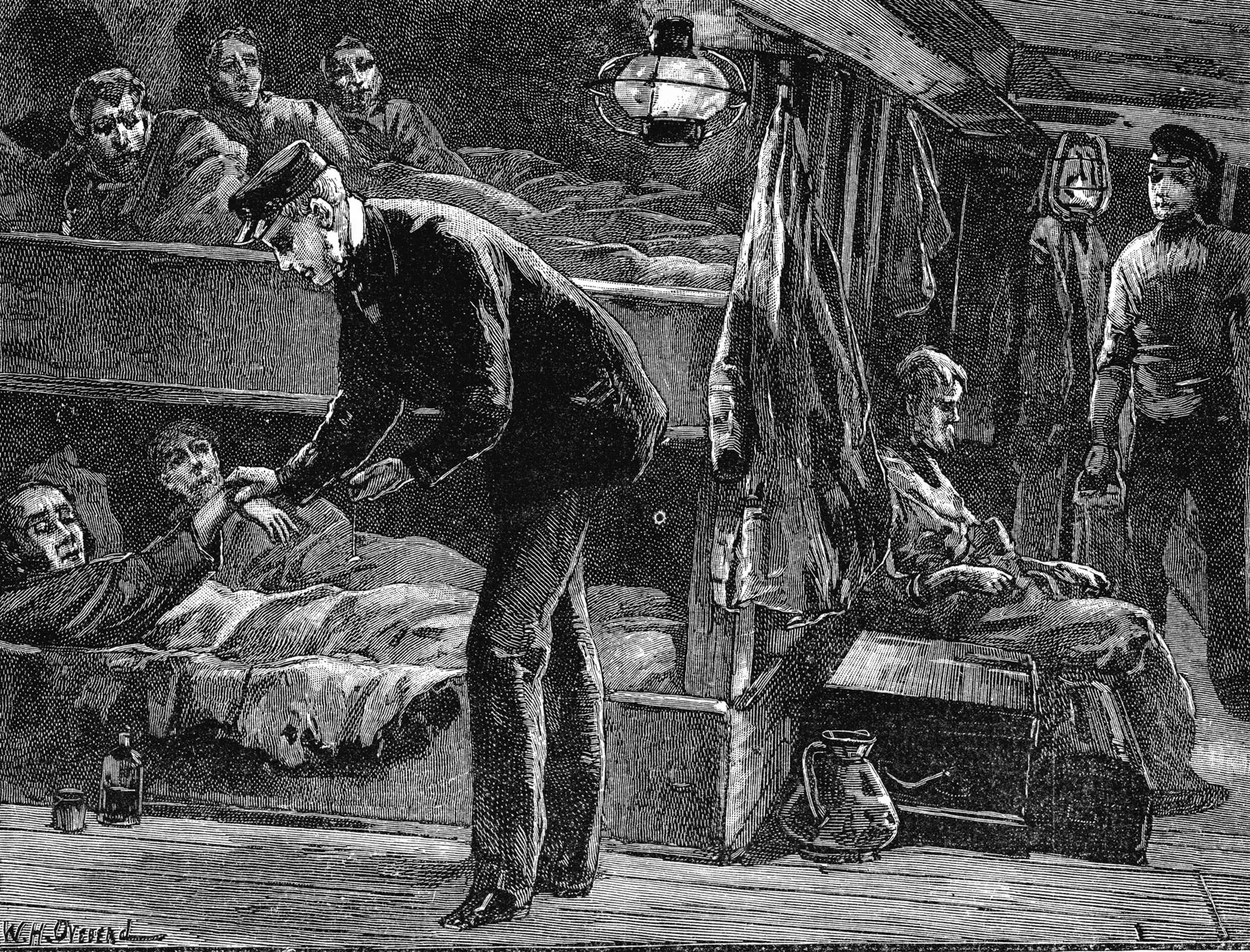
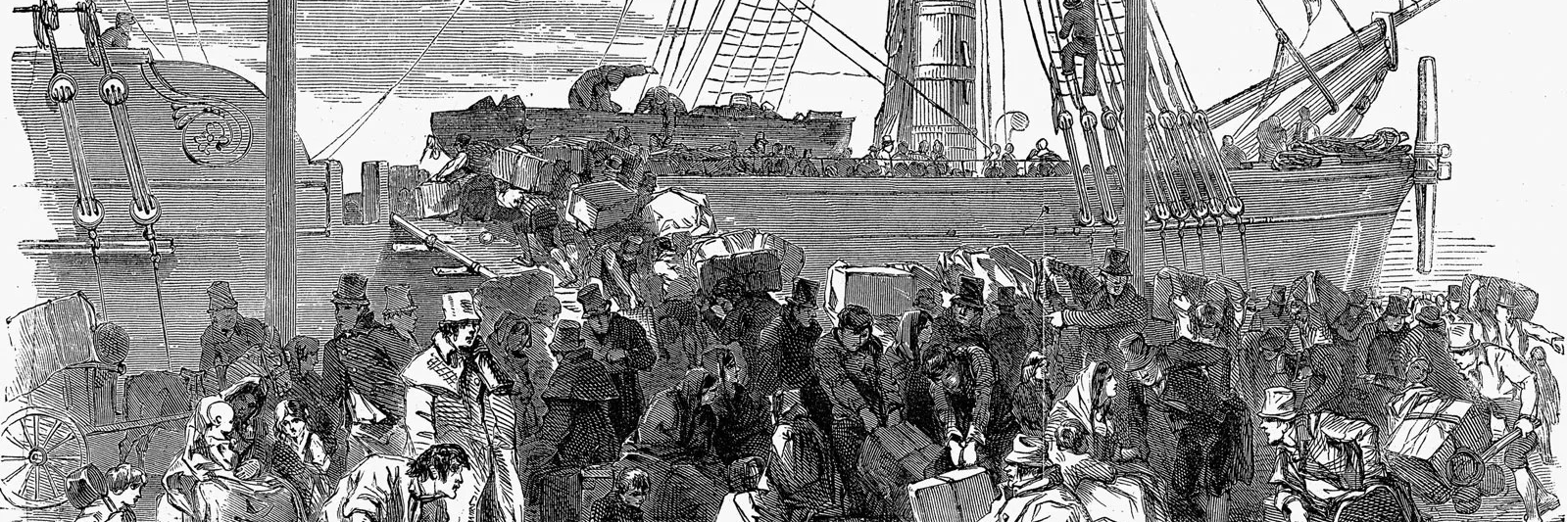
Victims of Ireland's Great Famine (1845–49) emigrating to North America by ship; wood engraving c. 18905
The potato is not native to Ireland or even to Europe, it is native to South America and was introduced to Europe during the Columbian Exchange, so the association of Ireland with potatoes is a relatively new concept in the larger historical context. Gray explains that "If the potato arrived in Ireland through colonial exchanges (it was allegedly first introduced by Sir Walter Raleigh on the estate granted to him as part of the sixteenth-century plantation of Munster), it was not until the later eighteenth century, and as a consequence of the rapid and under-capitalized boom in grain cash-cropping for export, that it began to acquire a dangerously high level of dominance in the diet of labourers and poor peasants"6, meaning that poor Irish peasants became dangerously reliant on the cheap, calorie dense potatoes not because they wanted to, but because they had to, to survive in the growing cash-crop industry. Kinealy says "Potatoes--grown mostly in the south and west of the country, and far less in the richer and more industrially developed east--played a unique part in the Irish economy. People from all social groups ate them, but the poor ate them almost exclusively. Close to half the population ate little except potatoes and buttermilk--a diet that, although monotonous, was highly nutritious"7, this two-tiered lifestyle with the rich English nobles living luxuriously while the Irish peasants were pushed into squalor greatly influenced who was effected by the famine most greatly. Kelly notes that "By the early 1830s, however, a consensus had emerged on one aspect of Irish poverty: it had become so terrible, it was draining the Irish people morally as well as physically"8, the British government knew about the worsening poverty situation in Ireland, but felt uninclined to spend the money necessary to fix the problem. Gray then explains that "The eminent geographer William J. Smyth at University College Cork, central to the team that produced the core sections of the Atlas of the Great Irish Famine in 2012, stresses 'longue durée' structures of colonial governance in explaining the events of 1845-50. In the Atlas, both Smyth and Nally trace long-term weaknesses in the economy to the early modern colonial period, the devastation of war, and the reconstruction of Ireland as an extractive agrarian producer, tied to English demand"9, which is to say that were it not for the English domination of the Emerald Isle, the Irish would not have been as reliant on potatoes when the blight hit.
Given the religious animosity between the English and Irish and the extraction economy set up in Ireland, subservient to England, it is unsurprising that "Sir Charles Trevelyan, who was in charge of the relief effort, limited government aid on the basis of laissez-faire principles and an evangelical belief that 'the judgement of God sent the calamity to teach the Irish a lesson'"10, seeing this disaster as a 'punishment from God,' the English refused their duty to help their citizens in need both to keep markets in England stable and to show the Irish the consequences of standing in opposition to the English crown. The English even made the Irish pay for the relief "Parliament legislated to place the financial onus for famine relief on Irish landowners, who in turn tried to save money by ejecting tenants from their land"11, to take the burden off their shoulders, further worsening the crisis by denying aid from England itself. The Poor Laws set up a system of workhouses for the poor in both England and Ireland, but Irish workhouses were especially cruel, to begin with, "The Irish Poor Law system was small—130 workhouses with a total capacity of 100,000 beds—and unlike the English system it offered no right to relief. When the last workhouse bed was taken, the right to assistance ended"12, so even if the system were well-intentioned, it was nowhere near able to handle the sheer severity of the crisis when it arrived, since it was already strained by the conditions before the famine. Kelly explains the job of these workhouses saying, "The task of the Irish (and English) workhouse was to rehabilitate the afflicted by further afflicting them—by making poverty so unendurable, its victims would embrace the virtues of the saved: industry, self-reliance, and personal discipline. The Irish system executed this mission with unfailing energy and imagination. The relief applicant who managed to remain unintimidated by the forbidding architecture of the workhouse—the high walls, the bleak grassless courtyard, the narrow windows like gun slits—had to endure an admissions process that included procedures 'disgusting to the Celtic mind,' including a 'fearful ordeal by water'"13, this shows that the workhouses were designed to break the Irish from their religion and culture as to assimilate them into the Empire, to reduce the chance of rebellion. After the relatively mild waves of the blight from 1845-46, Kinealy explains that "The consequences of the Whig policies were disastrous. The new public works schemes were inefficient and inadequate; bound up in a labyrinthine bureaucracy, they were slow to materialize. When they did, the wages they paid were very poor and very late. On top of that, the severe weather heavy snow replacing the usually "soft" Irish winter--crushed an already weakened people. Irish police estimated that in the winter of 1846--47 half a million died. In the early months of 1847 reports of dogs eating dead bodies became commonplace"14, with the more severe round of the blight in '47 compounding with the unusually severe winter, the lack of government action had massive, irreversible consequences. Kinealy highlights the government's prioritization of profit over people saying, "Wholesale want was made worse by the government's decision to allow merchants to continue exporting food from Ireland, and not to import food itself--a move made largely to appease grain merchants in both England and Ireland, a powerful political lobby"15, instead of importing food to the island to make up for the drastic food shortage, the British government saw the crisis as an opportunity for their merchants to get extremely wealthy off of the suffering of the Irish people.
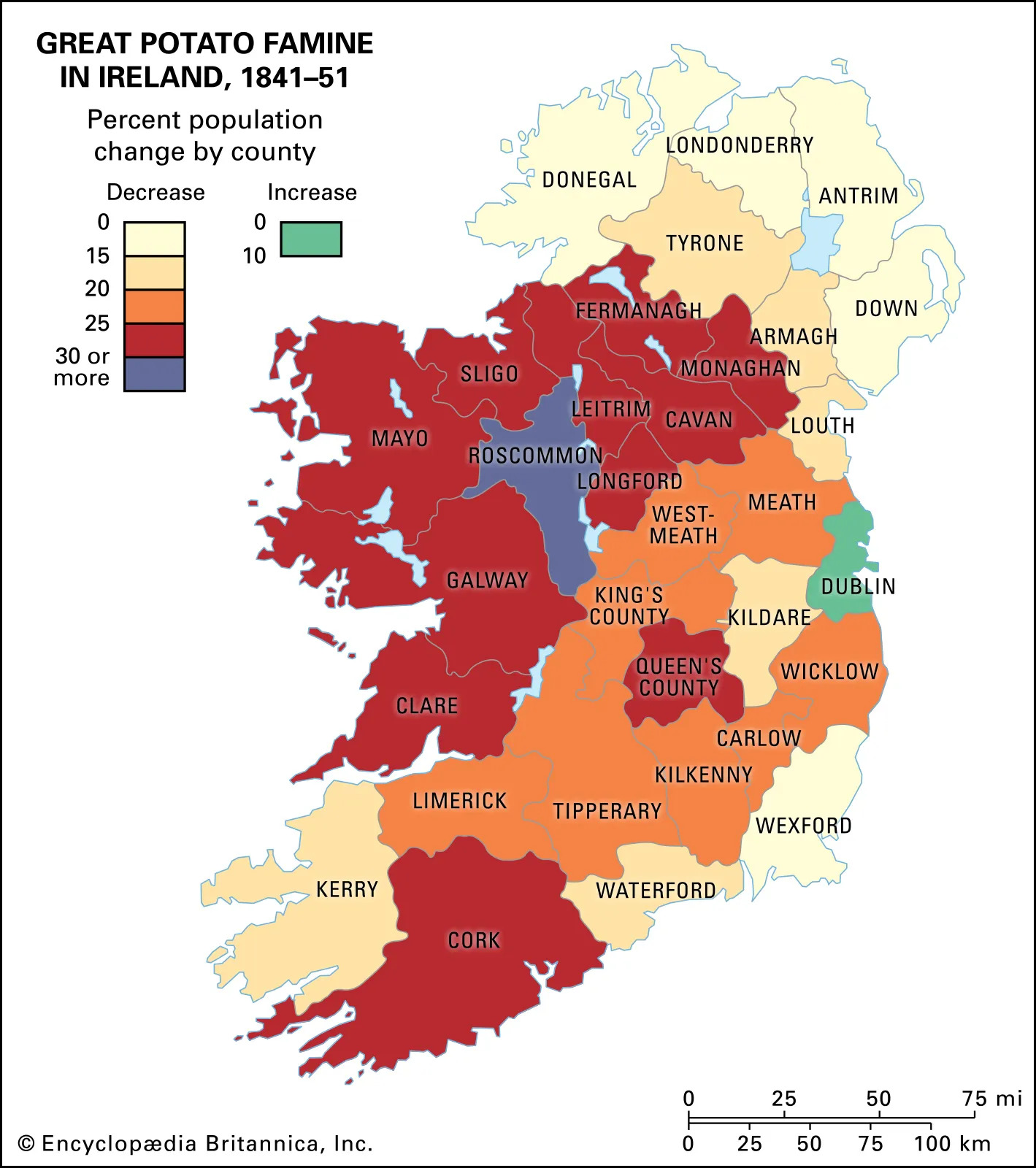
Map depicting population changes in Ireland from 1841 to 1851 as a result of the Great Potato Famine16
The Great Irish Potato famine may have been initiated by crop failure, but it was British government policies that ultimately led to the immense severity of the crisis. Long-standing colonial structures and practices left the native Irish Catholic people economically venerable and largely dependent on the potato and British use of laissez-faire economic policies limited the government's response to a level that led to catastrophic loss of life and emigration, with the Irish population still not recovering to pre-famine levels some 175 years later. The continuation of food exports out of Ireland, the inadequacy of Poor Law relief, and the shifting of the financial responsibility onto Irish landowners only worked to worsen food insecurity while accelerating evictions, emigration and ultimately mortality. These policies were reinforced by deep-seated prejudices that framed the suffering of the Irish Catholics as 'divine punishment,' discouraging effective relief efforts. As a consequence, market stability and fiscal restraint were prioritized over the lives of the Irish people. Therefore the Great Famine cannot just be reduced to an unavoidable natural disaster; it was a calculated move by the British government to let the Irish people starve in the pursuit of capital, and letting people starve when there is plenty of food to eat is different from there being no food at all.
Footnote
- Peter Gray, “Was the Great Irish Famine a Colonial Famine?,” East/West: Journal of Ukrainian Studies 8, no. 1 (April 28, 2021): 159–72, https://doi.org/10.21226/ewjus643.
- Ibid.
- Hester Catherine De Burgh Browne to George Hildebrand, “H. C. Sligo to G. Hildebrand,” Letter, April 26, 1845.
- Holocaust Memorial Day Trust, “The Ten Stages of Genocide,” Holocaust Memorial Day Trust, 2025, https://hmd.org.uk/learn-about-the-holocaust-and-genocides/what-is-genocide/the-ten-stages-of-genocide/.
- Joel Mokyr, “Great Famine | History, Causes, & Facts,” in Encyclopedia Britannica, January 3, 2019, https://www.britannica.com/event/Great-Famine-Irish-history.
- Peter Gray, “Was the Great Irish Famine a Colonial Famine?.”
- Christine Kinealy, “How Politics Fed the Famine,” Natural History 105, no. 1 (January 1, 1996).
- John Kelly, The Graves Are Walking : The Great Famine and the Saga of the Irish People (New York: Picador, , Cop, 2013), 51.
- Peter Gray, “Was the Great Irish Famine a Colonial Famine?.”
- UK Parliament, “The Great Famine,” www.parliament.uk (UK Parliament, 2023), https://www.parliament.uk/about/living-heritage/evolutionofparliament/legislativescrutiny/parliamentandireland/overview/the-great-famine/.
- Ibid.
- John Kelly, The Graves are Walking, 51-52.
- John Kelly, The Graves are Walking, 53.
- Christine Kinealy, “How Politics Fed the Famine.”
- Ibid.
- Joel Mokyr, “Great Famine | History, Causes, & Facts.”