
Learning By Reviewing: Students as Partners in Open Pedagogy
Learning By Reviewing: Students as Partners in Open Pedagogy
Purpose: To introduce OER, MERLOT, and professional peer review to students in the form of a high-impact educational experience.
Abstract: We present an innovative use of MERLOT which engages undergraduate students as peer reviewers of Open Educational Resources (OER). With training, rubrics, and instructor guidance, students gain authentic professional development, enhance academic portfolios, and contribute to the continuous improvement of high-quality, accessible learning materials through open pedagogy. We have conducted this activity in a variety of contexts and found it to be reliably successful and high impact, promoting student engagement and learning.
Created by Medora Huseby1 and Michael Plotkin2.
1. Colorado State University medora.huseby@colostate.edu
2. Mt. San Jacinto College mplotkin@msjc.edu
Brief Description: Students conduct peer reviews of OER materials from the MERLOT collection using the MERLOT peer review template. This activity serves to significantly enhance student learning, interest, and engagement; provide authentic professional development; contribute to the improvement of OER; and benefit the MERLOT project.
Learning Outcomes:
Students will:
1. identify OER through Creative Commons licenses and explain its significance;
2. appraise the importance of MERLOT as a curator of OER;
3. articulate the value of peer review in academia;
4. conduct peer reviews of OER.
How the Activity Works
The activity is flexible and can be adapted to a variety of uses. The work flow for this project includes four basic steps:
1. Introduce OER, MERLOT, and peer review using the MERLOT
peer review process.
2. Train students in the process of peer review.
3. Assign or have students select OER to peer review.
4. Discuss and have students reflect on their experience.
Additional elements that may be included:
1. Provide an exemplar review of an OER for students.
2. Conduct a norming session of an OER can be done at the outset.
2. Have several students review the same OER and compare.
3. Have students review the peer reviews of fellow students.
4. Administer surveys, reflections, or other assessments.
5. The instructor can use student reviews as a basis for writing professional reviews and submitting them to MERLOT (the instructor must be a reviewer on a MERLOT editorial board--if you are not, consider joining the ranks of MERLOT reviewers).
Here is an example of a timeline for this activity.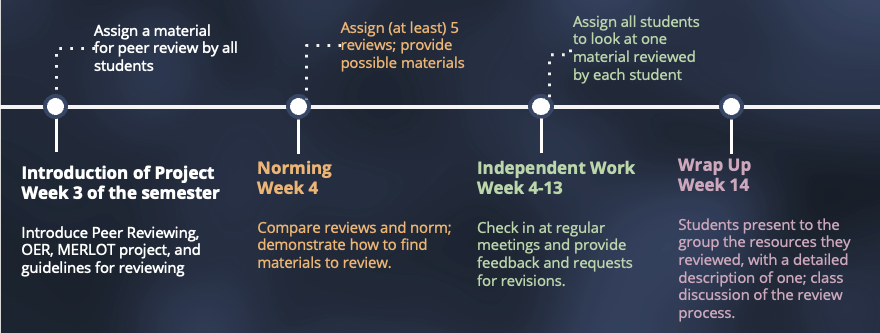
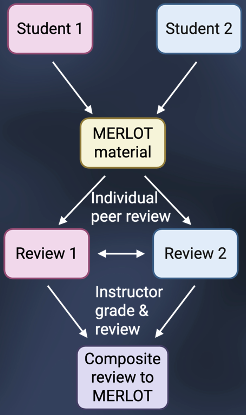
Here is an example work flow for this activity.
This activity and all associated documents are copyrighted under the Creative Commons:
Step 1: Introduce OER, MERLOT, and peer review using the MERLOT peer review process.
OER
1. Open Educational Resources (OER): Introduction a LibGuide from Clark University.
2. Open Educational Resources from UNESCO
3. A brief history of OER by Bliss and Smith (Hewlett Foundation)
4. Introduction to OER from Iowa State University
MERLOT
1. Who We Are from MERLOT
2. MERLOT article from Wikipedia
Peer Review
1. Guidelines for Students—Peer Review from Science Education Resource Center at Carleton College
2. Peer Review Best Practices from the Broad research at MIT
Step 2: Train students in the MERLOT peer review process.
Here is the MERLOT Peer Review Template.
Step 3: Assign or have students select OER to peer review.
Materials can be found on MERLOT. MERLOT curates a variety of materials and not all are OER.
Step 4: Discuss and have students reflect on their experience.
Provide opportunities for students to reflect individually and/or as a group.
Consider having students peer review each others work.
Consider allowing revisions.
Consider including formal reflection as part of the Activity.
Consider conducting formal surveys of student experience with the Activity, and/or assess indirect measures of learning. [See the Resources for examples.]
1. Explain emphatically to students the purpose, value, and importance of peer review in academia.
2. Explain to students what OER is and why faculty might use it.
3. Demonstrate MERLOT, explain the MERLOT project to students.
4. Emphasize the authentic nature of this peer review activity and the opportunity to participate in a professional activity.
5. Provide a highly structured explanation of the process of peer review.
6. Provide detailed guidelines or a rubric for the process. See the MERLOT template link in Step 2.
7. Provide at least one example review.
8. Consider assigning reviews that are relevant to the course material and/or student interest/knowledge.
9. Think of the peer review process as iterative; students might not produce adequate peer reviews initially; allow them to revise their work.
10. Allow in class time for the first review to answer student questions and provide direct guidance.
11. Provide opportunities for students to reflect on their reviewing.
12. Consider having students do presentations on their work.
13. Consider doing a survey of students to understand where students find value in this assignment and where it can be improved.
14. Share survey results with students.
15. Show students how to add peer review to their CV or resume.
16. Join a MERLOT editorial board and consider submitting the review to MERLOT. If the material is to be submitted to MERLOT, faculty are ultimately responsible for the reviews. Reviews must verified and amended to the professional standards of MERLOT.
1. Inexperience with formal peer review, OER, or MERLOT can present a problem for faculty who want to do this Activity.
Remedies:
-Read the resources we have provided to learn more;
-Invite a colleague with more experience to present;
-Investigate MERLOT if you have not already by using the collection.
2. Student inexperience frequently leads to inadequate reviews.
Remedies:
-Consider giving detailed feedback and allowing students to revise their work;
-Content quality can be difficult to judge without strong background knowledge--give students resources on the specific content to improve their knowledge.
3. Imposter syndrome among students
4. Skepticism from the professional community that students can produce high quality peer reviews.
5. This Activity can take significant time for faculty and students. Faculty should consider workloads and time commitments for themselves and their students.
6. Students do not receive official credit for peer review if they are eventually published in MERLOT.