Which Side Are You On? - Harlan County, USA
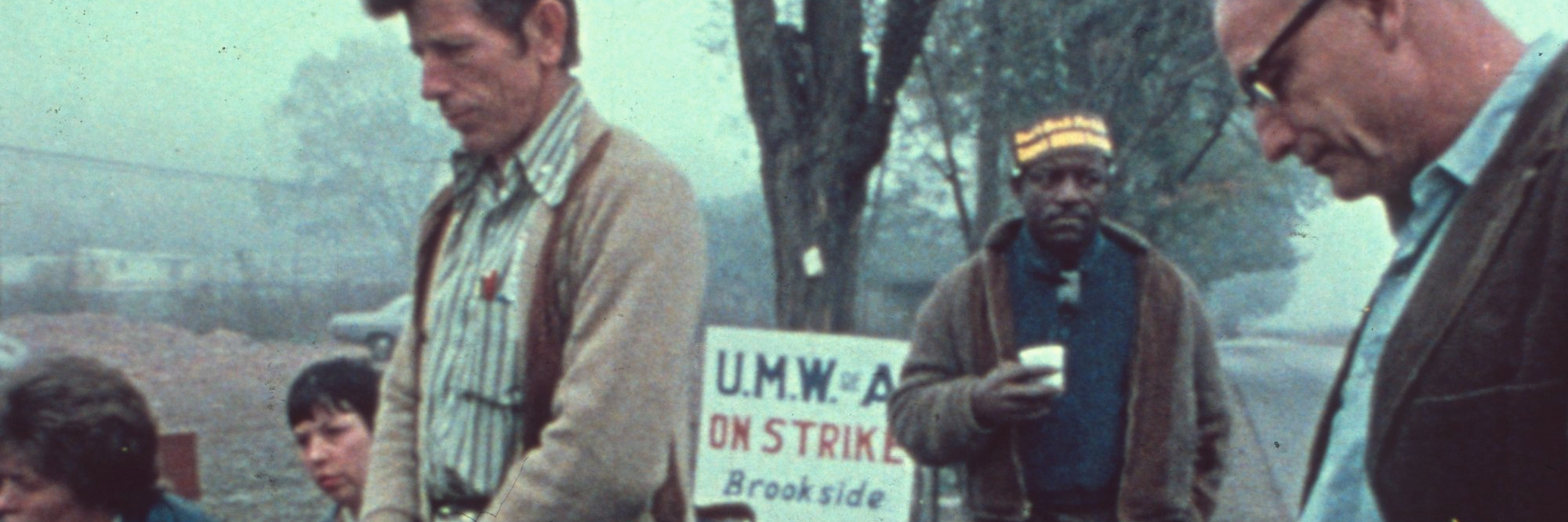
Originally traveling to Harlan, KY to document the changes happening within the United Mine Workers of America (UMWA) after the assassination of a family running against corrupt union leadership, Barbara Kopple found herself in the middle of the Brookside Miners' Strike. This strike wasn't the first in Harlan, a city already coined as "Bloody Harlan" from a similar strike in the 1930s knows as the "Harlan County War." during which union meetings were raided, and where hired guns, police, and workers exchanged fire. Kopple had found herself in the middle of a 13 month strike which she documented for the American public to see. The reality of class and workers' struggle in the United States during the beginning of a new era for union busting.
While Harlan wasn't a company town, it was a town split up by coal companies, each company erecting company owned homes, stores, and of course, mines. The workers lived off of company scrip (company made currency for the workers to use at the stores owned by the company.) The workers of Duke Power decided as workers to join the UMWA and were just waiting for a signature from Duke Power. Duke Power was not planning on signing the agreement.
Whilst picket lines, demonstrations, and clashes between police, hired guns, scabs, and the striking workers seemed to be getting the workers some attention and traction, County Judge F. Byrd Hogg, a mine owner himself, demanded that no more than three workers can strike at once at each entrances to the facility. After the police arrested workers who picketed despite the order found themselves behind bars for 3 months.
The solution against the judge's order came in the form of the Brookside Women's Club. The Brookside Women's club were made up of the wives, mothers, daughters, and sisters of the striking miners. Due to the fact that these women weren't employed by Duke Power, as many of them could go out to picket, block roads, and heckle scabs without breaking the judge's order for Harlan. Although there was a belief that the hired guns, sheriff's department, and scabs would be reluctant to attack the women, many cases of violence against them still occured. It was believed that although shots were fired, men, women, and children were beaten, and 90 arrests occured, the presence of Kopple's shoulder-mounted 16mm camera detered futher violent action against the men and women present in the street during the strike.
Later Kopple and her production crew stating they would keep the camera out and pointed at the hired guns, and police even when they had ran out of film just to deter violent action towards the strikers.
The actions taken by the women in Harlan are a key reason why the strike was able to stay alive up until its conclusion in August of 1974.
The Brookside Strike ended just after August 24, 1974, after the fatal shooting of a young miner, Lawrence D. Jones. After the death of the 23 year old and the death hitting the news nationwide, Eastover Mining company, a subsidary of Duke Power, agreed to the terms of the workers in Harlan, KY.
This strike is what could be called the beginning of the end of militancy in labor unions.
Provided below is a video of Florence Reese, who wrote the song "Which side are you on?" during the 1930s "Harlan County War", performing the song in a meeting during the Brookside Strike.