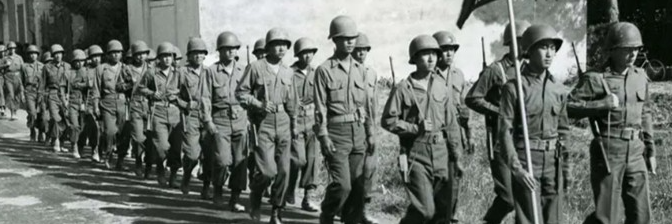
Who where the 442nd Regimental Combat Team ?
Who where the 442nd Regimental Combat Team ?
Before World War 2, approximately 120,000 people in America was of Japanese decent. The first generation to come over to America were referred to as the Issei. The second generation of the Japanese Americans who were born in the United States were referred to as the Nesei, and their children where known as the Sansei. Much like most immigrants the Japanese formed small communities, mainly, on the Pacific coast and Hawaii. Like most minority groups that lived in the era they had to endure the segregation, prejudice, and discriminative laws. In the late 1930's most of Europe was at war. The Axis forces( Germany, Italy, and Japan), where trying to expand land and resources. Germany invaded France, Italy, supporting Germany declared war on France , and Britain, The Japanese were going to war with China, and other Asian countries. Since the US Government was suspecting war the FBI, and CIA conducted surveillance on the Japanese people living in America.
On December 7, 1941, America found itself under attack by the Imperial Japanese Air Force, and because of that the world changed. America, at the time, already racially segregated. Pearl Harbor made it worse, specifically, for the Japanese Americans. Japanese Americans where being interned throughout the United States. War Relocation Authority (WRA) camps operated during World War II to incarcerate over 120,000 Japanese Americans. No formal internment camps existed before the signing of Executive Order 9066 on February 19, 1942. However, the Department of Justice (DOJ) and the U.S. Army operated separate detention facilities immediately following the attack on Pearl Harbor in December 1941.[1] Internment camps had the same atmosphere as prisons, but to add to the outward distrust towards the Japanese, Governor Adkins and his Advisors where being “insistent that these camps be guarded by white troops”[2]The fear was also encouraged by the belief that if white people would show favor towards the Japanese that it would in turn give the African American community more leverage when in regards to rights. However, the Nisei, which was the name of second generation Japanese Americans, where determined to change the perception of their fellow Americans by showing their loyalty to the country they called home, America.
In order to change the mind of Americas the Nisei would volunteer to enlist in the US Army and serve in the 442nd Regimental Combat Team. An all Japanese unit, keeping with the times of segregation in the Armed Forces, but determined to prove to society that they they where not only loyal, but an affective in regards to the fight to keep the American dream alive to all the minorities of America.
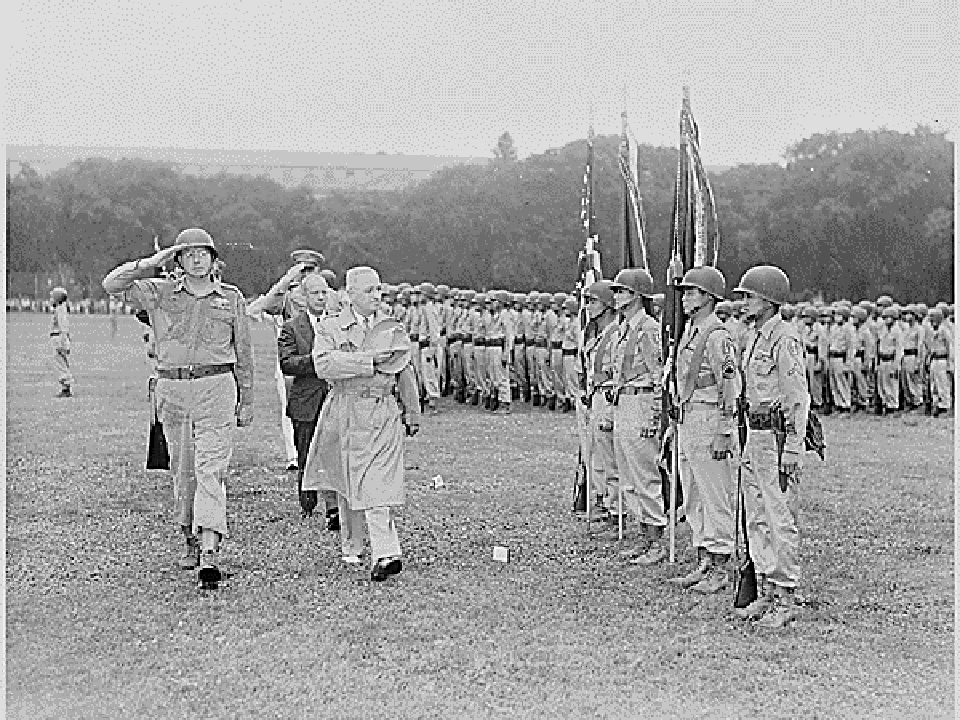
President Harry S. Truman removes his hat in front of the color guard of the 442nd.Courtesy Harry S. Truman Presidential Library
On January 19, 1942 the US Army discharged all Japanese Americans in the US military, and changed their draft status to 4C, "enemy alien". Prior to the directive from the US War Department there were approximately 5,000 Nisei serving in the US military a large portion of that serving in the Hawaiian National Guard. In fact, there were 600 Japanese American soldiers training at the Schofield Barracks when the Japanese attacked Pearl Harbor. In response, One hundred and seventy students petitioned the military governor saying, "Hawaii is our home; the United States our country. We know but one loyalty and that is to the stars and stripes. We wish to do our part as loyal Americans in every way possible, and we hereby offer ourselves for whatever service you may see fit to use us."[3] Despite the prejudice, the Nisei were determined to show their loyalty, and not only by volunteering for service, but often taking the more dangerous jobs. The Nisei served a few roles during their service. One of their roles where to be interpreters for the Military Intelligence Service(MIS), but they gained most of their glory in the Infantry. Do to the military still being predominantly segregated, the Nisei served in the 442nd Regimental Combat team.
The contribution of the Nisei, of the 442nd during WW2 cannot be ignored. They arrived in Italy in June 1944, where they began to fight against Germans encamped across the country. Also in 1944, they were ordered into northeastern France. The 442nd achieved its most famous victory by breaking through heavy German lines to rescue 211 trapped men of the Texas 141st Infantry Regiment, suffering over 400 casualties to do so. By August, the 100th , another jJapanese-American unit was absorbed into the 442nd, with all units serving under the motto “Go For Broke.” In September 1944, the 442nd participated in the invasion of Southern France, successfully liberating French cities from Nazi-Germany control. After being ordered back to Italy, the regiment executed a stealthy, surprise night assault on Mt. Folgorito in April 1945, they disrupted the German forces, which helped expedite the surrender of German forces in Italy. Further more, Elements of the unit specifically, the 522nd Field Artillery Battalion) assisted in southern Germany and encountered/liberated survivors from Dachau sub-camps.
An estimated 33,000 Japanese served in the United States military during World War II. This high level of enlistment meant that roughly 27.5% of the entire Japanese American population in the United States served in the armed forces. They did so despite widespread discrimination and the forced internment of their families.[4) The determination of the 442nd came at a terrible cost. Because, of its astronomical casualty rate, the regiment required constant reinforcement; roughly 14,000 men served in a unit designed to hold only 4,000 at a single time. The combined total of their military awards includes; 21 Medals of Honor (the nation's highest military award)9,486 Purple Hearts, 8 Presidential Unit Citations1 Congressional Gold Medal (awarded collectively to the unit in 2011)[5].
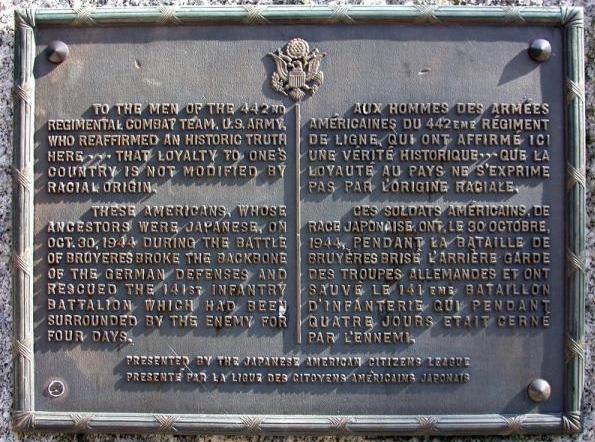
Located on the north side of an unmarked road in the Forêt de l’Helledraye. Monument A granite monument sits atop a white pedestal decorated with a painted silver star
Although their medals, and achievements are nothing less than amazing, we need to remember that these where men with families back home and who left their loved ones to serve this country of ours, Despite the way that they were being treated as a result of their race. It is hard to quantify what made these Japanese Americans so affective in war. One may reasonably suggest that it was out of pure patriotism and the goal to be treated as equals. Another reason may have been to bring honor to their families.
Throughout the war Minoru Masuda, a medic who was serving in the 442nd, would write to his wife from the during his time serving in WW2. Through these first-hand experiences we may be able to get more clarity from the perspective of the Nisei. Before pearl harbor Masuda was a pharmacist. His father was a owner of a hotel in Japanese town near Seattle, WA. After the tragedy of Pearl Harbor, Masuda, and his family were forced into Minidoka, one of many internment camps for Japanese-Americans, before, and during WW2. Masuda writes, “The physical hardships we could endure, but the most devastating experience was the unjust stigmatism by American society, the bitter reminder that racism has won again over the constitution and Bill of Rights…It was galling, infuriating, and frustrating” [6] . Although, we were liberating concentration camps in Europe, we, at the same time where putting the Nesei through the same type of tyranny that we were fighting against. . In early 1943 the Army decided to form an all Japanese-American unit, and thus turned to the concentration camps for recruitment. The hypocrisy should not be lost upon us, and it was lost upon the Nesei. According to Masuda, recruitment failed…the fact there was no volunteers only proved their rightness in calling us disloyal and throwing us into camps””[7].
The Niseis' proved their loyalty through countless acts of valor, which was being put on display for the world to see, and especial in America. However despite their sacrifices, at home they where still being discriminated agains which can be seen in a letter written by Masuda, to his wife, “We just read an article in Stars and Stripes about PFC Naitos being refused into the Spokane VFW (Veteran of Foreign Wars) and its cause a minor furor, it being plastered on the front page, with a commendation of the Nisei....if only the people back home could have the same viewpoint as the GI’s….I guess its up to us to show some. Of these narrow-minded bigots when we get back home” [8].
The Nesei from the 442nd accomplished their goals of proving loyalty .to America. Not only through their actions in combat, but also the willingness to sacrifice it at to accomplish their ultimate goal of equality among all races.
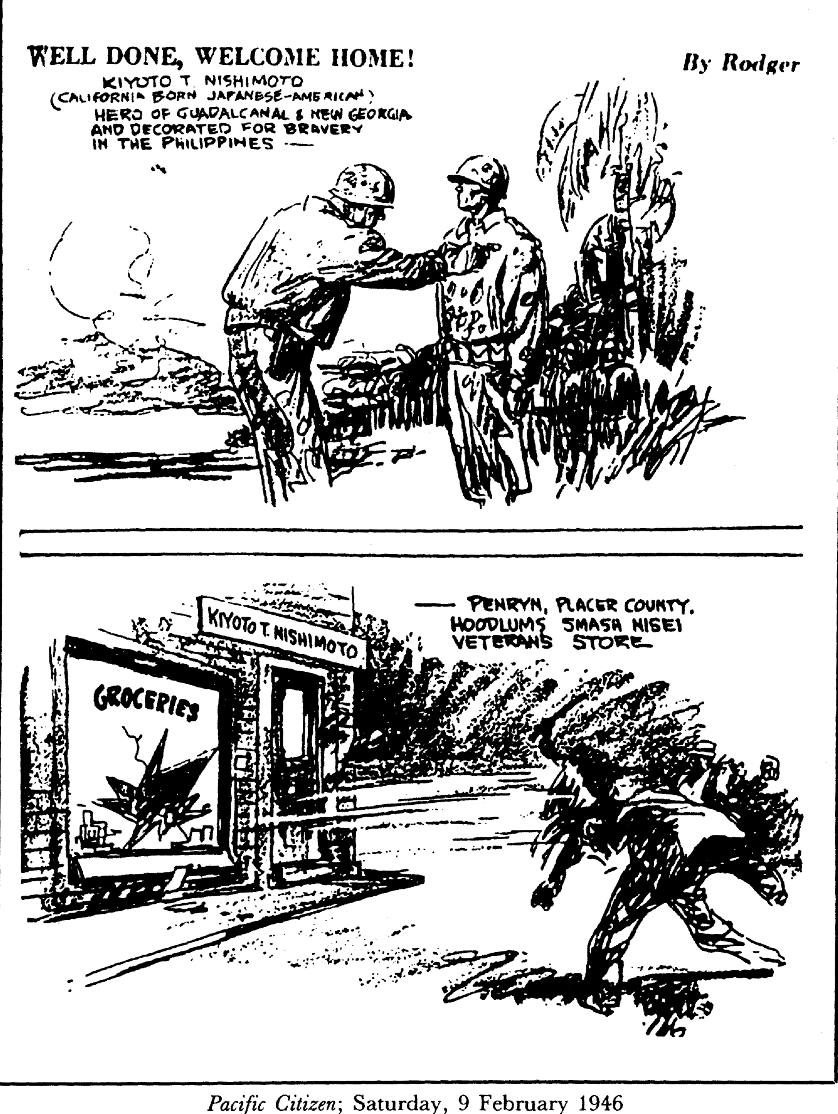
The Idea of being willing to sacrifice everything, and not being appropriately treated for it sounds horrific, but immediately after the brave men who served in the 442nd still had to deal with discrimination. In fact, the war with Japan officially ended in 1945 the last Japanese internment camp was not closed until 1946. Further more, violence against the Japanese became more frequent. The increase in violence got so bad that in California, "two Japanese American soldiers sent Secretary of the Interior Harold Ickes a letter requesting protection for their family"[9] The racially motivated violence continued throughout the later half of the 1940s. The response of the local, and federal law enforcement was to blame the violence on rogue groups of individuals, and thus rarely resulted in any significant justice for the Japanese Americans.
In the 1950s however, Japanese Americans began to rebuild their lives after the often unjust internments of the 1940s. The McCarran-Walter Act of 1952, gave Japanese Americans the right to naturalize. Another factor in the change of tides for Japanese Americans was the diversity resulting from American soldiers "war wives", a lot of whom where from their tours in Japan. In the 1960s , Japanese Americans continued to gain more civil rights, and participated in broader civil rights movements. They greatly benefitted from the Civil Rights act of 1964, and the Immigration Act of 1965. During the 1970s a lot of the atrocities of the past where coming to light. There where images of the Japanese internment camps being shared with the general public. Which led to what is referred to as the Redress and Reparations movement. Which in part led to the Civil Liberties act of 1988. In the 1990s the US Government finished the distributions of the Redress payments to the survivors of the Japanese internment camps.
To answer the question of "Was their sacrifice worth it?", would depend on the individual to answer it. Although through out the years the US Government has made reparations and litigation that accomplished the goals that soldiers of the 442nd it took 35 years. That is a long time, and if you consider the fact that most of the solders where between 18 and 30, by the time they seen their sacrifices "pay off", they where already past the point where it would make a significant difference on their lives, with that being said, they would be proud of how they represented their family with honor. They would also be proud to know that thanks to their example they layed down a foundation that led to diversity we see in the military, and the country today as a whole. To end with a quote by Shosuke Kuroki's, the father of Ben Kuroki a soldier who was with the 442nd, "America is your country. Your loyalty must be to the United States. Fight if you must and die if you must, but remember, don't bring shame to family, to the community, or to your country."[10]