Advanced Psychological Statistics Lab
Advanced Psychological Statistics Lab
Purpose: to help other instructors teaching the same course
Course name/number: PSY 301 & PSY 301L
CSU Instructor Open Textbook Adoption Portrait
Abstract: This affordable learning resource is being used in an Advanced Psychological Statistics course for undergraduate students by Professor of Experimental Psychology Justin L. Matthews at California State University, Monterey Bay. The affordable resource chosen for this course provides step-by-step guides for a variety of common statistical tests used by undergraduate students in their content courses, Capstone projects, and later in graduate programs and careers. This title emphasizes easy to understand descriptions of tests, step-by-step guides, and accessible problem sets for students to practice and master. The main motivation to adopt an affordable resource was so students could acquire needed learning materials at no cost in addition to mastering statistical computation and interpretation using a software suite that was also free and easy to use (jamovi.org). Students can access this OER resource via OpenBookPublishers.com.
Course Title and Number - Advanced Psychological Statistics and Lab
PSY 301 & PSY 301L
Brief Description of course highlights: Lecture: Students learn strategies to evaluate experimental designs and methodology. Emphasis is on using computer application of statistical models that use multi-group paradigms and linear analyses including the t-test, Analysis of Variance, and regression. Nonparametric statistics and evaluation of quasi-experimental designs are also included. Lab: Computer laboratory to accompany PSY 301. Various advanced research laboratory exercises and training in statistics and computer data analyses. Catalog Link: https://catalog.csumb.edu/preview_program.php?catoid=12&poid=2556&returnto=632
Student population: This course is for undergraduate psychology majors and minors and is one of two classes that meets the Psychology Major Quantitative Requirement. Students are typically Juniors or Seniors. Prerequisite(s)/Corequisite(s): [(Prereq: (PSY 100 AND STAT 100 AND PSY 200 AND PSY 200L) OR (PSY 300)) AND (Coreq: PSY 301L)]
Learning or student outcomes:
Descriptive Statistics: Calculate and interpret measures of central tendency (mean, median, mode) and variability (variance, standard deviation) to summarize data sets.
Measurement & Probability: Distinguish between the four scales of measurement (nominal, ordinal, interval, ratio) and apply basic probability concepts using the normal curve.
Hypothesis Testing Logic: Explain null hypothesis significance testing (NHST), type I/II errors, p-values, and statistical power.
Inferential Analyses: Select and execute appropriate statistical tests—such as t-tests, analysis of variance (ANOVA), correlation, linear regression, and chi-square tests—to evaluate experimental hypotheses.
Effect Size Interpretation: Interpret statistical results by looking beyond simple significance to evaluate effect sizes.
Software Proficiency: Use Google Docs, Google Drive, and jamovi to manage, analyze, and present quantitative data in written and graphical forms adhering to APA standards.
Assigned Textbook: https://www.openbookpublishers.com/books/10.11647/obp.0333
Challenges and Solutions: I started teaching this course in 2016 using SPSS as the software suite and a book by Ronald D. Yockey titled “Demystifying SPSS.” Yockey’s book was great but cost each student about $80 to purchase. The SPSS software licence was provided by the school for use on campus lab computers. The challenge was that students upon graduation would no longer have access to SPSS unless they purchased a licence for themselves at a very high cost, about $1,000 per licence. I wanted to (1) avoid training students on a software suite that would cost them money to maintain once they graduate and (2) avoid forcing them to pay for a book that was tied to that expensive software package. To solve this, I switched from SPSS to jamovi and adopted a new free textbook. First, I switched to jamovi which is a free, open-source software suite that is just as easy to use as SPSS. Second, I found a free book on jamovi by Danielle Navarro and David Foxcroft. The newly designed course costs $0 for books and software. Switching to jamovi also allowed me to offer this course in a hybrid modality because students can install jamovi on their personal machine for free (meaning they can work from home).
Textbook or OER/Low-cost Title: Learning Statistics with jamovi: A Tutorial for Beginners in Statistical Analysis
Brief Description: From the authors: “Based on Danielle Navarro’s widely acclaimed and prize-winning book Learning Statistics with R, this elegantly designed textbook offers undergraduate students a thorough and accessible introduction to jamovi, as well as how to get to grips with statistics and data manipulation. Lucid and easy to understand, Learning Statistics with jamovi covers the analysis of contingency tables, t-tests, correlation, regression, ANOVA and factor analysis, while also giving students a firm grounding in descriptive statistics and graphing. It includes learning aids for applying statistical principles using the jamovi interface, as well as embedded data files to accompany the book, and comprehensive chapters on probability theory, sampling and estimation, and null hypothesis testing. Freely available in open access, Learning Statistics with jamovi is an ideal introduction for undergraduate and postgraduate students of psychology, as well as behavioural and health science students and anyone who needs to understand and use statistical analysis in their work.”
Please provide a link to the resource - OER Textbook
https://www.openbookpublishers.com/books/10.11647/obp.0333
Authors: Danielle Navarro & David Foxcroft
Student access: I post the official PDF of the book to Canvas for students to download, I also provide the link above for students to download the PDF directly from the author.
Supplemental resources: I have slide decks with step-by-step walkthroughs with screenshots that students access for each statistical test we cover in class. These are available for students to access in class and in future semesters as well, even when they leave CSUMB. After taking the class students can request access to the view-only Google Drive folder where the slides live. Another supplemental resource I use with this book is the free software suite jamovi. This software is downloadable from jamovi.org and the textbook is written to accompany the software.
Provide the cost savings from that of a traditional textbook. $80-$100; about 120 students take my stats class per academic year (60 in the Fall and 60 in the Spring).
License*: https://creativecommons.org/licenses/by-sa/4.0/
OER/Low-Cost Adoption Process
Motivation for Resource Adoption: My motivation was twofold: (1) to save students money, and (2) to find them a software solution that was also free and easy to use, so they could use their skills after CSUMB without costs.
Resource Selection Process: I researched a variety of free statistical programs; some were not so easy to use/teach (R), and some were comparable to jamovi (such as JASP). Ultimately jamovi was the easiest to learn quickly and was most similar to SPSS, the most commonly used software suite in psychology (many students do not “care for” math so the software suite needed to be easy to use and not involve a steep learning curve nor heavy coding). My next task was to find a free textbook to accompany the software and the book I chose is actually recommended by the developers of jamovi. Students can even download both the software and the textbook from the jamovi website!
Best Practices: I would say… do as much research as you can on what resources are already available out there for the course you are designing or teaching. Try not to re-invent the wheel. Ask your colleagues or even folks that teach similar courses at other campuses; most people are happy to share how they design their classes. Sometimes it is almost impossible to find a FREE textbook for certain courses, in these cases your goal is to find the most appropriate book at the lowest cost for the students. Again, asking colleagues or using a slightly older version of the text might be possible if students can find that version on the used textbook market reliably.
Challenges and Lessons Learned: I recently designed two online/async courses and found it very challenging to find textbooks that were free for those courses. Sometimes if the course covers very recent developments in a content area it is a challenge to find free textbooks. In my case I shopped around for the cheapest textbooks of the options I found. I have been fairly good at getting all books for any one class to not exceed $100 per student. I sometimes achieve this by supplementing with a popular press paperback book that is relevant to the course, and students tend to enjoy that supplement. Popular press books are usually obtainable on the used market for a low cost, as well.
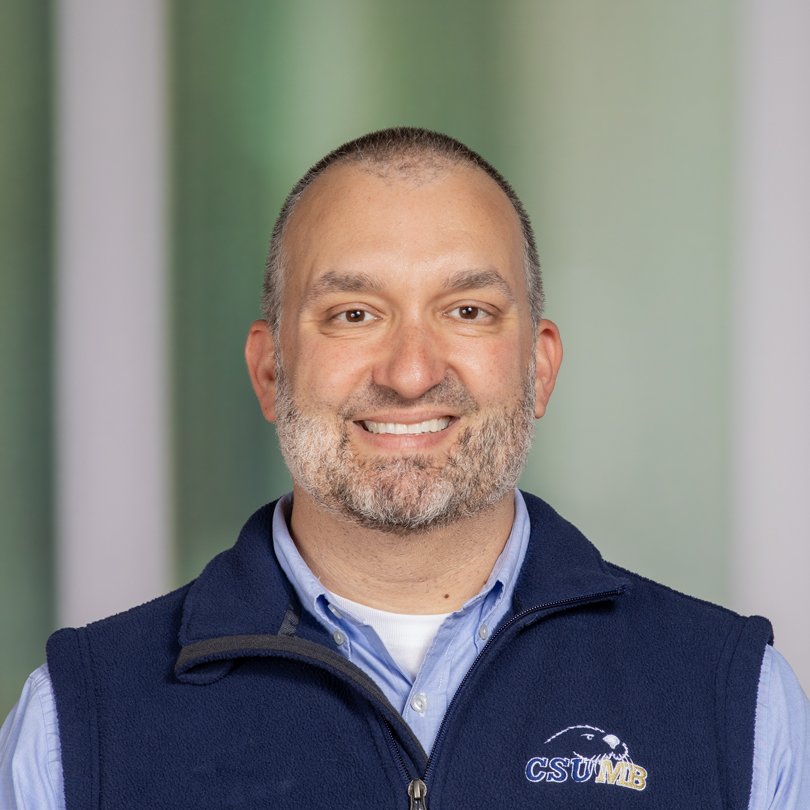
Instructor - Justin L. Matthews, MS, PhD
I am a Professor of Experimental Psychology at California State University, Monterey Bay.
 Please provide a link to your university page.
https://csumb.edu/directory/?keywords=3819785890&department=&=
Describe your teaching philosophy and any research interests related to your discipline or teaching. My teaching philosophy is guided by a passion for effective explanation and respect for mutual success. Successful students make for successful faculty. My courses are designed around these principles and incorporate a variety of teaching tools and experiences that provide a fun, comfortable, and safe learning environment. Many students here at CSUMB are first-generation college students, as was I. I dedicate the first meeting of all my courses to building common ground. As an undergraduate student I remember being uneasy with personal interaction with faculty members. I want to help my students overcome these feelings of unease. I coordinate an activity where all students have an opportunity to share their history and background with their peers and with me. Afterwards, I share my experience as a first-generation college student and detail my history of teaching, mentoring, and working alongside students and colleagues who also share these experiences. I make sure my students know my academic history of starting out at my local community college, transferring to a CSU, teaching, and navigating the process of applying to and completing graduate school in the UC system. The 45 minutes this activity takes sets the stage for a comfortable learning environment, and it affords the students the opportunity to understand who I am and where I come from. Many students have commented to me, over the years, about the importance of those first 45 minutes, so I continue to use that activity today.
Please describe the courses/course numbers that you teach. I teach courses in research methods and experimental design, statistics, human factors psychology, and media psychology.
In “PSY 200/L: Introduction to Research Methods” students learn ins and outs of designing research studies using the empirical method, from start to finish, including searching the literature, choosing an experimental design, selecting measures, planning appropriate analyses, and conveying ideas in APA style.
In “PSY 301/L: Advanced Psychological Statistics” students learn a variety of descriptive and inferential approaches to analyzing data, start to finish. Students learn how to clean and organize raw data, calculate descriptive statistics, produce data visualizations, and carry out & interpret a variety of inferential statistical tests. Finally, students learn how to report their findings in written form adhering to APA guidelines.
In “PSY 336/L: Human Factors Psychology” students explore how humans interact with environments, systems, and devices we use every day. Students use theory and research from cognitive science, human-centered design, human-systems engineering, ergonomics, human-computer interaction, user experience (UX) design, and industrial/organizational psychology to understand how humans interact with tools, technology, and the built world. Through understanding of human perceptual, cognitive, and physical processes, students learn how we design systems and devices that are safer, more intuitive, and more effective for people meant to use them. The course emphasizes current work in applied domains such as health and medicine, education, transportation design, building construction, and the design of technological devices.
In “PSY 351/L: Media Psychology (course currently in design phase)” students will explore the interaction of human behavior, digital technology, and contemporary media. Using psychological theories and empirical research methods, students will examine how media shapes cognition, emotion, and society. Course will emphasize current work in domains such as media representation, social justice, persuasion, propaganda, political communication, video games, social media, online violence, and media addiction.