Introduction to Research Methods Lab
Introduction to Research Methods Lab
Purpose: to help other instructors teaching the same course
Course name/number: PSY 200 & PSY 200L
CSU Instructor Open Textbook Adoption Portrait
Abstract: This affordable learning resource is being used in an Introduction to Research Methods course for undergraduate psychology students by Professor of Experimental Psychology Justin L. Matthews at California State University, Monterey Bay. The affordable resource chosen for this course is an easy to read, comprehensive overview of the most important topics undergraduate psychology majors need to know as they embark on their journey of understanding the scientific method. The resource prepares them to apply their knowledge of science and design an empirical project of their own. The main motivation to adopt an affordable resource was so students could acquire their needed PSY 200 & PSY 200L learning materials at no cost while learning the foundational concepts of research methods and experimental design in psychology. Students can access this OER resource via Pressbooks [https://pressbooks.bccampus.ca/rmip3amed].
Introduction to Research Methods + Lab
PSY 200 & PSY 200L
Brief Description of course highlights: Lecture: Introduction to the design, analysis, and critique of different experimentation methods in psychology. Students will demonstrate the ability to assess published research and express arguments orally and in writing according to the professional standards, such as the APA Publication Manual. Students will demonstrate the ability to conduct hypothesis testing using the scientific process and appropriate statistical data analyses. Lab: Computer laboratory to accompany PSY 200. Various research laboratory exercises and training in statistics and computer data analyses. https://catalog.csumb.edu/preview_program.php?catoid=12&poid=2556&returnto=632
Student population: This course is for undergraduate psychology majors and minors and is the first class in a three-course research methods sequence (Introduction to Research Methods, Advanced Research Methods, Psychology Capstone). Students typically take this course in their sophomore year. Prerequisite(s)/Corequisite(s): [(Prereq: PSY 100 and STAT 100) and (Coreq: PSY 200L)]
Learning or student outcomes:
Understand the Scientific Method: Contrast scientific inquiry with non-scientific ways of knowing.
Evaluate Research Designs: Compare experimental, quasi-experimental, correlational, observational, and survey methods, recognizing the strengths and limitations of each.
Apply Ethical Principles: Define and apply American Psychological Association (APA) guidelines to protect human research participants.
Analyze and Interpret Data: Apply basic descriptive and inferential statistical concepts to process research data.
Critically Evaluate Literature: Assess published empirical research reports, identifying flaws, validity issues (internal and external), and distinguishing good science from junk science.
Communicate Scientific Findings: Write comprehensive research reports and literature reviews formatted according to APA style guidelines
Calculate Descriptive Statistics: Calculate and interpret measures of central tendency (mean, median, mode) and variability (variance, standard deviation) to summarize data sets.
Understand Measurement: Distinguish between the four scales of measurement (nominal, ordinal, interval, ratio).
Understand Hypothesis Testing Logic: Explain null hypothesis significance testing, type I and type II errors, and p-values.
Calculate Inferential Analyses: Become familiar with t-tests and correlation.
Use Software Proficiently: Use Google Docs, Google Drive, and jamovi to manage, analyze, and present quantitative data.
Challenges and Solutions: I started teaching this course in 2014 when I came to CSUMB as an Assistant Professor. The instructor who taught this course prior to my arrival used a general social science research methods book that felt antiquated and cost anywhere from $150 to $200 depending on the format. In my opinion the title was not worth the cost. The book’s content was very general, with a social science focus, as opposed to a focus on research methods and experimental design in psychology. This led me to search for a new title that was more appropriate for this class’s intended purpose – introduce undergraduate psychology majors to research in psychology. A colleague of mine at Fresno State had recently published a research methods book through Flat World Knowledge and I decided to give it a try. The title was perfect for our needs in the psychology department and for this course in particular. The book was easy to read, included current, engaging, and relatable concept examples, and most of all it was affordable, being produced in two formats. The digital format was about $40, and the print format was about $65. After using the title for three years I came to find out that a newer digital version was available for free using a creative commons license (CSUMB’s library staff were very helpful in verifying the status of the publication). From that moment on, I used this free version. A few years later, I incorporated a popular press paperback book by Carl Sagan into the course. As of today, students in my class only need to buy the Sagan book for class, and that book can be found in good used condition for about $6.
Textbook Title: Research Methods in Psychology, 3rd American Edition
Brief Description: This book is a comprehensive research methods textbook for psychology majors. The book covers topics like the scientific method, research ethics, psychological measurement, experimental and non-experimental research, survey and quasi-experimental research designs, single-subject research designs, and even more complex factorial design approaches. The book also includes sections on both descriptive and inferential statistics, and a section on how to present research via a paper, a poster or a talk. The book is written at a comfortable reading level and the chapters are only as long as they need to be to get the concepts across to the reader. It is the perfect introduction to conducting research in psychology.
Please provide a link to the resource: https://pressbooks.bccampus.ca/rmip3amed
Authors: Paul C. Price, Rajiv S. Jhangiani, I-Chant A. Chiang, Dana C. Leighton, and Carrie Cuttler
Student access: I post the link to the textbook in Canvas for students to download. Students can also download their file in a variety of formats (EPUB, Digital PDF, Print PDF, or MOBI).
Supplemental resources: In this class I also assign a book by Carl Sagan titled “The Demon-Haunted World: Science as a Candle in the Dark.” Students read this popular press book alongside the research methods text. Students reflect on the Sagan text by writing a series of letters to friends (or family members) assuming the letter recipients do not have formal training in science. Another supplemental resource I use in this course is the free software suite jamovi. Jamovi is a software suite designed for carrying out descriptive and inferential statistics. The software is powerful yet easy to use with a user-friendly point and click interface. This software is downloadable, for free, from jamovi.org.
Provide the cost savings from that of a traditional textbook.
Student Resource Cost:
$0 for the Price et al. book
$0 for the jamovi software suite
$6 for a decent used copy of the Sagan paperback book.
Cost Savings: $144- 194; about 60 students take my methods class per academic year (30 in the Fall and 30 in the Spring).
OER/Low-Cost Adoption Process
Provide an explanation or what motivated you to use this textbook or OER/Low-Cost option. My motivation was twofold: (1) to save students money, and (2) to find them books and a software suite that were extremely low-cost or free while also being easy to read and/or use.
How did you find and select the open textbook for this course? I researched a number of introductory research methods texts for use in my class. Most options were problematic for a variety of reasons. Common reasons I disqualified a text: the author took too long to explain a concept leading to chapters that were overly lengthy without specific benefit, the text used too much jargon which led to confusion or disengagement, or the cost of the book was prohibitive. My initial goal was to get the total cost for the class under $100 per student. I not only met this goal but exceeded it in the end. In total, students can spend as little as $6 for all materials for my course (the sole cost of the Sagan book in a used format).
Sharing Best Practices: I would say… do as much research as you can on what resources are already available out there for the course you are designing or teaching. Try not to re-invent the wheel. Ask your colleagues or even folks that teach similar courses at other campuses; most people are happy to share how they design their classes. Sometimes it is almost impossible to find a FREE textbook for certain courses; in these cases your goal is to find the most appropriate book at the lowest cost for the students. Again, asking colleagues or using a slightly older version of the text might be possible if students can find that version on the used textbook market reliably.
Challenges and Lessons Learned: I recently designed two online/async courses and found it very challenging to find textbooks that were free for those courses. Sometimes if the course covers very recent developments in a content area it is a challenge to find free textbooks. In my case I shopped around for the cheapest textbooks of the options I found. I have been fairly good at getting all books for any one class to not exceed $100 per student. I sometimes achieve this by supplementing with a popular press paperback book that is relevant to the course, and students tend to enjoy that supplement. Popular press books are usually obtainable on the used market for a low cost, as well.
Instructor Name - Justin L. Matthews, MS, PhD
I am a Professor of Experimental Psychology at California State University, Monterey Bay. I teach courses in research methods and experimental design, statistics, human factors psychology, and media psychology. 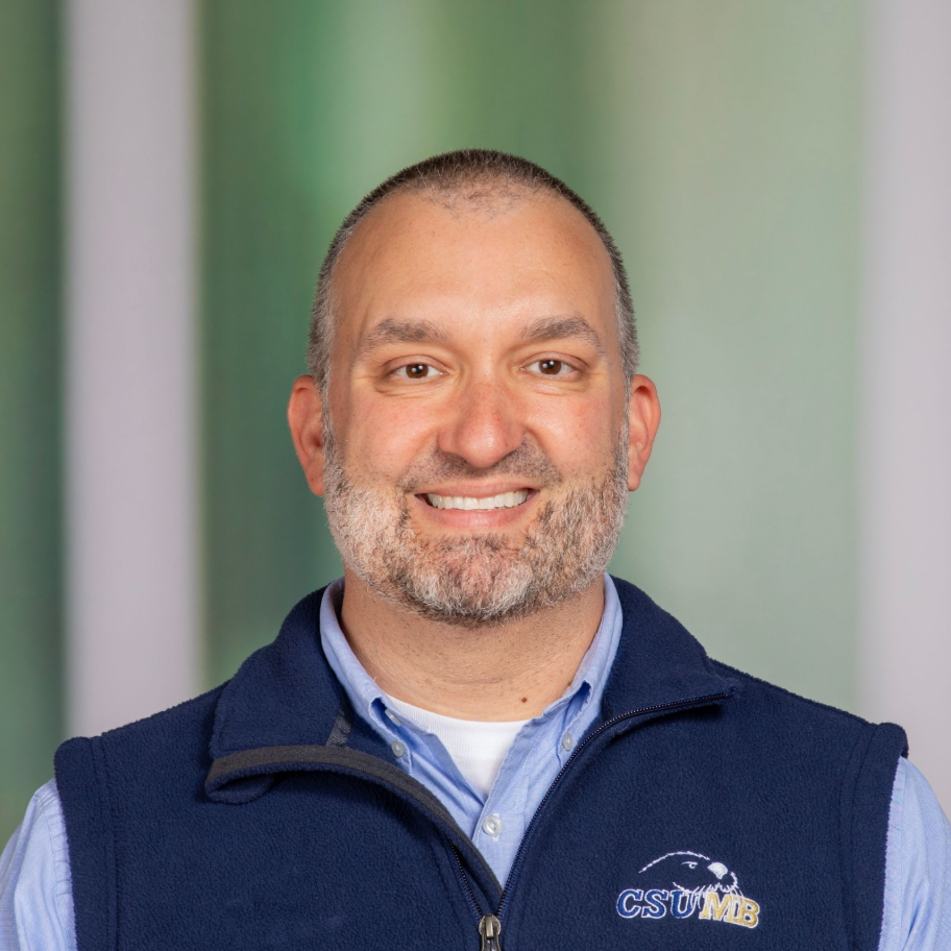 Please provide a link to your university page.
https://csumb.edu/directory/?keywords=3819785890&department=&=
Please describe the courses/course numbers that you teach. I currently teach three different psychology courses and I have one in the design phase:
In “PSY 200/L: Introduction to Research Methods” students learn ins and outs of designing research studies using the empirical method, from start to finish, including searching the literature, choosing an experimental design, selecting measures, planning appropriate analyses, and conveying ideas in APA style.
In “PSY 301/L: Advanced Psychological Statistics” students learn a variety of descriptive and inferential approaches to analyzing data, from start to finish. Students learn how to clean and organize raw data, calculate descriptive statistics, produce data visualizations, and carry out and interpret a variety of inferential statistical tests. Finally students learn how to report all their findings in written form adhering to APA guidelines.
In “PSY 336/L: Human Factors Psychology” students explore how humans interact with environments, systems, and devices we use every day. Students use theory and research from cognitive science, human-centered design, human-systems engineering, ergonomics, human-computer interaction, user experience (UX) design, and industrial/organizational psychology to understand how humans interact with tools, technology, and the built world. Through the understanding of human perceptual, cognitive, and physical processes, students learn how we design systems and devices that are safer, more intuitive, and more effective for people meant to use them. The course emphasizes current work in applied domains such as health and medicine, education, transportation design, building construction, and the design of technological devices.
In “PSY 351/L: Media Psychology (course currently in design phase)” students explore the interaction of human behavior, digital technology, and contemporary media. Using psychological theories and empirical research methods, students will examine how media shapes cognition, emotion, and society. The course will emphasize current work in domains such as media representation, social justice, persuasion, propaganda, political communication, video games, social media, online violence, and media addiction.
Describe your teaching philosophy and any research interests related to your discipline or teaching. My teaching philosophy is guided by a passion for effective explanation and respect for mutual success. Successful students make for successful faculty. My courses are designed around these principles and incorporate a variety of teaching tools and experiences that provide a fun, comfortable, and safe learning environment. Many students here at CSUMB are first-generation college students, as was I. I dedicate the first meeting of all my courses to building common ground. As an undergraduate student I remember being uneasy with personal interaction with faculty members. I want to help my students overcome these feelings of unease. I coordinate an activity where all students have an opportunity to share their history and background with their peers and with me. Afterwards, I share my experience as a first-generation college student and detail my history of teaching, mentoring, and working alongside students and colleagues who also share these experiences. I make sure my students know my academic history of starting out at my local community college, transferring to a CSU, teaching, and navigating the process of applying to and completing graduate school in the UC system. The 45 minutes this activity takes sets the stage for a comfortable learning environment and it affords the students the opportunity to understand who I am and where I come from. Many students have commented to me, over the years, about the importance of those first 45 minutes, so I continue to use that activity today.