
ENGL 1011: College Writing and Lab
ENGL 1011: College Writing and Lab
Purpose: to help other instructors teaching the same course
Course name/number: ENGL 1011
CSU Instructor Open Textbook Adoption Portrait
Abstract: The open textbook The Everyday Writer by Andrea Lunsford is being utilized in an English course for undergraduate or graduate students by Daniel Lambert at California State University, Los Angeles. The open textbook provides information on “Writing to Make a Difference in the World” and “Critical Reading.” The main motivation to adopt an open textbook was to provide students with alternatives to high-priced textbooks and to remove textbook purchase or rental as an obstacle to learning. Most students access the open textbook as a pdf file located on the course website through the Canvas Learning Management System (LMS).
Course Title and Number: ENGL 1011: College Writing + Lab
Brief Description of course highlights: First-year college writing course with writing lab focused on reading and writing to develop and communicate ideas. Instruction in strategies for planning, composing, and revising college writing that incorporates authorities, examples, arguments, and facts to write developed, supported texts. Graded A, B, C/NC.
Student population: This course is designed for incoming freshmen with a limited knowledge of previous English courses
Learning or student outcomes: Upon completion of ENGL 1011, you will achieve the following course learning outcomes and their associated skills and competencies:
- Rhetorical Knowledge: Compose texts in a variety of modalities that respond effectively to different rhetorical situations.
- Make connections between genre, audience, purpose, and message in multimedia texts (words, audio, images, animation, or video)
- Identify important rhetorical strategies (tools for communication)
- Adjust your writing to respond to your rhetorical situation (who you’re writing for and why)
- Critical Thinking: Develop persuasive positions on a variety of social and cultural issues and disciplinary topics using critical reading, logical reasoning, and engagement with diverse perspectives.
- Express the arguments that appear in a text
- Analyze different strategies authors use to achieve their purpose
- Form conclusions about a text
- Information Literacy: Produce college-level writing that demonstrates fundamental information literacy practices, including strategic inquiry, evaluation of diverse forms of evidence (e.g.: scholarly texts, media sources, ethnographies, lived experiences), use of evidence, and attribution of evidence.
- Find trustworthy sources to support an argument in your writing
- Include experts, examples, facts, and other forms of evidence in your writing
- Cite your sources in a preferred academic style (e.g. MLA, APA, Chicago)
- Writing Processes: Reflect on the process of writing as embodied, recursive, and involving multiple stages and collaborations.
- Study your and your peers’ writing experiences and processes
- Form writing processes to develop, revise, and edit your writing
- Use electronic devices to draft, review, revise, edit, and share texts
- Knowledge of Conventions: Make informed, purposeful decisions about whether to adhere to, modify, or resist genre writing conventions.
- Identify rules for different kinds of writing
- Use different tones and styles in your writing
- Improve syntax, grammar, punctuation, and spelling
ENGL 1011_College Writing and Lab_syllabus.docx
ENGL 1011_College Writing and Lab_Sample assignmnt.docx
Textbook or OER/Low-cost Title: The Everyday Writer (Fourth Edition)
Brief Description: This is a 683-page version of The Everyday Writer textbook (Fourth Edition) available through www.slideshare.net. It is an OER e-book. The book is designed to answer questions about all steps in the academic writing process. As described on the back cover of the book, The Everyday Writer is “an open invitation to develop awareness about the language we choose and use to write about topics we care about.”
Please provide a link to the resource
https://www.slideshare.net/slideshow/the-everyday-writer-pdfdrive-pdf/262850609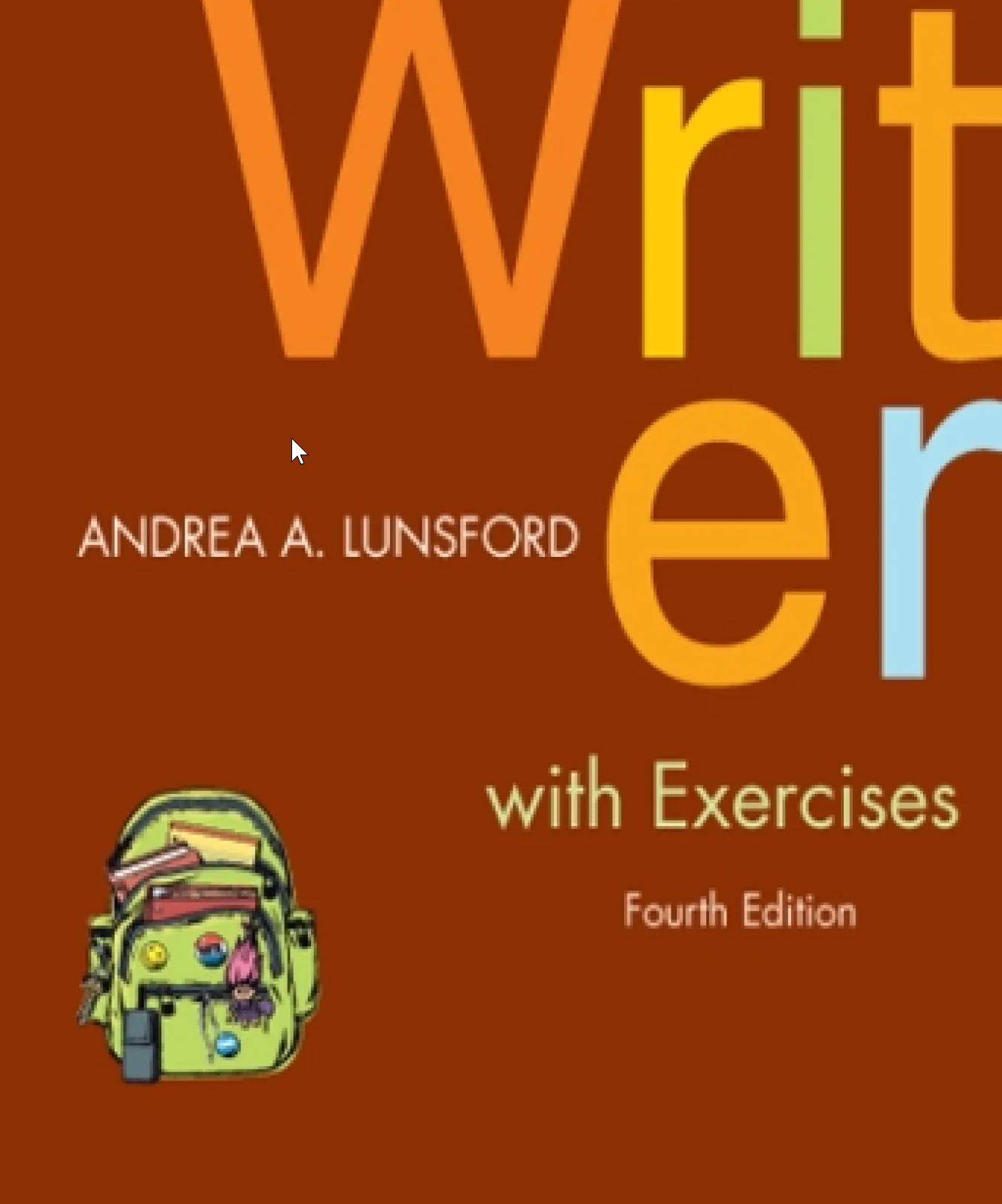 Authors: Lunsford, Andrea A.
Student access: Students access materials via links provided on the Syllabus as well as the Learning Management System (Canvas).
Supplemental resources: In addition to The Everyday Writer textbook, the following free resources are available for students on our Syllabus and our Canvas website:
- Purdue OWL’s “Giving Feedback for Peer-Review
- Finding Sources Library Tutorial
- Citing Sources and Avoiding Plagiarism Library Tutorial
Provide the cost savings from that of a traditional textbook. The Everyday Writer (Fourth Edition) has a retail price of $18.95. It is available to students in English 1011 for free.
License*: SlideShare does not enforce a single uniform license for all uploads; instead, uploaders can choose from seven different Creative Commons license options (or standard all-rights-reserved copyright) when publishing or editing their presentation details.
OER/Low-Cost Adoption Process
Please provide an explanation or what motivated you to use this textbook or OER/Low Cost. I believe The Everyday Writer is a very useful resource for first-year writers. However, I do not find it necessary for students to use all chapters of this book. In addition, my students are primarily from underserved communities and often experience issues such as food insecurity, so they will regularly choose not to purchase high-cost textbooks.
How did you find and select the open textbook for this course? I consulted the model Syllabus for English 1011 that was created by Dr. Danelle Dyckhoff Stelzriede, an Associate Professor of English and the Director of First-Year Writing at California State University, Los Angeles.
Sharing Best Practices: I suggest consulting with a faculty member who has experience with OER. I consulted with Dr. Mandy Concoff Kronbeck, who is the OER (Open Educational Resources) contact and librarian at East Los Angeles College (ELAC). In addition, I suggest using this resource from the ELAC website: https://researchguides.elac.edu/oer/findOER I wish I had known that pdf copies of numerous textbooks are available online for reasonable costs (many are free).
Describe any challenges you experienced, and lessons learned. Some of my favorite textbooks are not available as OER resources. In addition, numerous e-books are sold at exorbitant prices.
Instructor Name - Daniel E. Lambert
I am an English Lecturer at California State University, Los Angeles.
 Please provide a link to your university page.
https://www.calstatela.edu/faculty/daniel-lambert
Please describe the courses/course numbers that you teach.
English 1010: Accelerated College Writing (CSULA). Reading and writing to develop and communicate ideas.
English 1011: College Writing & Lab (CSULA): First-year college writing course with writing lab focused on reading and writing to develop and communicate ideas.
English 1050: Argumentative Writing and Critical Thinking (CSULA). Instruction in argumentation and critical writing, critical thinking, analytical evaluation of texts, research strategies, information literacy, and proper documentation.
English 2030: Professional and Technical Writing (CSULA). A course that teaches basic written communication techniques for the workplace. English 2070: Creative Writing (CSULA). A course that teaches fiction, poetry, and drama.
Describe your teaching philosophy and any research interests related to your discipline or teaching. My major pedagogical goal is to help under-served students achieve their professional goals through instruction in reading, writing, and critical thinking. In my first year and second-year English Composition courses, I utilize a variety of pedagogical approaches, depending on the course’s modality (on-ground or online). Some of the methods I utilize include peer review, small group discussion, in-class writing, “low-stakes” assignments, and skeletal notes exercises. In addition, I focus on instructing my students in the theory and practical use of numerous rhetorical concepts and methods (such as ethos, logos, and pathos).
I have worked with students in under-served communities for more than twenty years. I address equity and diversity in my teaching by discussing critical issues such as implicit bias and impostor syndrome with my students. In addition, I work with students to implement self-care strategies and use these strategies to improve my own work.
My philosophy of teaching is based upon the “four C’s” of Jesuit education: competence, conscience, compassion, and commitment. Having earned my Bachelor of Arts and Master of Arts at a Jesuit learning institution (Loyola Marymount University in Los Angeles), my own educational journey has been heavily influenced by these four principles. I find that competence in a subject does not constitute a complete education. In my writing classes, I focus on the ethical application of writing skills (conscience) as well as contemplation of the effect of written rhetoric on others (compassion) and the tenacity required to complete and revise a writing project (commitment). My philosophy of teaching is grounded in the principle of learning by example. I believe that teaching not only comprises the delivery of knowledge, but also the demonstration of effective systems of learning. If a system of learning works for me, I will share it with my students.